Content
Modern robotic and automation systems are becoming smaller, lighter, faster, and more intelligent. As equipment designers reduce the size of robotic joints, rotary tables, camera mechanisms, and miniature actuators, every component must deliver high performance without occupying unnecessary installation space. Bearings are particularly important in these systems because they influence rotational accuracy, rigidity, friction, service life, overall weight, and the stability of the complete assembly.
The CRBT lightweight rotary joint bearing is designed for applications where compact dimensions, low mass, and precise rotational guidance are essential. It is a cross roller bearing with a section height of only 5.5 mm and a width of 5 mm. The series is intended for small robotic arms, miniature surveillance cameras, humanoid robot joints, rotary tables, precision machine tools, and other mechanisms that require a highly compact bearing arrangement.
Unlike conventional bearings that may require a large surrounding housing or integrated mounting holes, the CRBT design uses a highly compact structure without mounting holes. This allows equipment designers to use the available installation space more efficiently. It also contributes to the bearing’s very low weight, making the product especially suitable for moving robot arms, compact joint modules, and mechanisms where inertia must be minimized.
Produced by UKL Bearing Manufacturing Co., Ltd., the CRBT series reflects the company’s focus on precision bearing engineering, OEM and ODM manufacturing, and international industrial supply. UKL combines research and development, forging, turning, heat treatment, grinding, assembly, inspection, and packaging in an integrated manufacturing system. This production structure supports consistent quality and enables the company to develop customized bearing solutions for robotics, CNC equipment, automation, and other demanding industries.
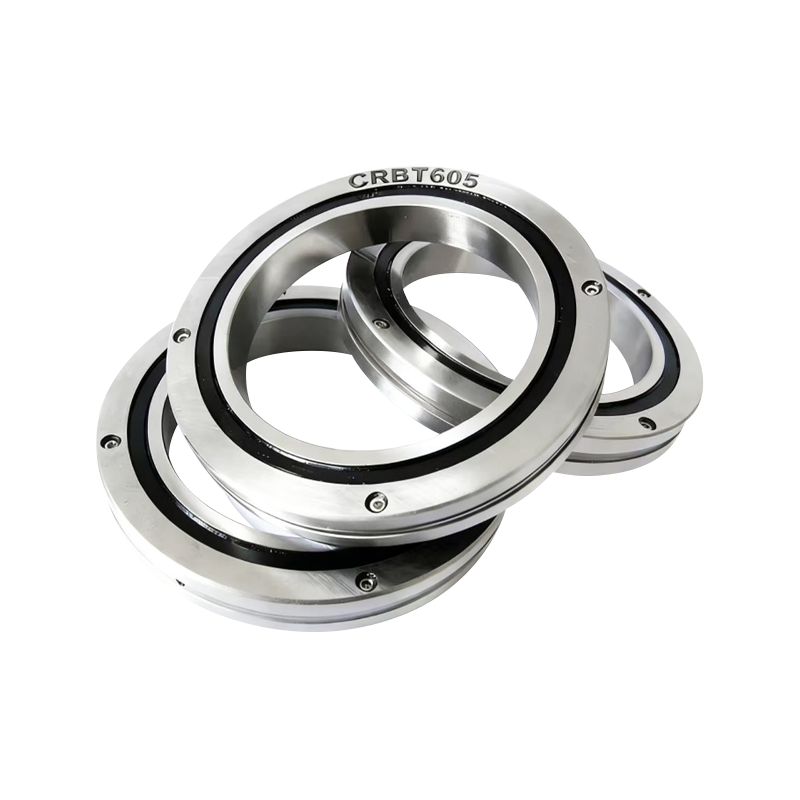
CRBT Lightweight Rotary Joint Bearing
The bearing is often one of the smallest parts in a motion system, but its effect on machine performance can be substantial. In a robotic arm, bearing mass contributes to the load that the motor and transmission must accelerate. A heavier bearing can increase inertia, require a larger actuator, raise energy consumption, and reduce the speed of response. In a camera gimbal or miniature surveillance mechanism, unnecessary weight may reduce stabilization performance or increase the size of the supporting structure.
Reducing the size of a bearing can also create additional design freedom. Smaller bearing sections allow motors, wiring, sensors, reducers, and structural components to be arranged more closely together. This is important in humanoid robots and collaborative robots, where joint modules must fit inside limited mechanical envelopes. A compact bearing can help engineers achieve a slimmer joint while retaining the precision required for controlled movement.
Cross roller bearings are particularly valuable in these applications because their rollers are arranged alternately at right angles. This arrangement enables the bearing to support radial loads, axial loads, and moment loads in a compact configuration. Instead of using several separate bearings to manage different directions of force, a cross roller bearing can provide multi-directional support through one integrated bearing assembly.
In precision mechanisms, the bearing must also resist unwanted movement. Excessive clearance or deformation can produce positioning errors, vibration, uneven rotation, and reduced repeatability. A properly selected cross roller bearing provides a rigid guidance solution for rotational systems while occupying less radial and axial space than many conventional bearing arrangements.
The CRBT series addresses these requirements by combining a thin cross section with a compact external form, low mass, and suitable load ratings for miniature and precision mechanisms. Its design is intended for equipment manufacturers that need to reduce the size of a joint or rotary assembly without abandoning the performance advantages of a crossed-roller arrangement.
The CRBT bearing has a width of only 5 mm. Its section height is specified as 5.5 mm, making it an extremely thin bearing for compact rotary applications. A small section reduces the amount of surrounding material needed in the housing and helps designers create flatter, slimmer, or more integrated assemblies.
The narrow structure is particularly useful where a bearing must be installed beside a motor, gear train, encoder, cable route, or structural plate. In many miniature mechanisms, the available space is restricted not only in diameter but also in width. A bearing that is thin in both directions can simplify the complete design and help preserve room for other components.
Compared with the previous thinnest cross roller bearing in the CRBS product family, the CRBT section height is approximately 69% of the earlier design. Its cross-sectional area is approximately 43% of previous products. This reduction represents a substantial change in the amount of material and installation space required by the bearing.
A smaller cross-sectional area can benefit designers in several ways. It may allow a smaller joint housing, reduce the diameter of a support structure, or make it possible to place multiple functional components within the same mechanical envelope. It can also reduce the volume of material used in the surrounding machine structure, which may lower the total weight of the assembly rather than only the weight of the bearing itself.
The CRBT series weighs approximately 0.38 times the weight of the referenced CRBS bearing when compared at an inner diameter of 50 mm. This significant weight reduction is valuable in components that repeatedly accelerate, decelerate, reverse direction, or operate from an elevated position.
Lower bearing mass can reduce rotational inertia and help an actuator respond more quickly to control commands. It may also reduce the motor torque required for acceleration. In a multi-axis robot, the weight saved at one joint can have a multiplied effect because upper joints may be required to move the mass of all components mounted beyond them.
For this reason, a lightweight bearing can contribute to improved energy efficiency, faster positioning, smoother motion, and a smaller actuator package. The exact result depends on the complete system design, but reducing passive mechanical mass is generally beneficial in dynamic robotic and automation equipment.
The CRBT bearing has no mounting holes. This feature supports an extremely compact structure and helps reduce the external envelope of the product. It also gives equipment designers flexibility in creating a dedicated housing, clamping arrangement, or integrated support structure.
A bearing without integrated mounting holes can be advantageous where the surrounding components are designed specifically for the application. The housing can be optimized for the customer’s available space, load direction, assembly process, and sealing requirements. This configuration is particularly suitable for OEM equipment manufacturers that prefer to design the bearing interface as part of the complete mechanism.
Because installation methods vary according to the application, the fit, preload, clamping method, housing rigidity, and assembly tolerances should be determined through engineering review. UKL can support customers with product selection and technical communication during the design stage.
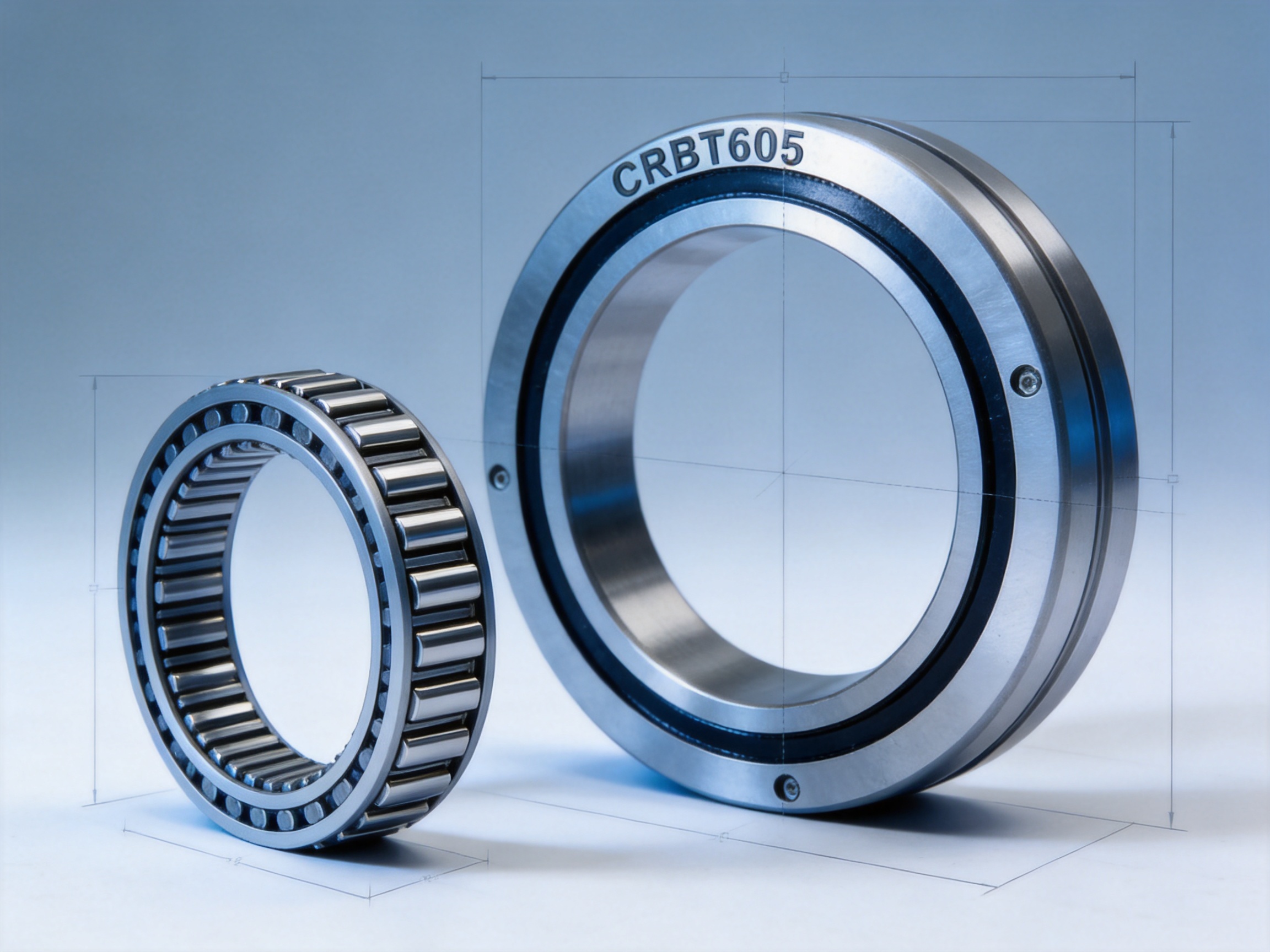
The CRBT product family covers inner diameters from 10 mm to 95 mm. Each listed model has a 5 mm width and a 0.15 mm minimum installation dimension designated as ds min. The outside diameter increases in relation to the inner diameter, providing a consistent compact series for different shaft sizes and rotary joint requirements.
| Model | Inner Diameter d (mm) | Outside Diameter D (mm) | Width B (mm) | ds min (mm) | Dh (mm) | C (kN) | Co (kN) | Mass (g) | Corresponding Model |
|---|---|---|---|---|---|---|---|---|---|
| CRBT105AC1P5 | 10 | 21 | 5 | 0.15 | 12.5 | 1.12 | 0.809 | 9 | RAU1005C0P5 |
| CRBT155AC1P5 | 15 | 26 | 5 | 0.15 | 17.5 | 1.32 | 1.10 | 12 | RAU1505C0P5 |
| CRBT205AC1P5 | 20 | 31 | 5 | 0.15 | 22.5 | 1.49 | 1.40 | 15 | RAU2005C0P5 |
| CRBT255AC1P5 | 25 | 36 | 5 | 0.15 | 27.5 | 1.65 | 1.77 | 18 | RAU2505C0P5 |
| CRBT305AC1P5 | 30 | 41 | 5 | 0.15 | 32.5 | 1.89 | 2.14 | 21 | RAU3005C0P5 |
| CRBT355AC1P5 | 35 | 46 | 5 | 0.15 | 37.5 | 2.05 | 2.42 | 24 | RAU3505C0P5 |
| CRBT405AC1P5 | 40 | 51 | 5 | 0.15 | 42.5 | 2.14 | 2.74 | 27 | RAU4005C0P5 |
| CRBT455AC1P5 | 45 | 56 | 5 | 0.15 | 47.5 | 2.30 | 3.09 | 29 | RAU4505C0P5 |
| CRBT505AC1P5 | 50 | 61 | 5 | 0.15 | 52.5 | 2.43 | 3.49 | 32 | RAU5005C0P5 |
| CRBT555AC1P5 | 55 | 66 | 5 | 0.15 | 57.5 | 2.53 | 3.79 | 35 | RAU5505COP5 |
| CRBT605AC1P5 | 60 | 71 | 5 | 0.15 | 62.5 | 2.63 | 4.09 | 38 | RAU6005COP5 |
| CRBT655AC1P5 | 65 | 76 | 5 | 0.15 | 67.5 | 2.71 | 4.29 | 41 | RAU6505C0P5 |
| CRBT705AC1P5 | 70 | 81 | 5 | 0.15 | 72.5 | 2.81 | 4.68 | 44 | RAU7005COP5 |
| CRBT755AC1P5 | 75 | 86 | 5 | 0.15 | 77.5 | 2.90 | 5.05 | 47 | RAU7505C0P5 |
| CRBT805AC1P5 | 80 | 91 | 5 | 0.15 | 82.5 | 3.05 | 5.43 | 50 | RAU8005C0P5 |
| CRBT855AC1P5 | 85 | 96 | 5 | 0.15 | 87.5 | 3.11 | 5.70 | 53 | RAU8505C0P5 |
| CRBT905AC1P5 | 90 | 101 | 5 | 0.15 | 92.5 | 3.19 | 6.03 | 56 | RAU9005C0P5 |
| CRBT955AC1P5 | 95 | 106 | 5 | 0.15 | 97.5 | 3.22 | 6.31 | 59 | RAU9505C0P5 |
The basic dynamic load rating, identified as C, ranges from 1.12 kN for the smallest listed model to 3.22 kN for the largest. The basic static load rating, identified as Co, ranges from 0.809 kN to 6.31 kN across the series. These ratings provide a starting point for bearing selection, but the actual application calculation must also consider speed, duty cycle, moment load, preload, lubrication, mounting accuracy, operating temperature, contamination, and required service life.
The listed mass ranges from 9 g to 59 g. Even the larger models remain lightweight relative to many bearing arrangements with comparable functional requirements. The consistent 5 mm width across the series makes it easier for designers to standardize housing concepts while selecting different inner and outer diameters according to the shaft and structural arrangement.
One of the primary advantages of the CRBT bearing is its compact installation envelope. Conventional bearing arrangements may require multiple rows, additional spacers, mounting flanges, or a larger housing to manage combined loads. The cross roller configuration provides a compact alternative by arranging rollers in alternating directions within a single bearing structure.
For a design engineer, the reduction in installation space can be more valuable than a simple reduction in component dimensions. A smaller bearing can enable a smaller joint body, more compact machine frame, or greater internal clearance for wiring and electronics. It may also help equipment manufacturers reduce the volume and weight of protective covers and supporting brackets.
Compared with the previous CRBS reference design, the CRBT bearing achieves a stated weight ratio of approximately 0.38 at a 50 mm inner diameter. This makes it well suited to moving joints and rotating platforms where every gram affects acceleration and control performance.
By lowering passive mass, the CRBT can help reduce the torque demand placed on motors and gear reducers. It can also help designers avoid oversizing the drive system merely to move the bearing and its housing. In a robot with several axes, lower component mass may contribute to better payload-to-weight efficiency and improved energy usage.
A cross roller bearing is designed to manage loads from multiple directions. The crossed arrangement of cylindrical rollers supports radial forces, axial forces, and overturning moments. This is an important advantage over simple radial bearings, which may need additional components to control axial movement or resist tilting moments.
In a rotary joint, the external load is rarely limited to one direction. A robot arm can experience radial load from the payload, axial load from the arm’s geometry, and moment load caused by the distance between the payload center and the bearing center. The CRBT structure is intended for this type of combined loading, provided that the bearing is correctly selected and mounted.
Cross roller bearings are widely used in precision machinery because their rolling elements provide controlled motion and can be configured with suitable preload. The CRBT product is intended for precision machine tools, rotary tables, robotic joints, and other applications where smooth rotation and repeatable positioning are important.
High precision does not come from the bearing alone. The housing, shaft, mounting surfaces, lubrication, preload, assembly cleanliness, and control system all influence the final result. Nevertheless, selecting a bearing designed for precision rotary guidance establishes an important foundation for the complete mechanism.
The absence of mounting holes gives equipment manufacturers greater freedom to develop application-specific interfaces. Instead of adapting the machine to a standardized flange pattern, designers can optimize the housing and clamping arrangement around the bearing’s actual load path.
This flexibility is valuable for custom robotic joints, miniature camera platforms, laboratory automation, semiconductor equipment, and other systems that do not follow a single standard form factor. It also allows the product to be incorporated into a broader OEM design strategy in which the bearing, housing, motor, reducer, and sensor are developed as one module.
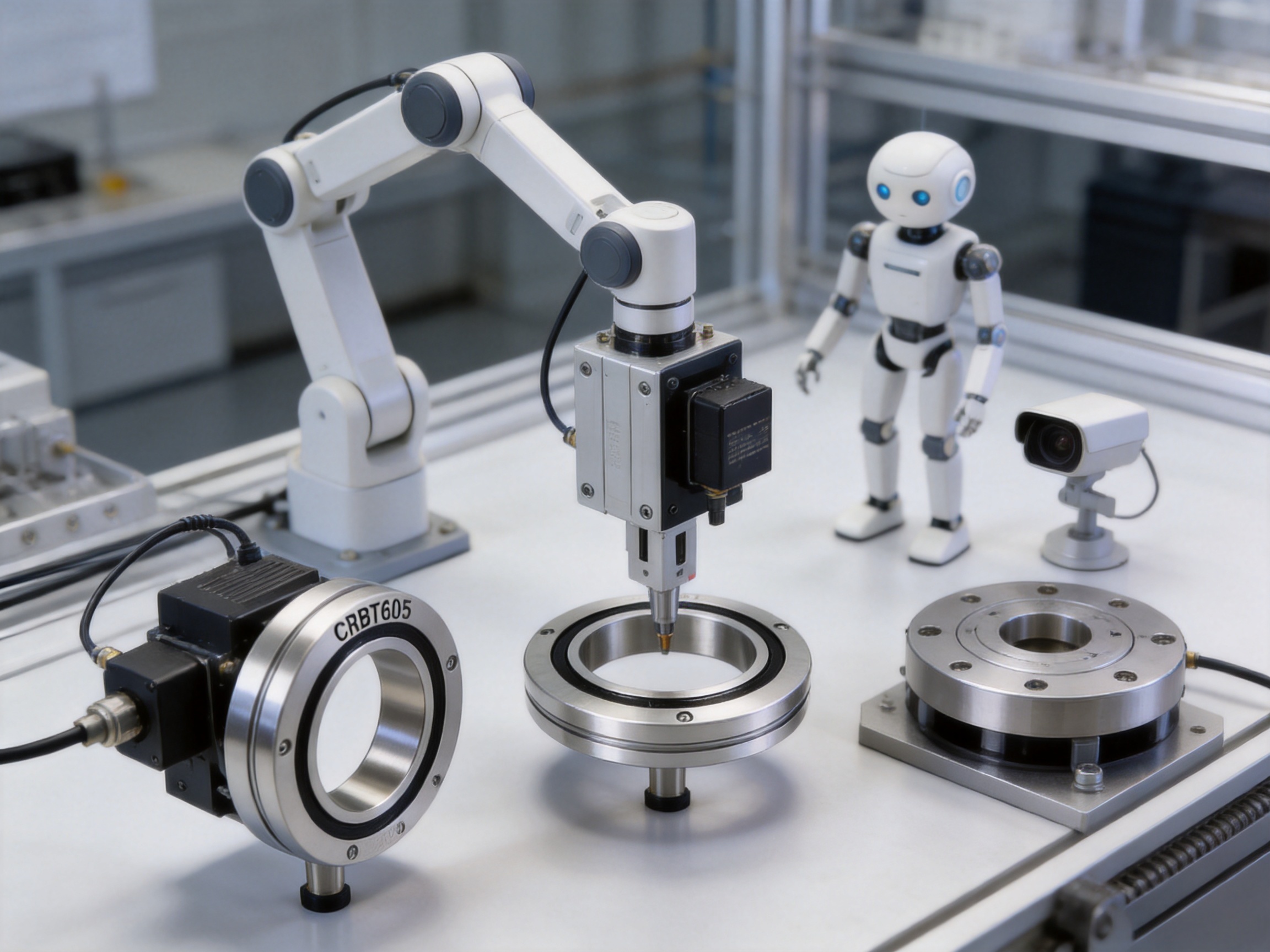
Small robotic arms require bearings that can support repeated movement without making the arm excessively heavy. The CRBT bearing’s narrow width and low mass make it appropriate for compact articulated arms, educational robots, laboratory robots, inspection mechanisms, and small pick-and-place systems.
In these applications, the bearing may be installed at a shoulder, elbow, wrist, or tool rotation axis. Engineers can select the inner diameter according to the shaft or central opening while maintaining a consistent 5 mm width across the series. This can simplify the design of multiple joints that use similar structural concepts.
Humanoid robots place demanding requirements on joint packaging. The bearing must fit within a limited body volume while supporting the loads generated by walking, balancing, arm movement, and interaction with the environment. Compact joint bearings can help leave space for motors, harmonic reducers, encoders, brakes, wiring, and thermal management components.
The CRBT series is suitable for consideration in humanoid robot joint modules where low weight and restricted installation space are key design priorities. The final selection must account for the dynamic and impact loads associated with the specific joint, especially in lower-limb systems and joints that support body weight.
Precision rotary tables used in inspection, positioning, assembly, and machining equipment require stable rotational guidance. A cross roller bearing can support the combined loads generated by a workpiece, fixture, tooling, and drive system while maintaining a compact axial profile.
The CRBT bearing can be considered for miniature rotary tables and lightweight precision platforms. For larger industrial tables or systems with high shock loads, the designer must compare the calculated loading and stiffness requirements with the bearing’s allowable limits and select a larger or different bearing type when necessary.
Small surveillance cameras, inspection cameras, and pan-tilt mechanisms benefit from low-mass rotational components. A lightweight bearing can reduce the drive force required to position the camera and may help the control system achieve faster and more stable movement.
In camera equipment, smooth movement and low vibration are essential. Clean assembly, appropriate lubrication, correct preload, and accurate housing geometry are therefore important. The compact CRBT structure can support a small camera head or rotary platform while preserving space for image sensors, cables, motors, and control electronics.
Precision machine tools often require bearings that combine stiffness, accuracy, and controlled motion. The CRBT design can be evaluated for compact rotary axes, indexing mechanisms, tool-positioning units, and other machine-tool modules where the available installation space is limited.
Machine-tool applications may involve continuous operation, temperature changes, cutting vibration, and contamination from chips or coolant. The bearing arrangement should therefore be designed with suitable protection, lubrication, housing rigidity, and maintenance provisions. The small size of the bearing should not be treated as a substitute for a complete application analysis.
Integrated joint modules combine a motor, reducer, bearing, encoder, brake, controller, and structural housing into a compact unit. The bearing is a central mechanical element because it supports the rotating member and transfers external forces into the housing.
The CRBT bearing’s compact structure and low mass can help module manufacturers reduce the size of the mechanical section. It may also make it easier to create standardized joint platforms with different bore sizes. Such modules are used in collaborative robots, autonomous equipment, automated inspection devices, and intelligent manufacturing systems.
UKL Bearing Manufacturing Co., Ltd. operates as an integrated bearing manufacturer and trader with capabilities covering research and development, production, international distribution, OEM services, and ODM cooperation. The company’s stated business focus includes customized bearings and precision products for industrial applications.
The company reports a workforce of approximately 201 to 500 employees and more than 15 years of OEM and ODM export experience. Its products are supplied to customers and distributors in Europe, Asia, Africa, Russia, and other international markets. This export experience is valuable for buyers that require technical communication, documentation, packaging coordination, and supply support across different regions.
The manufacturing process includes forging, turning, heat treatment, grinding, assembly, and packaging. Bringing these stages into a coordinated production system allows the manufacturer to manage important process variables more closely than a fragmented supply chain would permit.
Forging establishes the basic material form and supports efficient use of bearing steel. Turning creates the initial geometry of rings and related components. Heat treatment develops the hardness and structural properties needed for rolling contact performance. Grinding refines critical surfaces and dimensions. Assembly brings together rings, rollers, cages, seals where applicable, and lubrication requirements. Packaging protects the finished product during storage and transportation.
Each stage contributes to bearing reliability. A high-quality final product depends on appropriate raw materials, controlled heat treatment, accurate machining, stable grinding processes, clean assembly, and effective inspection. The integrated approach also supports production traceability and coordination between engineering and manufacturing teams.
UKL maintains an R&D focus on high-precision cross roller bearings, dual-direction thrust angular contact ball bearings, and other specialized products. This product development capability is relevant to customers working on robotics, CNC machines, intelligent automation, and custom motion equipment.
Developing an ultra-thin bearing requires careful consideration of ring geometry, roller dimensions, contact conditions, internal clearance, preload, material behavior, machining tolerances, and assembly procedures. A reduction in size must be balanced against load capacity, rigidity, service life, and manufacturability. The CRBT series demonstrates the company’s effort to address this balance through a lightweight cross roller bearing design.
The company describes the use of digital production control to support precision design and manufacturing consistency. Digital control can help coordinate work instructions, inspection data, process records, production planning, and quality feedback. When properly implemented, these systems support repeatability across multiple production batches and help manufacturing teams identify process deviations.
For OEM customers, production consistency is particularly important. A bearing used in a robot joint must fit the same housing design over many production cycles. Variations in dimensions, preload, rotation torque, or surface condition can affect the calibration and performance of the complete machine. Stable process management helps reduce these risks.
UKL reports a production capacity of approximately 10,000 to 50,000 units per month. This range enables the company to serve both development projects and established industrial programs, subject to model, specification, and order requirements.
Customers may require small batches during prototype development and larger quantities after product validation. A manufacturer with both engineering support and scalable production can help reduce the transition difficulty between these stages. The exact lead time, minimum order quantity, packaging method, and inspection documentation should be confirmed for each project.
UKL provides multilingual service, technical response, installation guidance, and after-sales maintenance support for international customers. Bearing selection is often an engineering process rather than a simple catalog purchase. Customers may need assistance comparing dimensions, confirming load ratings, understanding model designations, or planning installation.
Responsive technical communication can reduce the risk of selecting an unsuitable bearing or applying incorrect mounting procedures. For overseas customers, clear communication is also important when discussing drawings, tolerances, inspection reports, logistics, and quality requirements.
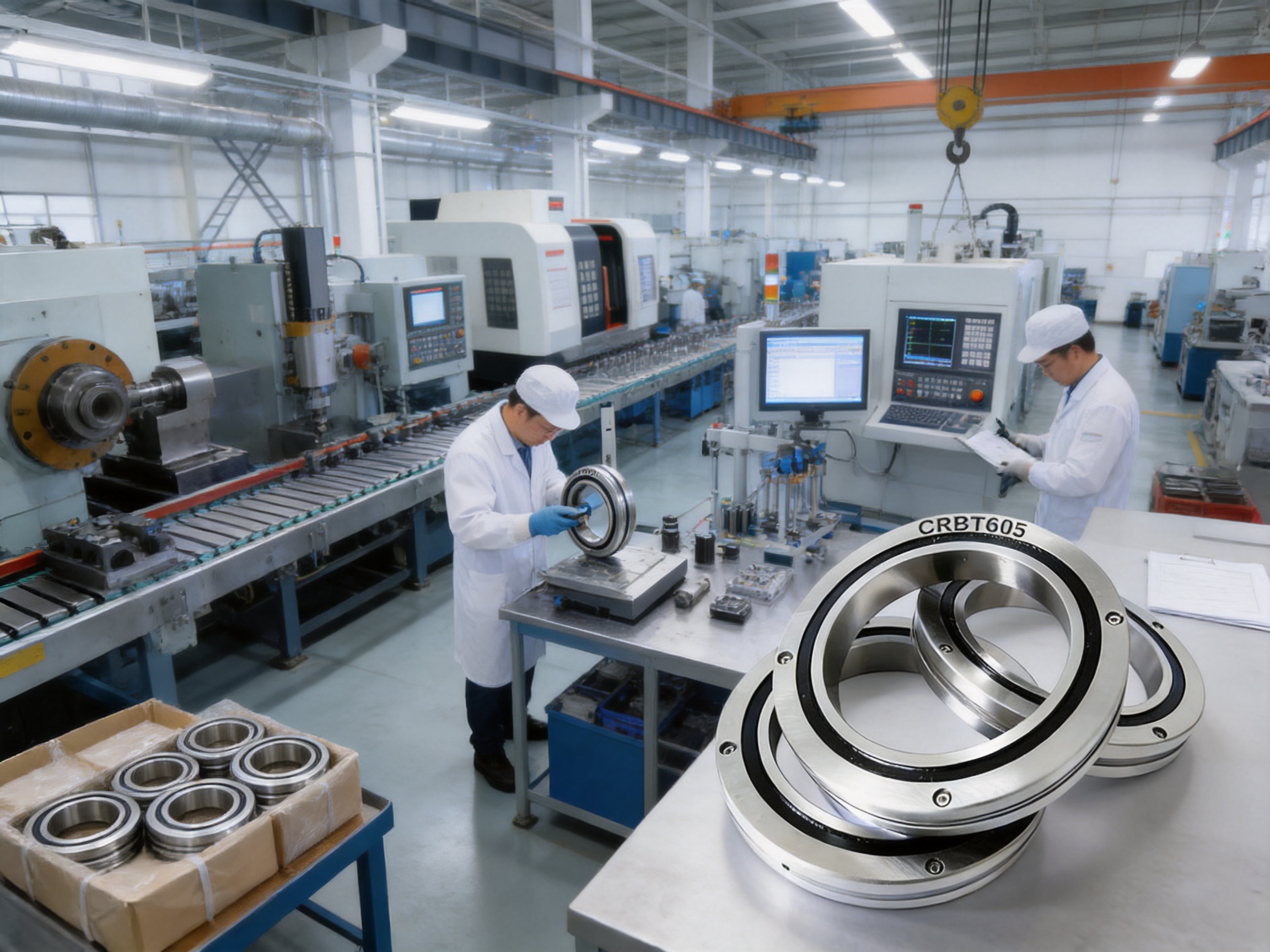
Ultra-thin bearings require a high level of manufacturing discipline because small dimensional deviations can have a noticeable effect on performance. When the bearing section is reduced, the available material supporting the rolling contact is also reduced. This makes geometry, surface finish, heat treatment, and assembly accuracy especially important.
The inner and outer rings must maintain accurate raceway geometry. The raceways guide the rollers and distribute loads across the contact area. Errors in roundness, waviness, raceway profile, or alignment may increase vibration and torque or create localized stress.
In a thin bearing, the rings may be more sensitive to distortion caused by machining, heat treatment, mounting, or housing deformation. The bearing should therefore be installed into a housing designed with suitable rigidity and dimensional accuracy. The housing should not impose excessive distortion on the rings.
Heat treatment gives bearing components the hardness and wear resistance required for rolling contact. It must be controlled carefully to achieve the desired material properties while limiting distortion. After heat treatment, precision grinding and inspection are required to restore the component to its specified geometry.
For an ultra-thin product, the relationship between heat treatment and final dimensional stability is particularly important. Consistent processing helps ensure that the bearing maintains predictable internal geometry from one production batch to the next.
Grinding is used to achieve the accurate dimensions and surface conditions required for bearing raceways and other critical areas. A suitable surface finish supports smooth rolling contact, reduces friction, and helps the lubricant form a stable film.
Grinding quality also affects noise and vibration. In precision applications such as camera mechanisms, rotary tables, and robot joints, excessive surface variation can influence positioning stability and acoustic performance. For this reason, grinding equipment, wheel condition, coolant management, and inspection procedures must be properly controlled.
Clean assembly is essential for bearing service life. Foreign particles can damage raceways, increase torque, produce noise, and accelerate wear. Assembly personnel must control the working environment, handling methods, tools, lubrication, and packaging procedures.
For a miniature or ultra-thin bearing, even a small contaminant may be significant compared with the size of the rolling contact. Customers should also protect the bearing during installation and avoid exposing it to dust, metal chips, moisture, or unsuitable cleaning chemicals.
Inspection provides confirmation that the finished bearing meets its required dimensions and performance criteria. Depending on the product and customer requirements, inspection may include dimensional checks, rotation torque, runout, noise, vibration, preload, visual condition, and material or heat-treatment verification.
Traceability connects the finished product with its production batch, process records, and inspection results. This is especially useful for OEM customers managing quality systems and long-term production programs. UKL’s integrated manufacturing and digital production control approach is intended to support such consistency and process visibility.
The correct bearing should be selected based on more than inner and outer diameter. Engineers should first define the operating conditions and then compare the calculated requirements with the available model data.
Identify the radial load, axial load, and moment load acting on the bearing. In a robot joint, the moment may be more important than the direct radial load because the payload is often located some distance from the bearing center. The load should be evaluated for normal operation, acceleration, deceleration, emergency stopping, and possible impact conditions.
The basic dynamic load rating C is used in bearing life calculations under appropriate operating assumptions. The basic static load rating Co is relevant when the bearing is stationary or moving slowly under substantial load. Neither value alone describes every possible application condition. Shock, oscillating motion, mounting deformation, and preload must also be reviewed.
Precision applications often require a specific level of rotational stiffness or moment resistance. A bearing with a small section can save space, but the designer must confirm that its stiffness is suitable for the machine. If a rotary table or robot joint experiences a large overturning moment, the housing and support structure must be designed to distribute that load correctly.
Housing rigidity is particularly important for thin bearings. A flexible housing can deform under load and transfer uneven forces into the bearing. This may increase friction, reduce accuracy, or shorten service life. The bearing and housing should be treated as one mechanical system during design validation.
Preload can improve rigidity and reduce unwanted movement, but excessive preload may increase friction, heat generation, and wear. The required preload depends on the application’s accuracy, speed, load, temperature, and service-life objectives.
Customers should confirm the available preload or internal specification for the selected CRBT model with the manufacturer. Installation procedures should follow the approved technical documentation. The bearing should not be forced into position or adjusted without suitable measurement equipment and engineering guidance.
Cross roller bearings may be used in continuous rotation, indexing, oscillating motion, or intermittent positioning. The motion profile affects lubrication, heat generation, contact stress, and service life. A bearing used in a slowly oscillating robot joint may have different requirements from one used in a continuously rotating precision table.
Designers should provide the operating speed, acceleration, oscillation angle, duty cycle, and expected number of cycles when requesting technical support. This information allows the supplier to evaluate whether the selected bearing is appropriate and whether special lubrication or design options may be required.
Because the CRBT bearing has no mounting holes, the customer’s housing and clamping system must be designed accurately. The mounting surfaces should be clean, flat, and free from burrs. Shaft and housing fits should be selected according to the load direction, operating temperature, required precision, and assembly method.
Improper interference, uneven clamping, or contamination can distort the bearing rings. Such distortion can change the internal running condition and increase rotation torque. Installation should therefore be completed using controlled tools and a documented procedure.
Industrial customers often require more than a standard catalog model. They may need customized dimensions, special preload, different lubrication, modified packaging, inspection reports, matched components, or a bearing designed around a unique mechanism. An integrated manufacturer can support these requirements more effectively when engineering and production resources are closely connected.
UKL’s OEM and ODM experience supports cooperation with equipment manufacturers during product development. The process may begin with a drawing, application description, load data, or sample component. Engineering teams can then review the space limitations, load conditions, motion requirements, and production quantities before recommending a model or custom solution.
For a custom CRBT application, customers should provide as much information as possible. Useful information includes inner and outer diameter limits, allowable width, radial and axial loads, moment load, speed, oscillation angle, operating temperature, environmental conditions, required accuracy, expected service life, lubrication preference, and annual demand.
Customization should preserve the fundamental balance between compactness, load capacity, rigidity, durability, and manufacturability. Reducing a dimension may improve packaging but create limitations elsewhere. A technical review helps identify these trade-offs before tooling or production begins.
Although the CRBT bearing is designed for precision applications, its service life depends on proper system maintenance. Lubrication should be selected according to speed, load, temperature, and environmental conditions. The recommended lubricant quantity should be observed because both insufficient and excessive lubrication can affect performance.
The bearing should be protected from contamination. In robotic and machine-tool applications, protective covers, seals, labyrinth structures, or clean enclosures may be required. Where coolant, dust, abrasive particles, or humidity are present, the complete sealing and maintenance strategy should be reviewed.
During operation, unusual noise, increased torque, vibration, temperature rise, or positional error may indicate a problem with lubrication, mounting, contamination, overload, or component alignment. Early inspection can help prevent secondary damage to the bearing, shaft, housing, motor, or reducer.
Service procedures should avoid applying impact directly to the bearing rings or rolling elements. The bearing should be handled with clean tools and stored in suitable conditions. If the bearing is removed for inspection, its orientation and installation condition should be recorded where relevant.
UKL identifies sustainability as a long-term business commitment. The company reports the adoption of environmentally responsible processes, material recycling, and energy-use optimization. These practices are relevant to industrial customers that increasingly evaluate not only product performance but also the environmental impact of their supply chains.
Manufacturing bearings involves steel processing, heat treatment, grinding, cleaning, packaging, and transportation. Improvements in material utilization, energy efficiency, recycling, and process control can reduce waste and resource consumption. A manufacturer that monitors these areas can make progress toward more responsible production while maintaining product quality.
Sustainability also includes product durability. A bearing that performs reliably and supports a longer service interval can reduce replacement frequency, downtime, waste, and maintenance resources. For this reason, precision manufacturing and environmental responsibility are not separate objectives. Consistent quality can contribute directly to more efficient use of industrial equipment.
Purchasing a specialized bearing from a manufacturer with engineering and production capabilities can provide advantages over selecting a generic component solely by dimension. The supplier can help evaluate combined loads, mounting conditions, precision requirements, and the interaction between the bearing and the machine structure.
For the CRBT series, the value of the product lies not only in its 5 mm width or low weight. The bearing is part of a broader precision manufacturing program that includes material processing, heat treatment, grinding, assembly, inspection, R&D, and technical support. These capabilities are important when the bearing is installed in a high-value robot, precision machine, or customized automation system.
UKL’s product range also includes other bearing categories, such as angular contact ball bearings, rod end bearings, spherical roller bearings, cylindrical roller bearings, tapered roller bearings, Nilos rings, and mounted bearings. This broader product knowledge can help customers develop complete bearing solutions rather than sourcing every component from unrelated suppliers.
For international customers, the combination of production capacity, OEM experience, multilingual service, and global distribution can simplify procurement. Technical requirements, packaging standards, delivery schedules, and after-sales communication can be coordinated through one manufacturing partner.
The CRBT is a compact cross roller bearing designed for rotary joints, robotic mechanisms, miniature camera systems, rotary tables, precision machine tools, and other applications requiring low weight and limited installation space.
The listed CRBT models have a 5 mm width and cover inner diameters from 10 mm to 95 mm. The section height is approximately 5.5 mm. The outside diameter varies by model and is listed in the product specification table.
Compared with the referenced CRBS design, the CRBT section height is approximately 69%, the cross-sectional area is approximately 43%, and the weight is approximately 0.38 times the earlier product when compared at a 50 mm inner diameter. These reductions provide a smaller and lighter bearing structure.
No. The CRBT design has no mounting holes. This contributes to its compact structure and allows the customer to develop a housing or clamping arrangement suited to the specific application.
A cross roller bearing is designed to support radial loads, axial loads, and moment loads. The allowable load depends on the model, preload, mounting conditions, speed, lubrication, and operating environment. Application-specific calculations should be completed before final selection.
The CRBT series is intended for applications including humanoid robots and joint modules. Its low weight and compact width can help reduce joint size and moving inertia. The selected model must still be checked against the joint’s static, dynamic, impact, and moment loads.
Yes. The product is suitable for consideration in miniature surveillance cameras, pan-tilt platforms, and precision camera mechanisms where low mass, compact dimensions, and controlled rotation are important.
The bearing should be installed in a housing and shaft arrangement designed according to the approved technical specifications. Mounting surfaces must be clean and accurate, and excessive force, impact, uneven clamping, or contamination should be avoided. The exact fit and assembly method should be confirmed for the application.
Customers should provide the required inner and outer diameter, available width, radial and axial loads, moment load, operating speed, motion profile, temperature, environment, accuracy, service-life target, lubrication requirements, annual quantity, and any special inspection or packaging requirements.
Yes. UKL operates as an integrated manufacturer and trader with OEM and ODM export experience. The company can support product selection, custom bearing development, production coordination, international distribution, technical response, installation guidance, and after-sales service.
The stated production processes include forging, turning, heat treatment, grinding, assembly, and packaging. These processes are supported by R&D and digital production control intended to promote precision and manufacturing consistency.
No. The listed basic dynamic and static load ratings are important reference values, but final design approval should consider actual combined loads, moment loading, speed, duty cycle, preload, housing rigidity, lubrication, contamination, temperature, shock, and required service life.
The CRBT lightweight rotary joint bearing is designed for a clear engineering challenge: providing precise multi-directional rotary support while using as little installation space and weight as possible. Its 5 mm width, approximately 5.5 mm section height, no-hole structure, broad inner-diameter range, and reduced mass make it suitable for compact robotic joints, humanoid robots, miniature surveillance cameras, rotary tables, precision machine tools, and intelligent automation modules.
Compared with the referenced CRBS design, the CRBT series offers a substantially reduced section height, cross-sectional area, and weight. These improvements can help machine designers develop smaller joint housings, lower actuator requirements, faster dynamic response, and more efficient use of internal space.
The performance of an ultra-thin bearing depends on more than its catalog dimensions. Correct load calculation, housing design, preload selection, lubrication, cleanliness, assembly accuracy, and maintenance are essential. Working with a manufacturer that understands these factors can reduce development risk and help ensure that the bearing performs as intended in the complete machine.
UKL Bearing Manufacturing Co., Ltd. supports the CRBT product with integrated production capabilities covering forging, turning, heat treatment, grinding, assembly, packaging, research and development, and digital production control. Its OEM and ODM experience, international distribution network, technical service, and wider bearing portfolio provide a foundation for cooperation with robotics companies, machine builders, automation integrators, and industrial distributors.
As equipment continues to become more compact and intelligent, lightweight precision bearings will remain important to the development of high-performance motion systems. The CRBT series provides a focused solution for engineers seeking a balance of compactness, low weight, cross-directional load support, and precision manufacturing.
1. UKL Bearing Manufacturing Co., Ltd., CRBT Lightweight Rotary Joint Bearing Product Information and Dimension Data.
2. UKL Bearing Manufacturing Co., Ltd., Company Manufacturing, OEM, ODM, and Technical Service Profile.
3. General engineering principles for cross roller bearing selection, mounting, preload, lubrication, and service-life evaluation.
4. General industrial design practices for robotic joints, rotary tables, precision machine tools, and miniature camera mechanisms.
5. General manufacturing principles for bearing forging, turning, heat treatment, grinding, assembly, inspection, and packaging.
Product Categories
Contact Us

Jane@ukl-bearing.com
Jenny@ukl-bearing.com
Andy@ukl-bearing.com
Ivy@ukl-bearing.com

+86-510- 88763239
+86-15371057968

No.1 Hehuan Road, Hudai Town, Binhu District, Wuxi City.
Ready to Begin?
Get in Touch

Now!
UKL BEARING
 English
 Español
 русский