Content
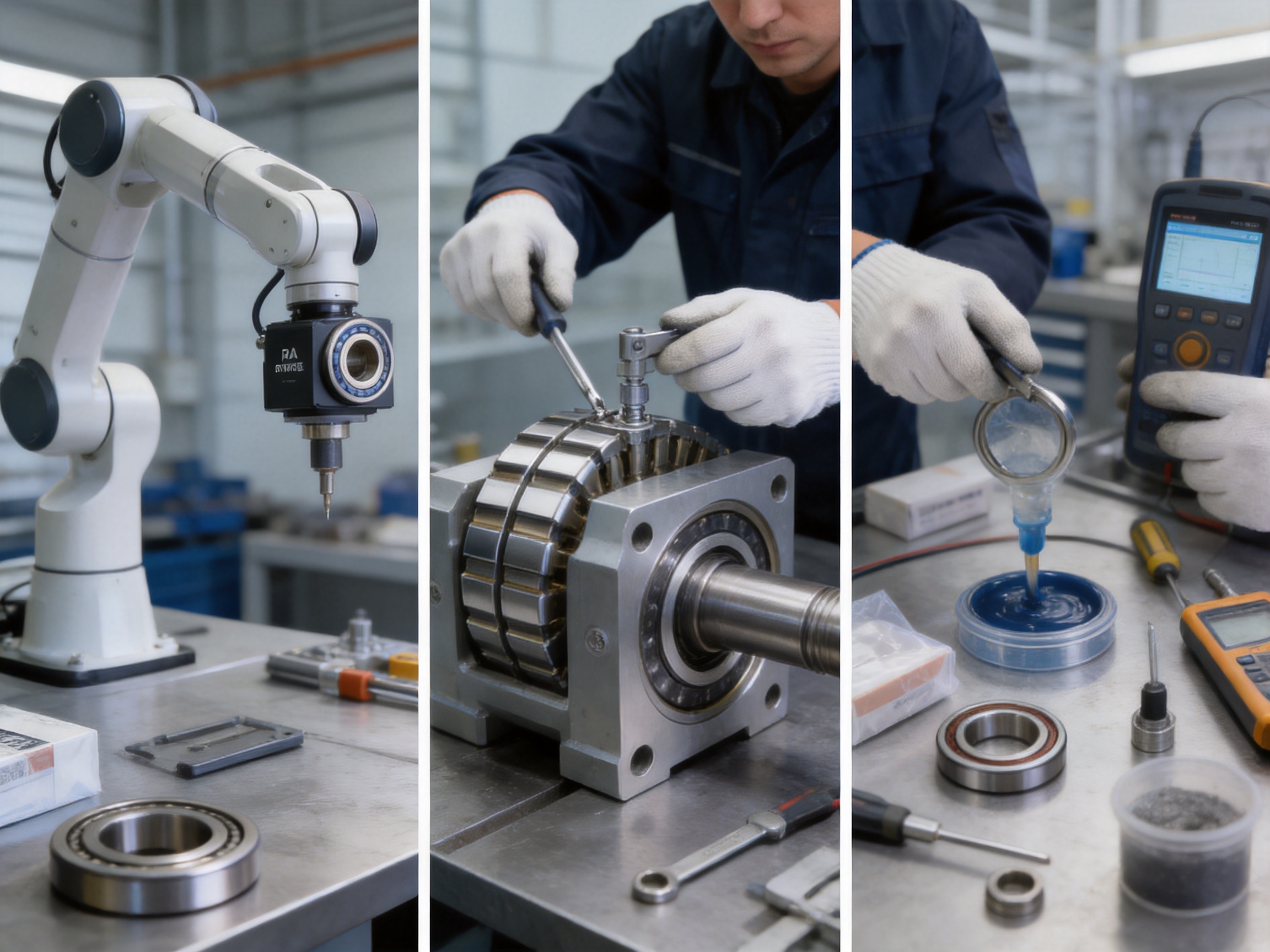
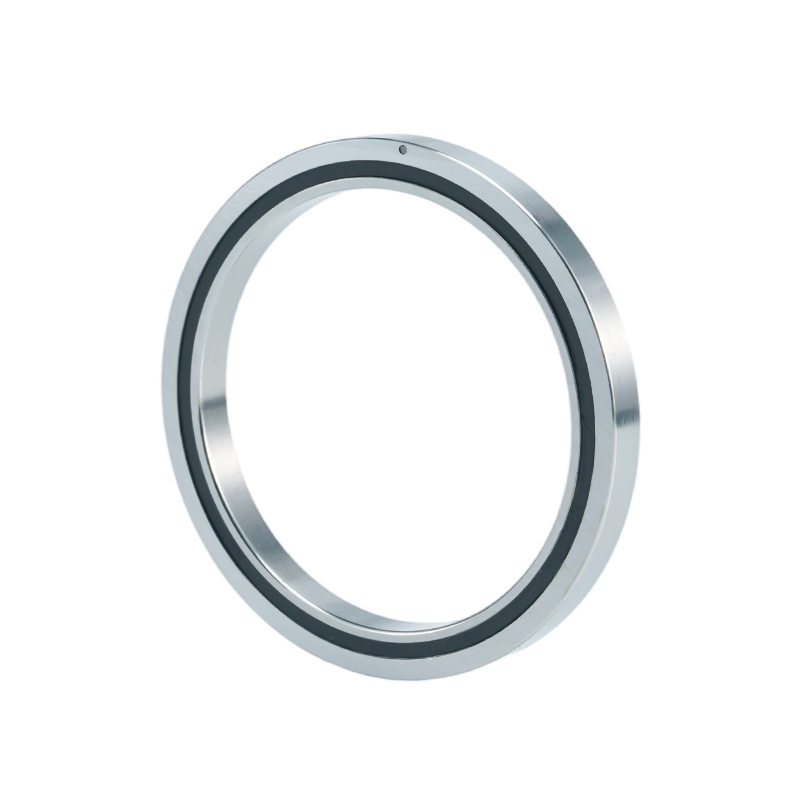
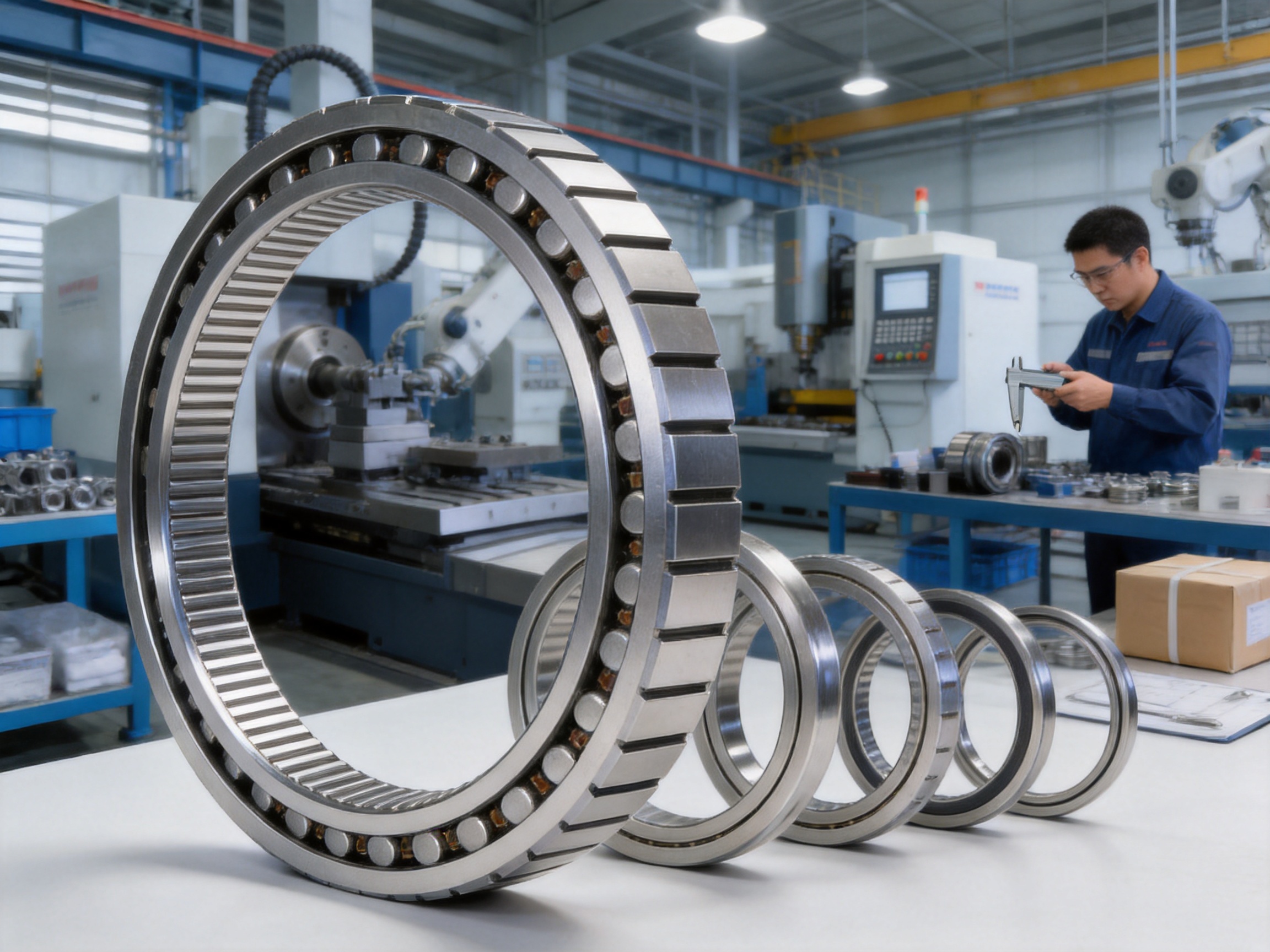
Modern industrial robots and mechanical manipulators demand bearing solutions that can combine compact dimensions, low weight, high rotational accuracy, and dependable service life. The RA Type bearing is designed specifically for this demanding environment. It is a compact slewing ring bearing with a segmented outer ring and an inner ring intended for rotation. By reducing the thickness of both bearing rings to an extremely compact level, the design provides a practical solution for robot joints, rotating mechanisms, and space-limited automation equipment.
In a robot, every millimeter of saved space can influence the size, weight, energy consumption, and motion performance of the complete machine. A bearing that is unnecessarily large or heavy can force designers to increase the size of surrounding structures, use more powerful actuators, or accept reduced acceleration. The RA Type series addresses these challenges through a thin-section architecture that maintains a useful load-carrying capacity while minimizing radial and axial envelope dimensions.
Manufactured by UKL Bearing Manufacturing Co., Ltd., the RA Type series is supported by integrated research and development, production, heat treatment, precision grinding, assembly, inspection, and packaging capabilities. These manufacturing resources enable the company to control the bearing process from material preparation through final delivery, supporting consistent quality for OEM, replacement, and custom applications.
The RA Type is a lightweight, thin-section robot bearing belonging to the compact slewing ring bearing family. Its defining construction includes an outer ring that is segmented and an inner ring designed for rotation. The configuration is intended for applications in which the inner ring rotates relative to the surrounding structure while the outer ring is mounted into the robot or machine housing.
Compared with conventional bearing arrangements that may require multiple angular contact bearings, spacers, housings, and additional structural components, a compact slewing ring bearing can simplify the rotating joint. It can provide a concentrated bearing interface within a limited installation space, which is particularly valuable in robotic arms, wrist mechanisms, indexing systems, rotary tables, camera positioning equipment, and automated manipulators.
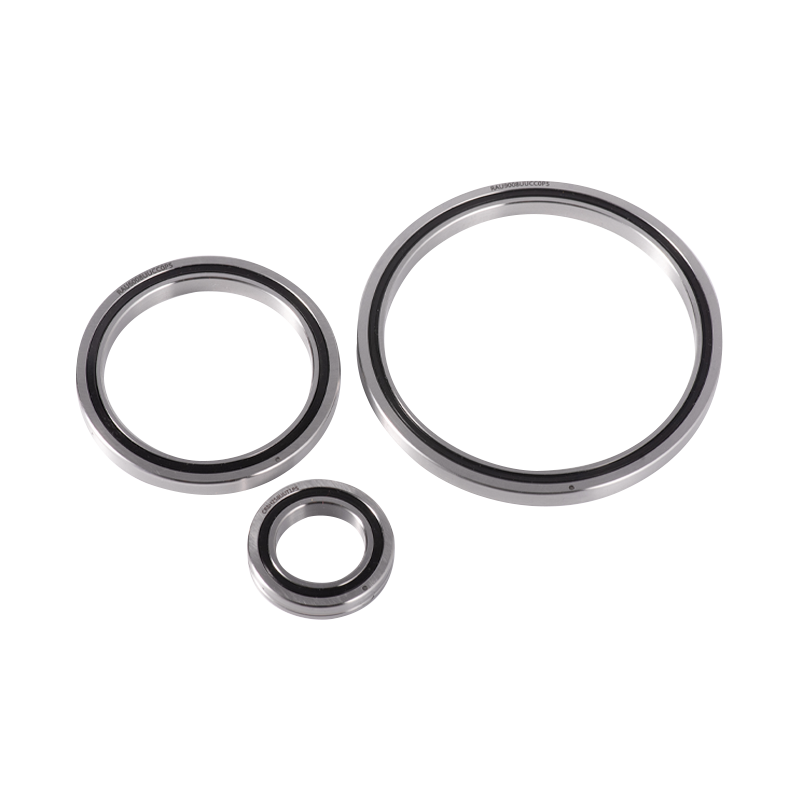
The series is available in multiple bore sizes. The listed models range from RA5008, with a 50 mm inner diameter, to RA20013, with a 200 mm inner diameter. The smaller models have an 8 mm bearing height, while the larger RA16013 through RA20013 models have a 13 mm height. This range allows designers to select a bearing according to shaft diameter, radial envelope, load requirements, and available assembly space.
The RA Type should not be selected solely by bore diameter. A complete selection process should consider radial load, axial load, moment load, speed, acceleration, oscillation angle, operating temperature, contamination risk, lubrication, shaft and housing accuracy, mounting rigidity, and the expected duty cycle. UKL can support application-specific selection when the operating conditions and installation drawings are provided.
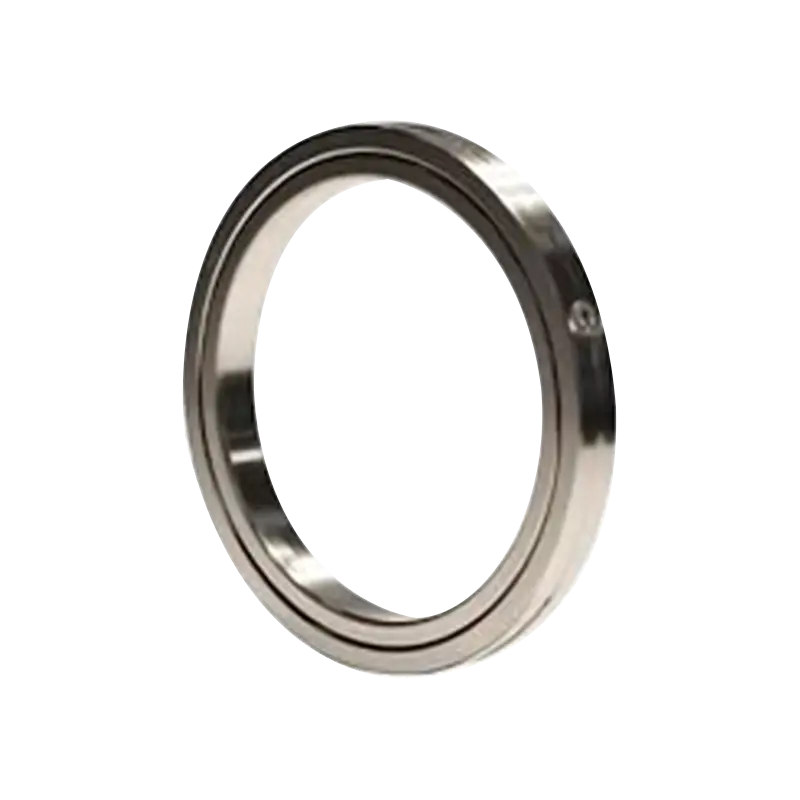
RA Type (Outer Ring Segmented, Inner Ring For Rotation)
Robotic equipment operates differently from many standard rotating machines. A robot joint may repeatedly accelerate, decelerate, reverse direction, pause, and perform short oscillating movements. It may also carry a payload at a distance from the rotational axis, producing a substantial overturning moment. In addition, the joint must remain compact enough to preserve the robot’s reach, speed, and movement flexibility.
Traditional bearing arrangements can create several design difficulties. A larger bearing increases the diameter and mass of the joint. Separate bearing pairs may require more axial space and additional components for preload, spacing, sealing, and alignment. These parts increase assembly complexity and can introduce more opportunities for tolerance accumulation or installation error.
A thin-section slewing ring bearing offers several potential engineering benefits:
• Reduced radial and axial envelope for more compact joint architecture.
• Lower bearing mass than a comparable heavy-section bearing.
• More freedom to design lightweight robot arms and housings.
• Simplified integration into rotating mechanisms.
• Improved suitability for restricted installation spaces.
• A practical solution for high-repeatability robotic motion when correctly selected and installed.
Reducing section thickness does not eliminate the need for careful engineering. Thin rings can be more sensitive to housing distortion, shaft accuracy, mounting flatness, and uneven clamping. For this reason, the performance of a thin-section bearing depends not only on the bearing itself but also on the accuracy and rigidity of the surrounding structure.
The segmented outer ring is a central feature of the RA Type design. The segmented configuration can support practical assembly and integration in mechanisms where a continuous ring would be difficult to install. It also provides design flexibility for robot joints and compact rotating modules.
During installation, the ring segments must be positioned correctly and supported evenly. The surrounding housing should provide the required roundness, flatness, and rigidity. Fasteners, clamping forces, and joining interfaces should follow the manufacturer’s technical recommendations. Uneven tightening can distort the raceway and create localized loading, friction, noise, or premature wear.
The inner ring is designed for rotational movement. In a typical robot joint, the inner ring may be connected to a drive shaft, rotary hub, or output flange, while the outer ring is secured to the stationary or supporting structure. The exact arrangement depends on the robot architecture and the required load path.
Because the bearing is part of a structural rotating joint, designers should assess not only the direct radial and axial loads but also the moment generated by payload offset. A robot wrist, for example, may experience a combined load from tooling weight, workpiece weight, acceleration, and the distance between the load center and the bearing centerline.
The RA Type bearing is intended to support rotating or oscillating movement while carrying applied loads through its internal rolling elements and raceways. Its compact design is especially suited to robot joints and manipulators where the bearing must fit inside a narrow housing without sacrificing the basic structural function expected from a precision bearing.
The combination of compact dimensions and useful load ratings makes this series suitable for applications that require a favorable balance between size and capacity. However, the published load ratings are reference values for bearing selection, not a substitute for a complete life and strength calculation.
The following table summarizes the available RA Type models listed in the supplied product information. The dimensions are expressed in millimeters, load ratings are expressed in kilonewtons, and weight is expressed in kilograms. The designation Cr refers to the basic dynamic radial load rating, while Cor refers to the basic static radial load rating.
| Model | Inner Diameter d (mm) | Outside Diameter D (mm) | Roller Pitch Diameter Dpw (mm) | Height BB1 (mm) | Chamfer Rmin (mm) | Shoulder ds (mm) | Shoulder Dh (mm) | Cr (kN) | Cor (kN) | Weight (kg) |
|---|---|---|---|---|---|---|---|---|---|---|
| RA5008 | 50 | 66 | 57 | 8 | 0.5 | 53.5 | 60.5 | 5.1 | 7.19 | 0.08 |
| RA6008 | 60 | 76 | 67 | 8 | 0.5 | 63.5 | 70.5 | 5.68 | 8.68 | 0.09 |
| RA7008 | 70 | 86 | 77 | 8 | 0.5 | 73.5 | 80.5 | 5.98 | 9.8 | 0.1 |
| RA8008 | 80 | 96 | 87 | 8 | 0.5 | 83.5 | 90.5 | 6.37 | 11.3 | 0.11 |
| RA9008 | 90 | 106 | 97 | 8 | 0.5 | 93.5 | 100.5 | 6.76 | 12.4 | 0.12 |
| RA10008 | 100 | 116 | 107 | 8 | 0.5 | 103.5 | 110.5 | 7.15 | 13.9 | 0.14 |
| RA11008 | 110 | 126 | 117 | 8 | 0.5 | 7.45 | 120.5 | 7.45 | 15 | 0.15 |
| RA12008 | 120 | 136 | 127 | 8 | 0.5 | 7.84 | 130.5 | 7.84 | 16.5 | 0.17 |
| RA13008 | 130 | 146 | 137 | 8 | 0.5 | 7.94 | 140.5 | 7.94 | 17.6 | 0.18 |
| RA14008 | 140 | 156 | 147 | 8 | 0.5 | 8.33 | 150.5 | 8.33 | 19.1 | 0.19 |
| RA15008 | 150 | 166 | 157 | 8 | 0.5 | 8.82 | 160.5 | 8.82 | 20.6 | 0.2 |
| RA16013 | 160 | 186 | 172 | 13 | 0.8 | 165 | 179 | 23.3 | 44.9 | 0.59 |
| RA17013 | 170 | 196 | 182 | 13 | 0.8 | 175 | 189 | 23.5 | 46.5 | 0.64 |
| RA18013 | 180 | 206 | 192 | 13 | 0.8 | 185 | 199 | 24.5 | 49.8 | 0.68 |
| RA19013 | 190 | 216 | 202 | 13 | 0.8 | 195 | 209 | 24.9 | 51.5 | 0.69 |
| RA20013 | 200 | 226 | 212 | 13 | 0.8 | 0.8 | 219 | 25.8 | 54.7 | 0.71 |
The supplied source table contains dimensional and rating fields arranged in a compact technical format. Before production release, customers should confirm the final drawing, tolerance class, clearance or preload condition, sealing arrangement, lubrication specification, and mounting details with the supplier. In particular, the shoulder fields should be checked against the current technical drawing before the housing or shaft is machined.
The most direct advantage of the RA Type design is its compact section. The 8 mm height models provide a narrow bearing envelope for applications with strict axial space limitations. The 13 mm models extend the range to larger shaft sizes while preserving a relatively compact form.
In comparison with standard deep-groove bearing pairs or larger conventional slewing bearings, a thin-section robot bearing may allow the designer to reduce the diameter or axial length of a joint. This can create room for motors, encoders, gear reducers, cable routing, brakes, or protective covers. The result may be a more integrated robot module rather than a bearing surrounded by oversized supporting components.
Low bearing weight is valuable in robot arms because the mass of a proximal component is carried by the joints below it. Reducing the mass at one joint can reduce the load imposed on the entire kinematic chain. This may support faster acceleration, lower energy consumption, and improved payload utilization, provided the complete robot is designed around the reduced mass.
The listed weights range from approximately 0.08 kg for RA5008 to approximately 0.71 kg for RA20013. These values give designers an early indication of the bearing’s contribution to total joint mass. The actual final assembly weight will also include the housing, seals, drive components, fasteners, lubrication, and encoder system.
A compact slewing ring bearing can reduce the number of bearing-related components required in a rotating joint. Fewer separate components may shorten assembly time and reduce tolerance stack-up. It can also help engineers establish a clear load path between the rotating and stationary structures.
Integration is particularly useful in robot joints that contain a motor, reducer, cable passage, position sensor, brake, and output flange within a limited volume. The bearing must work alongside these components, and its compact geometry provides greater freedom when the complete joint is modeled.
The RA series covers a range of inner diameters from 50 mm to 200 mm. This enables designers to use the same general product concept across different robot sizes and machinery platforms. A common bearing family can simplify sourcing, maintenance training, spare-parts planning, and design standardization.
Robot manufacturers and automation integrators often require more than a catalog item. They may need specific tolerances, mounting interfaces, lubrication options, inspection documentation, packaging, or production quantities. UKL’s integrated manufacturing and OEM/ODM export experience provide a foundation for discussing such requirements.
A customer can submit application information such as load spectrum, speed profile, environmental conditions, installation orientation, shaft and housing drawings, and expected service life. The supplier can then help determine whether a standard RA Type model is appropriate or whether a customized solution should be considered.
UKL Bearing Manufacturing Co., Ltd. operates an integrated production system covering research and development, forging, turning, heat treatment, grinding, assembly, and packaging. This structure is important for precision bearings because the final performance depends on the relationship between each stage.
Forging establishes the initial material form and can support efficient use of bearing steel. Turning creates the preliminary geometry. Heat treatment develops the required material hardness and structural properties. Grinding provides the precision raceway and dimensional finish required for smooth rolling contact. Assembly brings the components together under controlled conditions, while packaging protects the finished product during storage and transport.
When these operations are coordinated within one manufacturing organization, process feedback can move more efficiently between engineering, production, and quality teams. This is especially useful for thin-section bearings, where dimensional consistency and ring stability are critical to final performance.
The company maintains an R&D focus on high-precision bearings for CNC machines, robotics, and intelligent automation systems. This product orientation is relevant to the RA Type series because robot bearings must address more than simple rotational speed. They must support accuracy, stiffness, compactness, repeatability, and reliability under changing loads.
Engineering development may include raceway geometry, ring cross-section, material selection, heat treatment parameters, internal clearance, lubrication compatibility, sealing, and mounting behavior. The final objective is to produce a bearing that performs reliably within the complete mechanical system rather than only under isolated laboratory conditions.
The supplied company information states a production capacity of approximately 10,000 to 50,000 units per month. This capacity can benefit OEM customers that require repeat deliveries, stable production scheduling, and consistent batch availability. Capacity is particularly important when bearings are used in an automated production line, because supply interruptions can affect the delivery of complete robot systems.
Capacity alone does not guarantee quality. It must be supported by process discipline, inspection, traceability, skilled personnel, suitable equipment, and effective corrective action. UKL’s combination of production lines and technical personnel is intended to support this balance between volume and precision.
UKL serves customers in Europe, Asia, Africa, Russia, the United States, Italy, Germany, Poland, South Africa, Egypt, India, and other markets. International supply experience requires attention to technical communication, export packaging, documentation, delivery coordination, and after-sales support.
For industrial customers, the ability to communicate quickly about installation, lubrication, inspection, and replacement can be as important as the product itself. UKL provides multilingual service and technical response to support customers during installation and maintenance.
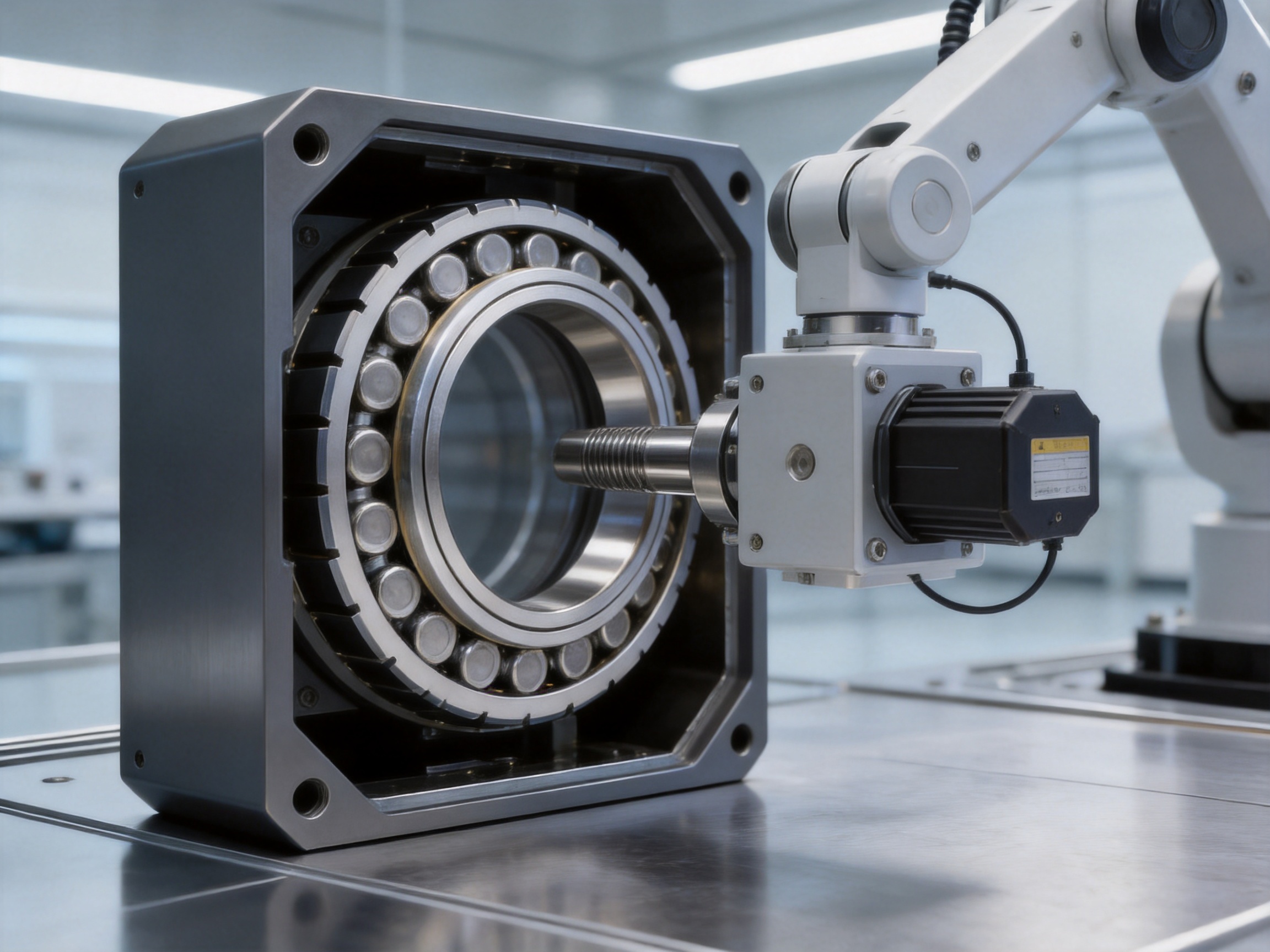
Bearing performance begins with material quality. Rings and rolling elements are subjected to repeated contact stress, and the raceway must maintain its geometry over the expected operating life. Proper material preparation and heat treatment are therefore essential parts of the manufacturing process.
Heat treatment is used to establish the hardness and structural stability needed for rolling contact. The process must be controlled carefully because excessive variation can affect dimensional stability, toughness, noise, and service life. After heat treatment, precision grinding is used to achieve the specified raceway geometry, surface condition, and dimensional accuracy.
For a thin-section bearing, the grinding process requires particular attention. The reduced ring thickness makes the component more sensitive to distortion and clamping conditions. Consistent machining and finishing practices help the bearing maintain its intended contact pattern after installation.
Assembly quality also matters. Rolling elements, rings, retainers, seals, and lubrication must be brought together in a clean environment. Contamination introduced during assembly can create indentations or abrasive wear. Correct assembly ensures that the bearing rotates smoothly and that the internal components remain properly positioned.
Industrial robots use bearings in base rotation, shoulder joints, elbow joints, wrist assemblies, and end-effector mechanisms. The RA Type is especially relevant where a joint must be compact and lightweight while supporting repeated rotational movement.
In a robot wrist, the bearing may need to fit around a drive system and preserve the compact profile of the tooling interface. In a larger articulated joint, the bearing may support radial and moment loads produced by the robot arm and payload. In each case, the bearing selection must match the actual torque, speed, duty cycle, and accuracy requirements.
Mechanical manipulators used in manufacturing, assembly, material handling, and inspection often perform repetitive rotary movements. Their bearing systems must withstand frequent starts and stops, intermittent loads, and possible vibration from adjacent equipment.
The RA Type’s thin-section architecture can help reduce the size of the manipulator’s rotary modules. This may be helpful when the machine must fit into a restricted production cell or reach around fixtures and workpieces.
Automation equipment may use compact bearings in rotary indexing units, tool-changing mechanisms, positioning stages, inspection systems, and precision handling equipment. Such machinery benefits from a bearing that occupies limited space while maintaining stable motion and a predictable load path.
Rotary tables and positioning mechanisms require controlled angular movement and resistance to applied loads. Depending on the load and accuracy requirements, an RA Type bearing may be used in a compact rotary table, indexing system, or sensor platform. Engineers should evaluate moment stiffness, runout, preload, and mounting rigidity before final selection.
Vision systems, inspection cameras, laser scanners, and sensor platforms may require smooth, repeatable rotation. The low profile of a thin-section bearing can help keep the positioning head small and reduce the load on the drive motor.
Correct installation is essential for realizing the advantages of a precision robot bearing. Before installation, inspect the shaft, housing, mounting surfaces, fasteners, and bearing components. Remove burrs, chips, rust, dust, and machining residue. Confirm that the bearing has not been damaged during transportation or storage.
The shaft and housing should meet the recommended dimensional tolerances and geometric requirements. Flatness, roundness, coaxiality, and perpendicularity can influence the contact pattern. A thin-section bearing installed in a distorted housing may experience uneven loading even when the bearing itself has been manufactured correctly.
When securing a segmented outer ring, tighten fasteners in a gradual and crosswise sequence where applicable. Use the specified torque and avoid concentrated clamping forces. If the design uses a locating shoulder, ensure that the shoulder dimensions are compatible with the bearing drawing. Do not force a ring into position with impact tools or uncontrolled pressing force.
The inner ring and shaft should be aligned carefully. If an interference fit is required, use a controlled installation method. Force should be applied only to the ring being mounted. Applying installation force through the rolling elements can damage raceways and create early fatigue marks.
After assembly, rotate the bearing by hand or at low speed to identify abnormal resistance, tight spots, scraping, or unusual noise. Confirm that the drive system is aligned and that seals, covers, encoder components, and cable routes do not impose unintended loads on the bearing.
Inadequate lubrication is one of the most common causes of bearing failure. Problems may result from using an unsuitable lubricant, applying too little or too much lubricant, or selecting an unreasonable relubrication interval. The correct lubricant depends on speed, load, temperature, environment, seal arrangement, and compatibility with adjacent components.
Too little lubricant can cause metal-to-metal contact, elevated temperature, wear, and noise. Excessive grease can increase churning resistance and temperature, particularly at higher speeds. Mixing incompatible greases can reduce lubrication performance or cause separation of the base oil and thickener.
For robot applications, the motion profile must be considered. A bearing subjected to short oscillations may not distribute lubricant in the same way as a bearing operating continuously in one direction. Reversing motion, low-speed positioning, and frequent acceleration can require a carefully selected grease and maintenance schedule.
Contamination control is equally important. Dust, metal particles, moisture, cleaning chemicals, and process debris can enter through damaged or incorrectly installed seals. Contaminants may create abrasive wear, indent the raceway, or accelerate lubricant degradation.
Regular inspection should confirm that seals remain intact and that the surrounding housing is clean. If the robot operates in a dusty, wet, corrosive, or high-temperature environment, additional protection may be necessary. The final sealing arrangement should be selected according to the actual operating conditions rather than assumed from a general application category.
Material fatigue accounts for a significant proportion of bearing failures. Repeated rolling contact eventually creates subsurface stress, which may develop into spalling or flaking. Excessive load, insufficient lubrication, contamination, misalignment, and incorrect mounting can shorten the fatigue life.
Preventive action includes selecting the bearing according to the actual load spectrum, maintaining clean lubrication, controlling installation accuracy, and avoiding overloads. In robot applications, the designer should calculate both operating load and peak transient load, including acceleration and emergency-stop conditions.
If the applied load exceeds the bearing’s design capacity, damage will accelerate. This may occur when a robot is operated beyond its rated payload, when a tooling change increases the center-of-gravity offset, or when an impact load is transmitted through the joint.
The listed Cr and Cor values provide a basis for initial comparison. They do not automatically establish the allowable load for every application. A complete analysis should account for radial load, axial load, moment load, speed, reliability target, operating temperature, and required service life.
Incorrect fits, misalignment, uneven tightening, impact during assembly, and contamination can all cause premature bearing failure. Installation personnel should follow documented procedures and use suitable tools. The bearing should never be treated as a component that can absorb arbitrary assembly force.
Improper transportation can cause shock damage, corrosion, packaging deformation, or contamination. Bearings should remain in their original protective packaging until they are ready for installation. Storage areas should be dry, clean, and free from excessive vibration or corrosive atmospheres.
Squeaking, grinding, humming, buzzing, or unusual metallic friction sounds may indicate inadequate lubrication, contamination, raceway damage, misalignment, or excessive preload. Vibration in the machine structure can accompany more severe damage.
When abnormal noise appears, operators should stop and inspect the system rather than continuing operation until failure. Check lubrication, seals, mounting bolts, alignment, load conditions, and nearby drive components. If the bearing is damaged, prompt replacement is recommended.
A maintenance program should be based on operating hours, motion cycles, load level, environmental conditions, and the consequences of failure. For critical robot joints, condition monitoring may include noise measurement, vibration monitoring, temperature checks, motor-current analysis, and position-error tracking.
Temperature trends can reveal lubrication problems, excessive preload, misalignment, or overload. A gradual increase in temperature may be more significant than a single reading because it can indicate developing degradation. Vibration analysis can help distinguish bearing damage from gearbox, motor, encoder, or structural problems.
Visual inspection should look for grease leakage, damaged seals, loose fasteners, corrosion, abnormal wear marks, and housing movement. During planned shutdowns, technicians can check rotational smoothness and backlash according to the robot manufacturer’s procedures.
Replacement bearings should match the specified model, accuracy, clearance, lubrication, and installation requirements. Substituting a bearing with a similar bore and outside diameter may produce unacceptable changes in stiffness, load capacity, friction, or service life.
UKL provides products for industrial customers, distributors, OEMs, and machinery manufacturers. Its service model combines product supply with technical communication, installation guidance, and after-sales maintenance support.
For an OEM project, useful information includes the bearing position, load direction, maximum and average speed, acceleration, oscillation angle, operating temperature, contamination level, expected life, mounting arrangement, and required delivery quantity. Drawings or three-dimensional models can further improve the accuracy of technical evaluation.
Customers may also require batch consistency, inspection reports, packaging specifications, marking, export documentation, and replacement planning. An integrated manufacturer is better positioned to coordinate these requirements across engineering, production, quality, and logistics functions.
Modern bearing production must consider both technical performance and environmental responsibility. UKL states that it adopts environmentally responsible processes, promotes material recycling, and works to optimize energy use. These practices support a more sustainable manufacturing model while maintaining the industrial capabilities required for precision components.
Long bearing life also contributes to sustainability. A bearing that remains reliable for the intended service period reduces replacement frequency, downtime, packaging consumption, and the need for emergency transportation. Correct lubrication, appropriate load selection, accurate installation, and timely maintenance are therefore both economic and environmental priorities.
The company also supports educational and technical training initiatives. Developing engineering skills is important for the future of precision manufacturing, particularly as robotics, intelligent automation, and digital production systems continue to expand.
Begin by identifying the required inner diameter and available outside diameter. The inner diameter must match the shaft or central mounting feature, while the outside diameter must fit the housing and leave sufficient room for surrounding components.
Next, calculate the combined loading condition. Include radial force, axial force, overturning moment, acceleration force, payload offset, tooling weight, and emergency-stop effects. Do not rely only on the nominal payload because robot joints may experience substantially higher transient forces during rapid movement or collision events.
Evaluate the operating motion. Continuous rotation, intermittent rotation, oscillation, indexing, and frequent reversing can create different lubrication and fatigue conditions. Also assess the maximum speed and acceleration because high dynamic activity can increase heat generation and internal stress.
Confirm the required accuracy and stiffness. A bearing that is suitable for general positioning may not be appropriate for a high-precision machining or inspection axis. Housing rigidity, mounting flatness, preload, and gear-reducer behavior must be evaluated together with the bearing.
Finally, consider the operating environment. Dust, water, chemicals, temperature variation, vacuum, cleanroom requirements, and washdown conditions may affect sealing and lubrication choices. A technical review with the supplier is recommended before committing to series production.
The RA Type is designed for compact rotating mechanisms, especially industrial robot joints, mechanical manipulators, and intelligent automation equipment. Its thin-section construction is intended for applications where low weight and limited installation space are important.
It means that the outer ring is constructed in segments rather than as one uninterrupted ring. This configuration can provide installation and integration flexibility, but the segments must be mounted and tightened according to the specified procedure to prevent distortion or uneven loading.
The product description identifies the inner ring as the ring intended for rotation. The actual machine arrangement should be confirmed from the application drawing because the load path, mounting structure, and drive configuration can vary.
The listed models range from a 50 mm inner diameter on RA5008 to a 200 mm inner diameter on RA20013. Intermediate models are available in 10 mm increments across the supplied range.
The RA5008 through RA15008 models have an 8 mm bearing height. The RA16013 through RA20013 models have a 13 mm height and larger diameters. The appropriate group depends on the required bore, load rating, stiffness, and installation envelope.
It may replace a conventional bearing arrangement in some compact rotating mechanisms, but replacement must be verified through load, moment, stiffness, accuracy, speed, life, and mounting calculations. Similar dimensions alone are not sufficient for a safe substitution.
Use a lubricant compatible with the bearing, seals, speed, load, and operating temperature. Follow the recommended quantity and maintenance interval. Avoid mixing incompatible greases and protect the bearing from contamination during lubrication.
Common causes include inadequate or unsuitable lubrication, material fatigue, contamination, seal damage, installation errors, excessive load, incorrect fit, poor transportation, and improper storage.
Symptoms may include squeaking, grinding, metallic friction noise, humming, buzzing, elevated temperature, abnormal vibration, increased backlash, or changes in positioning accuracy. The machine should be inspected promptly when these symptoms appear.
UKL provides OEM and ODM export services and can discuss custom requirements such as dimensions, tolerances, lubrication, packaging, inspection documentation, and production scheduling. Customers should provide detailed application and technical information for evaluation.
Important information includes shaft diameter, housing size, radial and axial loads, moment load, speed, acceleration, duty cycle, operating temperature, environment, required service life, accuracy, mounting method, and expected annual quantity.
A thin-section ring can be more sensitive to distortion caused by an inaccurate or insufficiently rigid housing. Poor flatness, roundness, or uneven clamping can change the raceway contact pattern and lead to noise, friction, wear, or reduced service life.
The RA Type segmented outer ring robot bearing is a compact solution for industrial robots, mechanical manipulators, and automated rotating mechanisms. Its thin-section construction, inner ring rotation design, broad bore range, and low listed weight make it attractive for applications where space, mass, and integration flexibility are important.
Its competitive value lies in the combination of compact architecture and industrial manufacturing support. Rather than focusing only on a catalog dimension, the product can be evaluated as part of a complete robot joint, including the motor, reducer, encoder, housing, seals, lubrication, and payload structure. This system-level approach helps engineers obtain the benefits of reduced size without compromising reliability.
UKL’s integrated manufacturing capabilities cover forging, turning, heat treatment, grinding, assembly, and packaging. Its R&D focus on robotics, CNC equipment, cross roller bearings, angular contact ball bearings, and intelligent automation provides relevant technical experience for demanding industrial applications. Production capacity, international supply experience, technical response, and OEM/ODM support further strengthen its position as a bearing manufacturing partner.
For the best result, customers should select the RA Type model using complete operating data and confirm all dimensions, tolerances, lubrication requirements, and installation procedures with the supplier. When correctly specified, installed, lubricated, and maintained, this compact bearing family can contribute to lighter, smaller, and more efficient robot and automation systems.
1. UKL Bearing Manufacturing Co., Ltd., RA Type Product Data and Technical Information.
2. UKL Bearing Manufacturing Co., Ltd., Company Manufacturing and Engineering Profile.
3. ISO 281, Rolling Bearings — Dynamic Load Ratings and Rating Life.
4. ISO 76, Rolling Bearings — Static Load Ratings.
5. ISO 15243, Rolling Bearings — Damage and Failures — Terms, Characteristics, and Causes.
6. General engineering guidance on rolling bearing lubrication, mounting, contamination control, and maintenance.
7. General design practices for bearings used in industrial robots, mechanical manipulators, CNC equipment, and intelligent automation systems.
Product Categories
Contact Us

Jane@ukl-bearing.com
Jenny@ukl-bearing.com
Andy@ukl-bearing.com
Ivy@ukl-bearing.com

+86-510- 88763239
+86-15371057968

No.1 Hehuan Road, Hudai Town, Binhu District, Wuxi City.
Ready to Begin?
Get in Touch

Now!
UKL BEARING
 English
 Español
 русский