Content
Modern robotic systems are becoming smaller, lighter, faster, and more capable. As a result, every component inside a robot joint must deliver more performance within a smaller installation envelope. Bearings are especially important because they support rotating structures, control friction, maintain positional accuracy, and transfer loads between moving assemblies. A bearing that is too large or too heavy can restrict the design of an entire machine. A bearing with insufficient precision or stiffness can reduce repeatability and shorten service life.
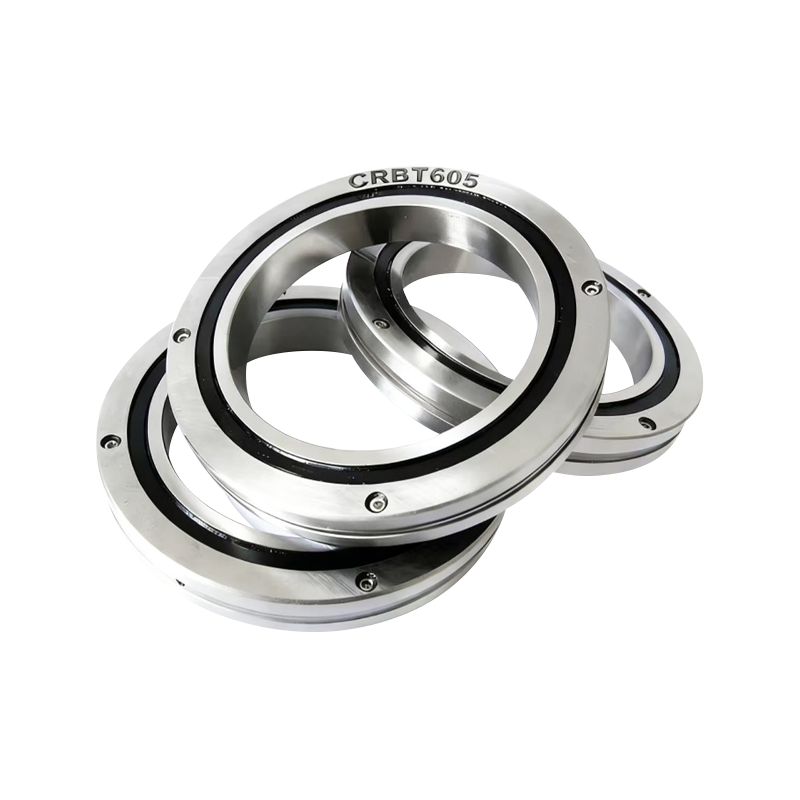
The CRBT lightweight rotary joint bearing is designed to address these challenges. It is a compact cross roller bearing developed for applications where installation space, weight, rigidity, and rotational accuracy are all critical. With a section height of only 5.5 mm and a width of 5 mm, the bearing provides a highly space-efficient solution for small robotic arms, miniature surveillance cameras, humanoid robots, precision rotary tables, joint modules, and other advanced mechanisms.
Unlike conventional bearing arrangements that may require multiple components to support radial, axial, and moment loads, a cross roller bearing can provide a compact structural solution. Its internal rollers are arranged alternately at right angles, allowing the bearing to accommodate loads from several directions while maintaining smooth rotational movement. The CRBT series extends this concept through an especially thin and lightweight design.
Manufactured by UKL Bearing Manufacturing Co., Ltd., the CRBT series reflects the company’s focus on precision bearing engineering, OEM and ODM production, and customized solutions for industrial customers. The product combines a small cross section with carefully controlled geometry, low mass, high rotational precision, and a broad range of inner diameters from 10 mm to 95 mm.
CRBT Lightweight Rotary Joint Bearing
Rotary joints are central to the operation of robotic arms, motion platforms, camera mechanisms, medical instruments, semiconductor equipment, and precision automation systems. In each of these applications, the bearing must guide rotation accurately while resisting forces generated by the supported structure and the machine’s movement.
Traditional bearing selections often involve a compromise. A larger bearing may offer greater load capacity, but it also consumes more space and adds weight. A thinner bearing may simplify the mechanical layout, but designers must verify that it can maintain adequate stiffness and accuracy. A bearing with integrated mounting holes may simplify installation in some designs, but the additional material around the mounting features can increase the overall cross section.
The CRBT lightweight rotary joint bearing is intended for situations in which compactness is not simply a preference but a fundamental design requirement. Small robot joints, for example, may have limited internal space for motors, cables, reducers, sensors, brakes, and structural supports. Reducing bearing width and mass can make room for other components or allow the complete joint to become smaller.
Reducing moving mass can also improve dynamic performance. A lighter joint may require less motor torque during acceleration and deceleration. Lower inertia can support faster response, reduced energy consumption, and improved control stability. In applications with repeated reciprocating motion, weight reduction may also reduce mechanical stress on gears, couplings, shafts, and support frames.
For miniature surveillance cameras and optical mechanisms, a compact bearing can help preserve a small external profile. This is useful when the camera must fit inside a limited housing or move through a narrow angular range with minimal vibration. For precision machine tools and rotary tables, a thin bearing can simplify the design of surrounding structures while supporting accurate angular motion.
The CRBT series is a lightweight cross roller bearing for rotary joint applications. The standard bearing width is 5 mm, and the product information identifies a section height of approximately 5.5 mm. The available models cover inner diameters from 10 mm to 95 mm, allowing the same basic bearing concept to be applied to different machine sizes.
The bearing is supplied without mounting holes. This design choice produces an extremely compact structure and helps reduce weight. Instead of using integrated holes in the bearing rings, the bearing can be installed through suitable surrounding components designed by the equipment manufacturer. This gives the machine designer greater freedom to define the mounting arrangement, preload method, housing geometry, and fastening system.
Each listed model uses a 5 mm width and a minimum installation dimension value of 0.15 mm in the supplied technical table. The table also specifies the outside diameter, installation dimensions, basic dynamic load rating, basic static load rating, mass, and corresponding model reference. These values allow engineers to compare the available sizes during preliminary bearing selection.
The CRBT series is identified by model numbers such as CRBT105AC1P5, CRBT155AC1P5, and CRBT955AC1P5. The model naming structure should be confirmed with UKL before ordering, particularly when customers require a specific internal clearance, preload, accuracy class, sealing arrangement, lubrication specification, or other customization.
| Model | Inner Diameter d (mm) | Outside Diameter D (mm) | Width B (mm) | ds min (mm) | Dh (mm) | C (kN) | Co (kN) | Mass (g) | Corresponding Model |
| CRBT105AC1P5 | 10 | 21 | 5 | 0.15 | 12.5 | 1.12 | 0.809 | 9 | RAU1005C0P5 |
| CRBT155AC1P5 | 15 | 26 | 5 | 0.15 | 17.5 | 1.32 | 1.10 | 12 | RAU1505C0P5 |
| CRBT205AC1P5 | 20 | 31 | 5 | 0.15 | 22.5 | 1.49 | 1.40 | 15 | RAU2005COP5 |
| CRBT255AC1P5 | 25 | 36 | 5 | 0.15 | 27.5 | 1.65 | 1.77 | 18 | RAU2505C0P5 |
| CRBT305AC1P5 | 30 | 41 | 5 | 0.15 | 32.5 | 1.89 | 2.14 | 21 | RAU3005C0P5 |
| CRBT355AC1P5 | 35 | 46 | 5 | 0.15 | 37.5 | 2.05 | 2.42 | 24 | RAU3505C0P5 |
| CRBT405AC1P5 | 40 | 51 | 5 | 0.15 | 42.5 | 2.14 | 2.74 | 27 | RAU4005C0P5 |
| CRBT455AC1P5 | 45 | 56 | 5 | 0.15 | 47.5 | 2.30 | 3.09 | 29 | RAU4505C0P5 |
| CRBT505AC1P5 | 50 | 61 | 5 | 0.15 | 52.5 | 2.43 | 3.49 | 32 | RAU5005C0P5 |
| CRBT555AC1P5 | 55 | 66 | 5 | 0.15 | 57.5 | 2.53 | 3.79 | 35 | RAU5505COP5 |
| CRBT605AC1P5 | 60 | 71 | 5 | 0.15 | 62.5 | 2.63 | 4.09 | 38 | RAU6005COP5 |
| CRBT655AC1P5 | 65 | 76 | 5 | 0.15 | 67.5 | 2.71 | 4.29 | 41 | RAU6505C0P5 |
| CRBT705AC1P5 | 70 | 81 | 5 | 0.15 | 72.5 | 2.81 | 4.68 | 44 | RAU7005COP5 |
| CRBT755AC1P5 | 75 | 86 | 5 | 0.15 | 77.5 | 2.90 | 5.05 | 47 | RAU7505C0P5 |
| CRBT805AC1P5 | 80 | 91 | 5 | 0.15 | 82.5 | 3.05 | 5.43 | 50 | RAU8005C0P5 |
| CRBT855AC1P5 | 85 | 96 | 5 | 0.15 | 87.5 | 3.11 | 5.70 | 53 | RAU8505C0P5 |
| CRBT905AC1P5 | 90 | 101 | 5 | 0.15 | 92.5 | 3.19 | 6.03 | 56 | RAU9005C0P5 |
| CRBT955AC1P5 | 95 | 106 | 5 | 0.15 | 97.5 | 3.22 | 6.31 | 59 | RAU9505C0P5 |
One of the principal advantages of the CRBT bearing is its reduced cross section compared with the previous thinnest cross roller bearing identified in the product information as the CRBS type. The CRBT section height is approximately 69% of its predecessor. Its cross-sectional area is approximately 43% of the earlier product, while its weight is approximately 0.38 times that of the CRBS when compared using a bearing with a 50 mm inner diameter.
These comparisons illustrate the design emphasis behind the series. A reduction in section height can make a major difference in a rotary joint because the bearing is usually surrounded by structural plates, motor housings, reducers, sensors, and wiring. Even a few millimeters saved in the bearing can help reduce the width of the complete joint.
The reduction in cross-sectional area may also support more efficient use of materials and internal machine space. For a robot manufacturer, this can provide additional room for a larger actuator, improved cable routing, a more substantial encoder, or a protective housing. For a camera manufacturer, it may allow the optical assembly and drive mechanism to fit within a smaller enclosure.
Weight reduction is equally important. A bearing mass of 32 g for the 50 mm inner diameter model is significantly lower than what would normally be expected from a larger, thicker rotary bearing arrangement. Lower mass is especially valuable in articulated arms because the weight of one joint can affect the load carried by all upstream joints. A lighter distal joint can reduce the required capacity of the arm’s proximal actuators.
It is important to understand that a smaller bearing should not be selected solely on the basis of its dimensions. Designers must consider radial load, axial load, overturning moment, rotational speed, acceleration, operating temperature, lubrication, mounting stiffness, and required service life. The CRBT series offers a compact platform, but application-specific engineering remains essential.
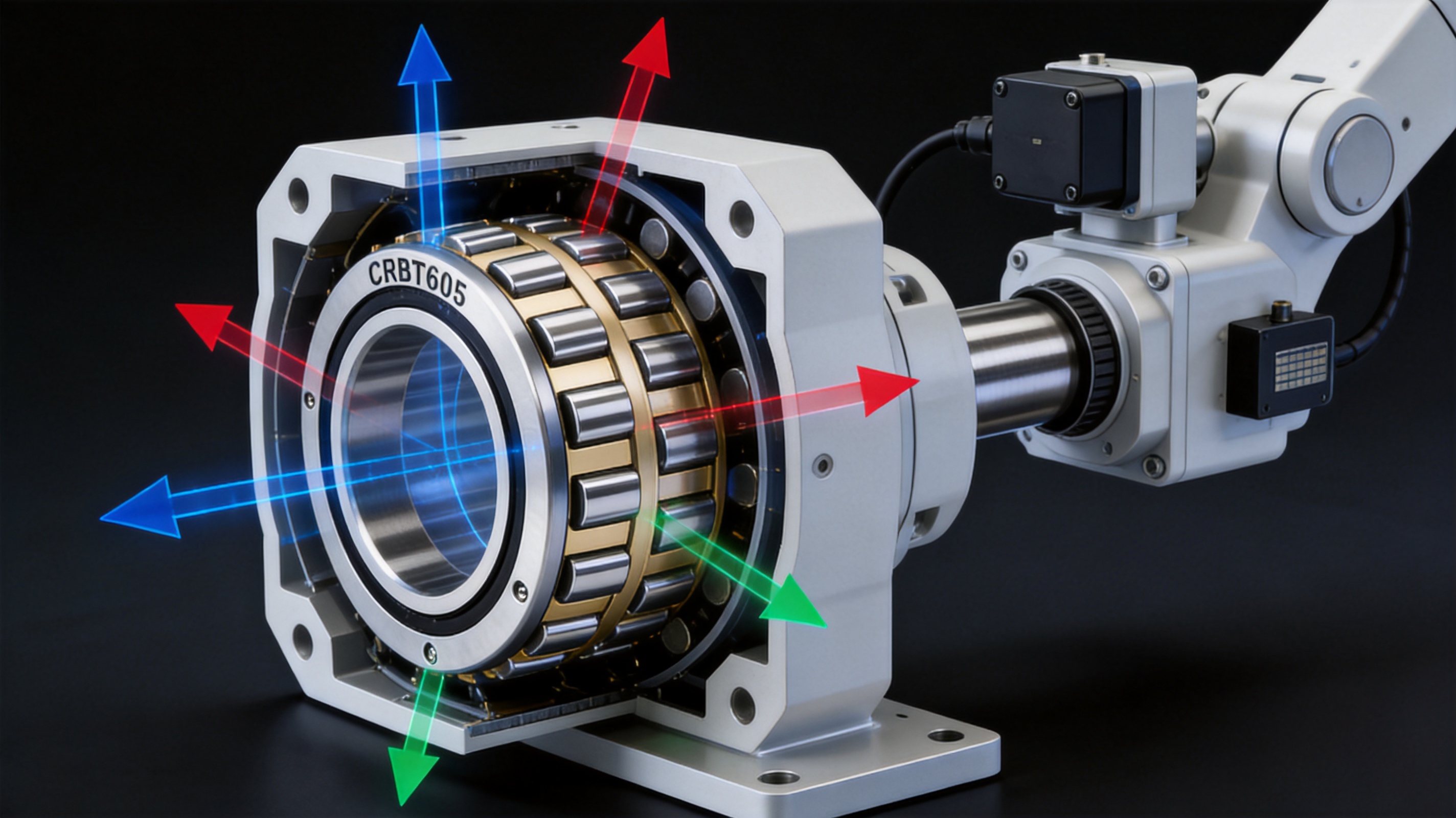
A cross roller bearing uses cylindrical rollers arranged alternately at approximately 90-degree orientations. One set of rollers primarily responds to loads in one direction, while the adjacent set responds to loads in the perpendicular direction. Through this arrangement, the bearing can support radial loads, axial loads, and moment loads within a single compact bearing assembly.
The raceways and rollers must be manufactured with high geometric accuracy. Small deviations in roller diameter, raceway profile, spacing, or ring roundness can influence running torque, friction, stiffness, and load distribution. In a lightweight bearing with a very small cross section, the control of these variables becomes particularly important because there is less structural material available to absorb installation errors or deformation.
The CRBT concept is therefore based on more than simply reducing the outside dimensions. The bearing must retain suitable internal contact conditions and maintain stable rotation after installation. Correct mounting surfaces, housing rigidity, fastening sequence, and preload control are all important to achieving the intended performance.
Cross roller bearings are often selected when designers require high rotational accuracy and compact support for combined loads. Their ability to resist moment loads can simplify a rotary joint that would otherwise require two or more conventional bearings positioned apart from each other. A single compact bearing may reduce the axial length of the mechanism and simplify assembly.
The CRBT series does not include mounting holes in the bearing rings. This structure gives the designer control over the surrounding mounting components. Depending on the machine design, the rings may be retained by clamping flanges, precision housings, threaded fasteners, or other suitable structures. The final mounting design should prevent ring distortion and provide sufficient support over the full contact area.
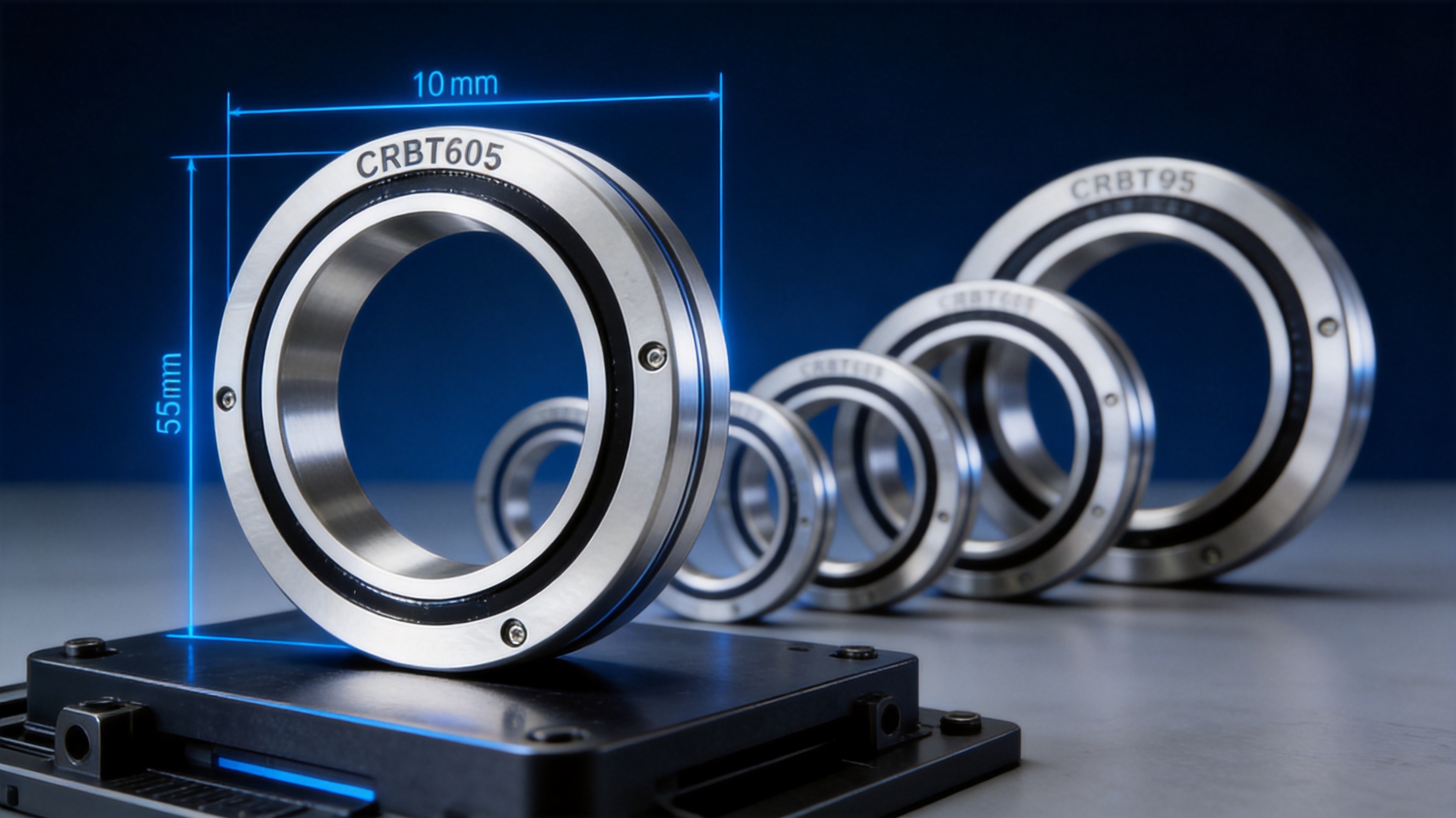
The standard width of the listed CRBT models is 5 mm. This narrow dimension is one of the strongest reasons to consider the product for miniature rotary mechanisms and compact joints. A 5 mm bearing width can help reduce the axial length of an assembly and create more space for adjacent parts.
In small robotic joints, a narrow bearing can support a more compact arrangement of the motor, reduction mechanism, encoder, and joint shell. In precision instruments, it can help preserve valuable space for optics, sensors, or test fixtures. The narrow profile can also make it easier to design a lightweight support structure around the bearing.
The product information describes the CRBT series as approximately 0.38 times the weight of the previous CRBS design under the stated comparison condition. The listed model masses range from 9 g for the 10 mm inner diameter model to 59 g for the 95 mm inner diameter model.
Low mass can reduce the inertia of moving assemblies and lower the torque requirement during acceleration. It may also help improve the energy efficiency of battery-powered robots, portable instruments, and small automated devices. In multi-axis systems, a reduction in the mass of one joint can produce benefits throughout the kinematic chain.
The cross roller arrangement enables the bearing to support more than one type of load. This is particularly useful in rotary joints exposed to radial forces, axial forces, and tilting moments at the same time. The basic dynamic load ratings in the listed series range from 1.12 kN to 3.22 kN, while the basic static load ratings range from 0.809 kN to 6.31 kN.
These ratings provide a starting point for bearing selection. Actual allowable loads depend on operating conditions, load direction, duty cycle, mounting accuracy, lubrication, environmental contamination, and required reliability. Engineers should use the manufacturer’s technical guidance for detailed life and static safety calculations.
The absence of mounting holes creates a clean and compact bearing profile. It also allows the equipment designer to develop a dedicated installation arrangement instead of being limited to a fixed hole pattern. This can be helpful when the bearing must be integrated into a custom joint module or precision housing.
However, installation flexibility requires careful mechanical design. The housing and shaft should have appropriate dimensional accuracy and surface quality. Clamping forces should be applied evenly, and the mounting structure should be sufficiently rigid to avoid raceway distortion. Clean assembly procedures are also necessary because dust, chips, and foreign particles can affect bearing motion and life.
The CRBT range includes 18 listed models with inner diameters from 10 mm to 95 mm. This size range supports both very small mechanisms and larger compact rotary modules. The common 5 mm width across the listed models simplifies initial design comparisons and may help manufacturers standardize their product architecture.
Humanoid robots require many compact joints, including joints in the wrists, elbows, shoulders, ankles, neck, and fingers. Each joint may need to combine a motor, reducer, encoder, wiring, structural frame, and bearing within a limited volume. A lightweight rotary joint bearing can contribute to a smaller and more responsive joint design.
Weight distribution is particularly important in humanoid robots. Heavy distal components increase the torque required at the shoulder and upper arm. Lightweight bearings can help reduce the mass of limbs and end-effectors, potentially improving balance, walking efficiency, and motion control.
The moment-load capability of a cross roller bearing can also be valuable in joints where the supported link extends away from the rotational axis. Nevertheless, the designer must evaluate the complete load path, including impact loads, dynamic acceleration, emergency stops, and possible collisions.
Small robotic arms used in laboratories, electronics assembly, inspection, education, and light material handling often require compact joints with accurate positioning. The CRBT series can help reduce the size of the joint housing without relying on a large bearing arrangement.
Reduced bearing mass may improve the arm’s acceleration and deceleration response. This can support shorter cycle times, smoother motion, and reduced motor loading. The bearing’s compact profile may also help manufacturers produce tabletop robots and collaborative devices with smaller footprints.
Compact rotary tables are used for indexing, inspection, assembly, optical positioning, and precision measurement. In these systems, the bearing must resist moment loads generated by an offset workpiece or fixture. A cross roller bearing can support the rotating platform while maintaining a short axial layout.
The CRBT design may be suitable for miniature or lightweight rotary tables where conventional slewing arrangements would consume too much space. The application engineer should confirm the required indexing accuracy, rotational speed, acceleration, stiffness, and allowable runout before final selection.
Precision machine tools and auxiliary positioning systems depend on stable, accurate movement. A compact bearing can be used in tool-changing systems, rotary positioning mechanisms, sensor heads, inspection units, and other equipment where installation space is restricted.
Machine tool applications also demand attention to thermal conditions, coolant exposure, contamination control, lubrication compatibility, and mounting precision. The bearing should be integrated into a system that protects the raceways and maintains stable operating conditions over the intended duty cycle.
Camera pan and tilt mechanisms often require smooth rotation, low vibration, low noise, and compact packaging. A lightweight cross roller bearing can help reduce the size of the camera head and support precise angular movement.
In portable or aerial imaging equipment, low mass is particularly beneficial. It may reduce the power required by the drive system and make it easier to stabilize the optical platform. The final design should consider environmental sealing, temperature changes, cable routing, and the effect of lens or sensor weight on the bearing moment load.
Integrated joint modules combine a bearing, motor, reducer, encoder, and control electronics in one compact unit. The CRBT series can be considered when the bearing must fit inside a highly integrated module with limited radial or axial space.
Automation equipment increasingly uses modular architectures to reduce development time and simplify maintenance. A consistent range of lightweight cross roller bearings can support the development of multiple joint sizes while preserving common design principles and manufacturing methods.
UKL Bearing Manufacturing Co., Ltd. integrates research and development, production, and international distribution. The company’s manufacturing operation includes production processes covering forging, turning, heat treatment, grinding, assembly, and packaging. Bringing these stages into an integrated production system can improve process coordination and traceability.
Forging is used to form bearing ring blanks and establish the basic material structure before machining. A controlled forging process can help improve material utilization and produce a suitable foundation for subsequent turning and heat treatment. Consistent raw material preparation is important for bearings because the rings must withstand repeated contact stress during operation.
Material selection should be matched to the required hardness, dimensional stability, fatigue strength, corrosion resistance, and operating environment. For customized orders, customers can discuss material grades, heat treatment requirements, surface treatments, and special operating conditions with the manufacturer.
Turning creates the preliminary geometry of the bearing rings and prepares reference surfaces for later processes. Controlled turning reduces machining allowance and helps establish concentricity between important features. Stable tooling, appropriate cutting parameters, and effective chip control are necessary when producing thin bearing components.
Because the CRBT series has a compact structure, dimensional errors may have a proportionally greater effect on installation and running performance. Precision turning therefore serves as an important foundation for grinding and final inspection.
Heat treatment gives bearing rings the hardness and internal structure required to resist rolling contact fatigue, wear, and plastic deformation. The process must be carefully controlled to achieve the desired mechanical properties while limiting distortion.
Thin rings can be particularly sensitive to heat treatment deformation. A suitable process sequence, temperature control, cooling method, and post-treatment inspection program are important to ensure that the components remain suitable for precision grinding and assembly.
Grinding is one of the most critical stages in precision bearing production. The raceway geometry, ring dimensions, surface finish, and roundness must be controlled to support smooth contact with the rollers. Grinding also determines the final accuracy of key functional surfaces.
For a cross roller bearing, the relationship between the raceways and the alternately oriented rollers is especially important. Inconsistent geometry can produce uneven load distribution, increased friction, vibration, or unstable torque. UKL’s focus on high-precision bearing production supports the requirements of robotics, CNC equipment, and intelligent automation.
Assembly involves installing the rollers, spacers or separators where applicable, rings, lubrication, and other components according to the product configuration. Cleanliness is essential because small particles can interfere with the rolling contacts of a compact bearing.
Assembly controls may include checking rotational torque, internal clearance or preload, smoothness, appearance, and dimensional conformity. The appropriate inspection items depend on the bearing specification and customer requirements.
Packaging protects the bearing from contamination, moisture, impact, and corrosion during storage and transportation. Correct identification and documentation are also important for industrial customers managing multiple bearing sizes or production batches.
UKL supplies products to customers in Europe, Asia, Africa, Russia, North America, and other regions. Its international distribution capability is supported by experience in OEM and ODM export projects. This is valuable for customers who require consistent communication, production coordination, and shipping support across borders.
Precision bearings require quality control at every stage rather than relying only on final inspection. Raw materials, forging, machining, heat treatment, grinding, assembly, lubrication, and packaging can all affect final bearing performance. A process-oriented quality system helps identify variation earlier and supports more consistent production.
For the CRBT series, important quality considerations include inner and outside diameter accuracy, width, raceway geometry, ring roundness, roller quality, surface finish, rotational torque, preload or clearance, and visual cleanliness. Customers may also require batch traceability, inspection reports, samples, or specific quality documentation for their own production systems.
UKL’s R&D team develops high-precision cross roller bearings, dual-direction thrust angular contact ball bearings, and other specialized products. This engineering capability allows the company to work with customers on more than standard catalog selection. It can support discussions about load conditions, mounting structures, operating temperature, rotation pattern, lubrication, and customization.
Application support is especially important for thin bearings because installation conditions strongly influence performance. The bearing may be technically capable of supporting a specified load, but an inadequate housing, poor shaft accuracy, uneven clamping, or excessive structural deflection can reduce practical performance.
UKL also provides technical response, installation guidance, and after-sales maintenance support through its service team. For international customers, multilingual communication can simplify the exchange of drawings, specifications, samples, inspection requirements, and delivery information.
The first selection parameter is the required inner diameter. The CRBT series provides sizes from 10 mm to 95 mm. The shaft or central structural opening should be matched to the selected bearing while allowing for the required mounting arrangement and tolerance conditions.
The second parameter is the outside diameter and available radial space. Because each model has a 5 mm width, the primary dimensional differences in the listed range are the inner and outside diameters. The designer should verify the bearing envelope together with housing walls, fasteners, seals, encoders, cable channels, and other adjacent components.
Load analysis is essential. Radial load, axial load, and moment load should be calculated separately and in combination. Dynamic loads caused by acceleration, deceleration, vibration, shock, and emergency stopping should be included. If the bearing supports a cantilevered link or platform, the moment generated by the offset load may be more significant than the simple radial load.
Basic dynamic load rating is used in bearing life calculations, while basic static load rating is used to evaluate the risk of permanent deformation under stationary or slowly moving loads. The values in the product table are reference ratings and should not be treated as universal allowable loads without considering operating conditions and safety factors.
Rotational behavior must also be considered. Some applications require continuous rotation, while others involve oscillation through a limited angle. Oscillating motion can create different lubrication and surface fatigue conditions compared with continuous rotation. The frequency, amplitude, speed, and duration of the movement should be provided to the bearing manufacturer.
Operating temperature, humidity, dust, chemicals, vacuum, and cleanliness requirements may influence the choice of lubricant, sealing arrangement, material, and surface treatment. The standard product configuration should be confirmed before use in corrosive, high-temperature, cleanroom, or vacuum environments.
Finally, installation and maintenance requirements should be addressed during the initial design stage. The housing should provide even support, and the fastening system should avoid local distortion. Customers should request detailed mounting recommendations and product drawings when developing a new machine.
Before installation, inspect the bearing, shaft, housing, and surrounding parts. Remove burrs, dust, machining chips, rust-preventive residue that is incompatible with the selected lubricant, and other contaminants. Do not force the bearing into position by applying impact to an inappropriate ring or rolling element.
The shaft and housing dimensions should comply with the recommended tolerances for the intended application. Excessive interference may increase internal stress and running torque, while insufficient interference may allow creep or movement between the bearing ring and mounting surface.
Mounting surfaces should be flat and sufficiently rigid. Thin bearing rings can be sensitive to uneven support. If the housing or shaft is distorted, the bearing may experience uneven raceway loading, increased friction, or reduced accuracy. The surrounding structure should therefore be designed as part of the bearing system.
When fastening a bearing without mounting holes, use an appropriate clamping or retention structure. Tighten fasteners gradually and in a balanced sequence. If a preload or clearance specification is required, measure the bearing after installation rather than assuming that the unmounted condition will remain unchanged.
Lubrication should be compatible with the bearing materials, speed, temperature, load, and operating environment. Use the correct quantity. Too little lubricant can increase wear and temperature, while too much can increase drag and heat generation. The maintenance interval should be established through testing and operating experience.
After installation, rotate the assembly slowly and check for abnormal resistance, noise, vibration, or irregular torque. A functional inspection at low speed can identify installation problems before the machine is operated at full speed or load.
OEM and ODM customers often need more than a standard bearing. They may require a particular size, preload, accuracy grade, lubricant, packaging method, inspection document, or delivery schedule. UKL’s integrated manufacturing and engineering structure is suited to projects in which bearing requirements are defined by the customer’s machine design.
The company has experience serving industrial customers in multiple markets and maintains production capacity of approximately 10,000 to 50,000 units per month, according to the supplied company information. This capacity can support both development samples and recurring production orders, subject to product complexity, quantity, and scheduling.
Integrated production can also improve communication between design engineering and manufacturing. A bearing design can be reviewed for machinability, heat treatment behavior, grinding requirements, assembly conditions, and inspection capability before mass production begins. This reduces the risk of discovering manufacturability problems late in the project.
For customers developing robotic joints or compact rotary modules, early collaboration is recommended. Sharing the shaft and housing drawings, load spectrum, operating temperature, rotation profile, expected life, and installation method allows the manufacturer to provide a more appropriate recommendation.
Industrial customers increasingly evaluate suppliers according to environmental responsibility as well as technical performance. UKL identifies material recycling, energy optimization, and environmentally responsible production processes as part of its long-term sustainability commitment.
Efficient material use during forging and machining can reduce waste. Process monitoring can help limit rework and reduce unnecessary consumption of energy, coolant, packaging, and raw materials. A durable bearing can also support sustainability by extending maintenance intervals and reducing premature replacement in industrial equipment.
Sustainability should be evaluated across the complete product life cycle. A lightweight bearing may reduce the energy required to move a robotic joint. A precisely manufactured bearing may reduce vibration and improve machine efficiency. Reliable production and suitable quality control can decrease the number of rejected parts and reduce the environmental impact associated with repeated manufacturing.
UKL also supports educational and technical training initiatives intended to develop future engineering talent. This broader investment in technical capability can contribute to the long-term development of precision manufacturing and industrial automation.
Before specifying a CRBT lightweight rotary joint bearing, the equipment designer should confirm the following points:
1. Required inner diameter and available outside diameter.
2. Maximum radial, axial, and moment loads.
3. Static load conditions, shock loads, and emergency-stop loads.
4. Required rotational speed, acceleration, oscillation angle, and duty cycle.
5. Required operating life and acceptable maintenance interval.
6. Housing and shaft material, rigidity, flatness, and dimensional tolerance.
7. Required running accuracy, repeatability, stiffness, and rotational torque.
8. Temperature, humidity, dust, chemicals, vibration, and other environmental conditions.
9. Lubricant type, quantity, replenishment method, and compatibility.
10. Required inspection reports, traceability, packaging, and delivery schedule.
11. Whether a standard model is suitable or a customized configuration is needed.
12. Whether samples and endurance testing are required before volume production.
The CRBT series is a lightweight cross roller bearing designed for compact rotary joints and precision rotating mechanisms. Its rollers are arranged in alternating directions to support combined radial, axial, and moment loads within a compact structure.
The listed models have a width of 5 mm. The product information also identifies a section height of approximately 5.5 mm, making the bearing suitable for applications with strict space limitations.
No. The CRBT bearing has no mounting holes. This helps create an extremely compact and lightweight structure while allowing the equipment designer to develop a dedicated housing or clamping arrangement.
The listed models have inner diameters from 10 mm to 95 mm. The corresponding outside diameters range from 21 mm to 106 mm. Each listed model has a 5 mm width.
According to the supplied product information, the CRBT section height is approximately 69% of the previous CRBS design. Its cross-sectional area is approximately 43% of the previous product, and its weight is approximately 0.38 times that of the CRBS when comparing a bearing with a 50 mm inner diameter.
Yes. Humanoid robot joints are among the intended application areas. The bearing’s small width and low mass can support compact joint designs, but the selected model must be verified against the robot’s load spectrum, impact conditions, required life, and installation structure.
They may be suitable for continuous rotation, depending on the selected configuration and operating conditions. Speed, lubrication, temperature, load, and accuracy requirements should be reviewed with the manufacturer before final selection.
UKL provides OEM and ODM engineering services and manufactures custom bearings. Customers should discuss required dimensions, preload, clearance, accuracy, lubrication, materials, packaging, and other specifications with the technical team.
Useful information includes the model or required dimensions, radial and axial loads, moment load, rotational speed, movement pattern, operating temperature, environment, expected service life, mounting arrangement, quantity, and documentation requirements.
Installation surfaces must be clean, flat, accurate, and sufficiently rigid. The retention arrangement should apply even support without distorting the rings. Fasteners should be tightened in a balanced sequence, and the bearing should be checked for smooth rotation after installation.
The CRBT lightweight rotary joint bearing is manufactured by UKL Bearing Manufacturing Co., Ltd., a China-based bearing manufacturer and supplier with capabilities in R&D, production, OEM and ODM services, and international distribution.
Potential industries include robotics, intelligent automation, precision machine tools, miniature camera systems, rotary tables, joint modules, inspection equipment, optical instruments, and other applications requiring compactness, low weight, and high rotational precision.
The CRBT lightweight rotary joint bearing is designed for a new generation of compact and intelligent machines. Its 5 mm width, approximately 5.5 mm section height, low mass, and mounting-hole-free structure address the demands of applications where every millimeter and gram matters.
Compared with the previous CRBS design identified in the product information, the CRBT series offers a substantially reduced section height, cross-sectional area, and weight. These characteristics can help engineers create smaller robotic joints, lighter rotary tables, more compact camera mechanisms, and more integrated automation equipment.
The product’s value depends not only on its dimensions but also on the complete manufacturing and engineering system behind it. UKL integrates forging, turning, heat treatment, grinding, assembly, packaging, R&D, and international customer support. This integrated approach helps provide a practical foundation for standard supply, OEM projects, ODM development, and customized precision bearing solutions.
For successful application, the bearing should be selected through a complete review of loads, speed, movement, life, temperature, lubrication, housing design, and installation accuracy. When these factors are properly controlled, the CRBT series can provide an efficient solution for high-precision rotary joints in robotics and advanced industrial equipment.
1. UKL Bearing Manufacturing Co., Ltd., CRBT Lightweight Rotary Joint Bearing Product Information.
2. UKL Bearing Manufacturing Co., Ltd., CRBT Series Dimensional and Load Rating Table.
3. General engineering principles for cross roller bearing selection, mounting, lubrication, and load analysis.
4. General bearing manufacturing process references covering forging, turning, heat treatment, grinding, assembly, and inspection.
5. General technical references for robotic joint design, rotary tables, precision automation, and compact motion systems.
6. General standards and manufacturer guidance concerning rolling bearing load ratings, dimensional accuracy, operating life, and installation practices.

For product selection, technical drawings, samples, customization, and application assistance, customers should provide their operating requirements and consult the manufacturer before placing a production order.
Product Categories
Contact Us

Jane@ukl-bearing.com
Jenny@ukl-bearing.com
Andy@ukl-bearing.com
Ivy@ukl-bearing.com

+86-510- 88763239
+86-15371057968

No.1 Hehuan Road, Hudai Town, Binhu District, Wuxi City.
Ready to Begin?
Get in Touch

Now!
UKL BEARING
 English
 Español
 русский