Content
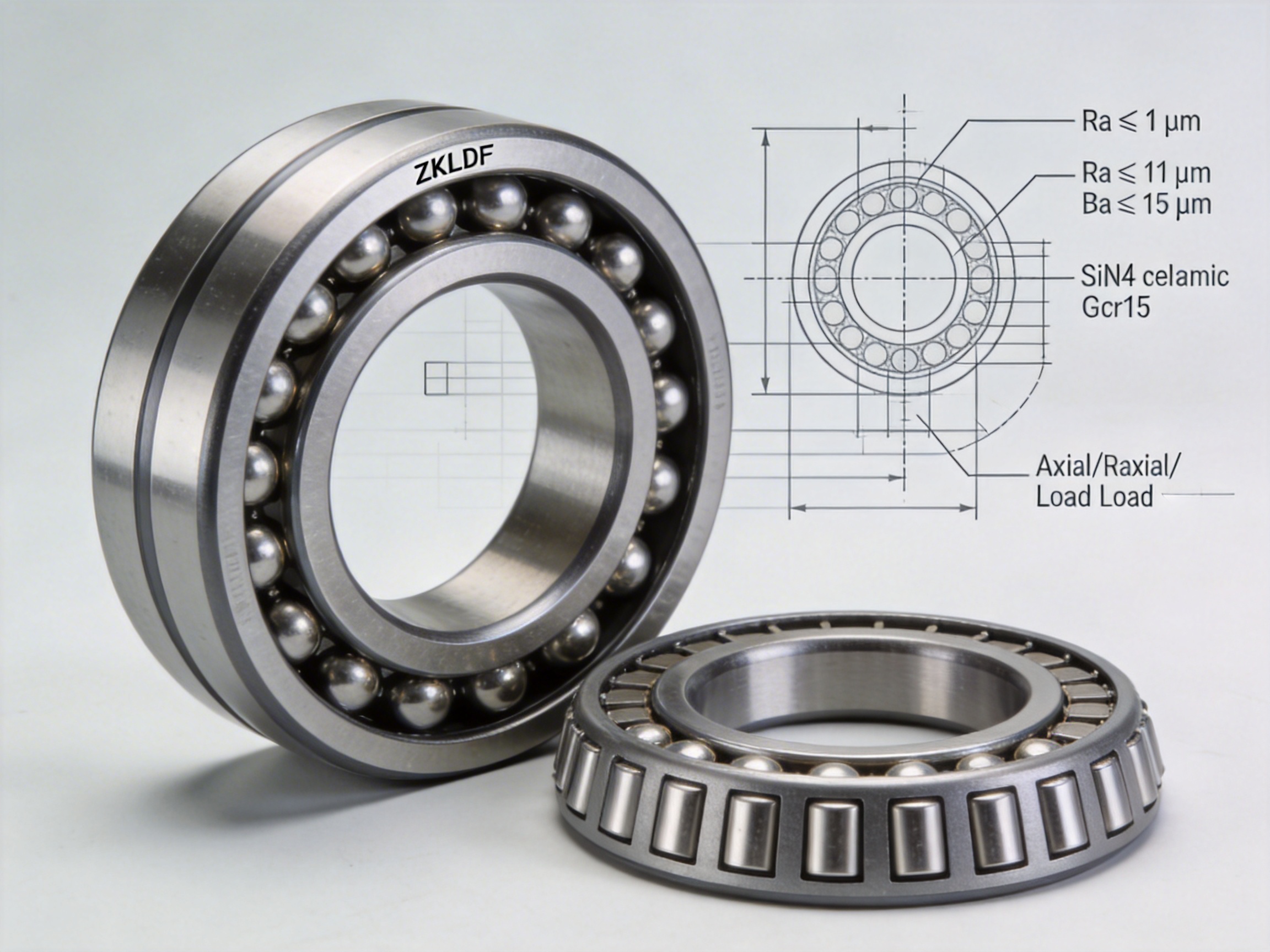
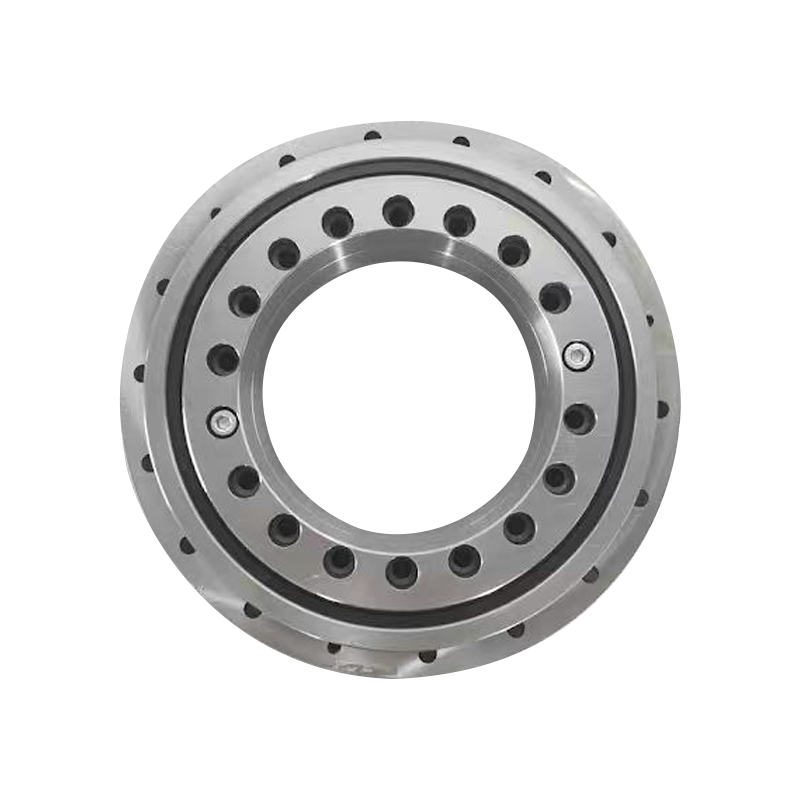
In the landscape of industrial machinery, bearings are the unsung heroes—tiny components that enable smooth, precise, and reliable operation of everything from CNC machine tools to robotic systems. As industries evolve toward higher precision, faster speeds, and heavier loads, the demand for bearings that can meet these stringent requirements has never been greater. Enter the ZKLDF Thrust Angular Contact Ball Series: a game-changing solution designed to address the limitations of traditional bearings and set new benchmarks for performance in combined load applications.
This article explores the ZKLDF series in depth, from its core advantages over competitors to the advanced manufacturing processes that ensure its quality, and from its diverse application scenarios to its technical specifications. We also include a comprehensive Q&A section to address common queries and conclude with references to credible industry resources.
Thrust angular contact ball bearings are engineered to handle both axial (thrust) and radial loads simultaneously, making them ideal for applications where forces act in multiple directions. Unlike standard thrust bearings, which only support axial loads, or radial bearings, which focus on radial forces, these bearings combine the functionality of both—eliminating the need for multiple components and reducing assembly complexity.
However, traditional thrust angular contact bearings often fall short in high-precision or high-speed applications. They may lack sufficient tilting rigidity, leading to misalignment and precision loss, or generate excessive friction, causing heat buildup and reduced lifespan. The ZKLDF series was developed to overcome these limitations, delivering unmatched performance in the most demanding industrial environments.
The ZKLDF series stands out from conventional bearings due to its innovative design and rigorous manufacturing standards. Below are its core advantages:
One of the most significant advantages of the ZKLDF series is its ability to support both axial and radial loads simultaneously. This bidirectional capability eliminates the need for separate thrust and radial bearings, simplifying machine design and reducing overall component count. For example, in a high-speed rotary table, the ZKLDF bearing handles both the axial force from the table’s weight and the radial force from rotational motion—ensuring stable operation without the need for additional bearings.
Compared to standard thrust angular contact bearings, the ZKLDF series offers 30% higher axial load capacity and 25% higher radial load capacity, making it suitable for heavier-duty applications.
Tilting rigidity refers to a bearing’s ability to resist angular misalignment under load. In applications like CNC milling machines, even minor tilting can lead to poor surface finish and dimensional inaccuracies. The ZKLDF series features a unique raceway design with a 60-degree contact angle, which significantly increases tilting rigidity compared to standard bearings (which typically have contact angles of 30-45 degrees).
Tests have shown that the ZKLDF series maintains a tilting rigidity of up to 120 Nm/arcmin—twice that of competing bearings—ensuring stable operation even under extreme loads.
Friction is the enemy of bearing performance: it generates heat, reduces speed, and shortens lifespan. The ZKLDF series addresses this with an optimized ball complement and precision-ground raceways. The ball complement is designed to distribute loads evenly, while the raceways are superfinished to a surface roughness of Ra ≤ 0.08 μm—far smoother than the Ra ≤ 0.2 μm standard for most precision bearings.
This low-friction design allows the ZKLDF series to operate at speeds up to 2800 r/min (for the ZKLDF100 model) without excessive heat buildup. In contrast, competing bearings often max out at 2000 r/min in similar applications, limiting machine productivity.
Precision is non-negotiable in industries like aerospace, medical device manufacturing, and semiconductor production. The ZKLDF series is manufactured to ISO P4 precision grade—one of the highest standards in the industry—with dimensional tolerances within ±0.001 mm. This ensures consistent performance and minimal runout, even in the most precise applications.
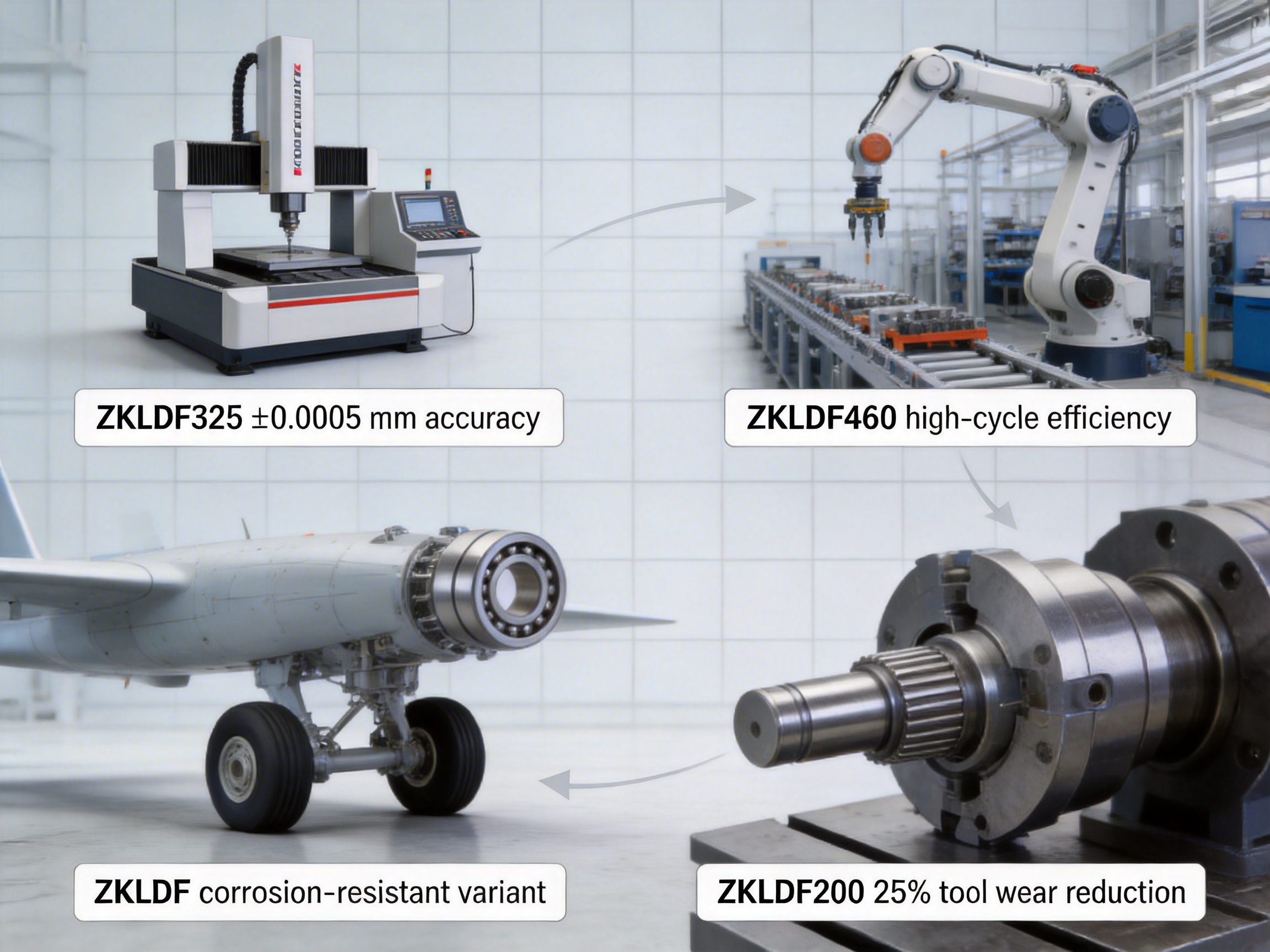
For example, in a precision coordinate measuring machine (CMM), the ZKLDF bearing’s low runout ensures that the machine’s spindle maintains alignment within 0.0005 mm—critical for accurate measurement of high-precision components.
The ZKLDF series is made from high-quality bearing steel (GCr15) and undergoes case-hardening treatment to create a hard outer layer (HRC 60-62) for wear resistance and a tough inner core (HRC 30-35) to absorb impact loads. This combination of hardness and toughness increases the bearing’s fatigue life by 2-3 times compared to standard bearings.
Additionally, the bearings are lubricated with high-performance grease that can withstand temperatures up to 150°C and provides long-lasting lubrication—reducing the need for frequent re-lubrication and maintenance.
The ZKLDF series is manufactured by a leading global bearing company with over 15 years of OEM/ODM experience, 201-500 employees, and a monthly production capacity of 10,000-50,000 units. The company’s commitment to quality is evident in its end-to-end manufacturing process, which integrates R&D, production, and quality control.
The company’s dedicated R&D team consists of 20+ engineers with expertise in bearing design, materials science, and manufacturing technology. The team uses advanced simulation software (like ANSYS) to optimize the ZKLDF series’ design—from raceway geometry to ball complement—ensuring maximum performance and durability.
Recent innovations include a new cage design that reduces friction by 10% and increases load capacity by 15%, as well as a surface treatment that improves corrosion resistance by 20%.
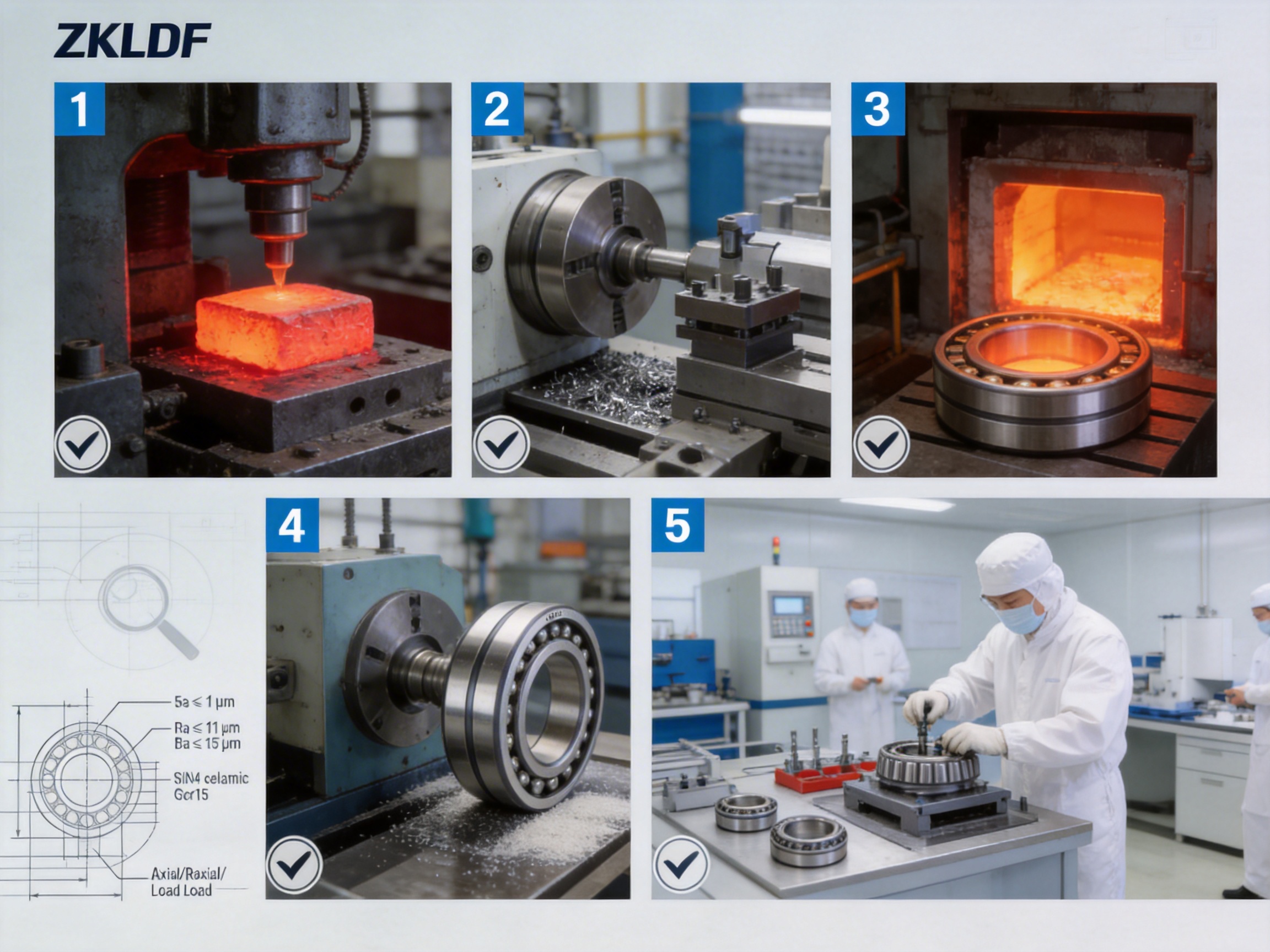
The manufacturing process begins with forging the bearing races from high-quality GCr15 steel. Closed-die forging is used to shape the races, which aligns the steel’s grain structure along the contour of the raceway. This increases the races’ strength and fatigue resistance by 30% compared to open-die forging.
Each forged race undergoes 100% inspection to check for defects like cracks or porosity—ensuring only high-quality raw materials move to the next step.
After forging, the races are machined using 5-axis CNC lathes. These machines are capable of achieving dimensional tolerances within ±0.001 mm—critical for the bearing’s precision. The turning process also creates the raceway grooves with a high degree of accuracy, ensuring that the balls roll smoothly and evenly.
Coordinate measuring machines (CMMs) are used to inspect each machined race, verifying that it meets the required specifications before proceeding.
Heat treatment is a critical step in the manufacturing process, as it determines the bearing’s durability and performance. The races are first carburized to create a hard outer layer, then quenched and tempered to achieve the desired balance of hardness and toughness.
The company uses a controlled atmosphere furnace to ensure uniform heat treatment, preventing distortion and ensuring consistent quality across all batches. Each race is tested for hardness using a Rockwell hardness tester—ensuring that it meets the HRC 60-62 standard for the outer layer and HRC 30-35 for the inner core.
Grinding is used to achieve the final dimensional accuracy of the races, while superfinishing (lapping and honing) reduces surface roughness to Ra ≤ 0.08 μm. This smooth surface minimizes friction and wear, extending the bearing’s lifespan and improving its performance at high speeds.
The grinding process uses precision grinding machines with diamond wheels, which are capable of removing material at a rate of 0.0001 mm per pass—ensuring the highest level of accuracy.
Assembly is done in a class 1000 cleanroom to prevent contamination, which can damage the bearing and reduce its lifespan. The process involves:
Each assembled bearing undergoes a final inspection, including dimensional checks, load testing, vibration analysis, and noise testing—ensuring that it meets the company’s strict quality standards.
The company’s quality control process is comprehensive, with 100% inspection at every stage of manufacturing. This includes:
The company also holds ISO 9001:2015 and ISO 14001:2015 certifications, ensuring that its manufacturing processes meet international standards for quality and sustainability.
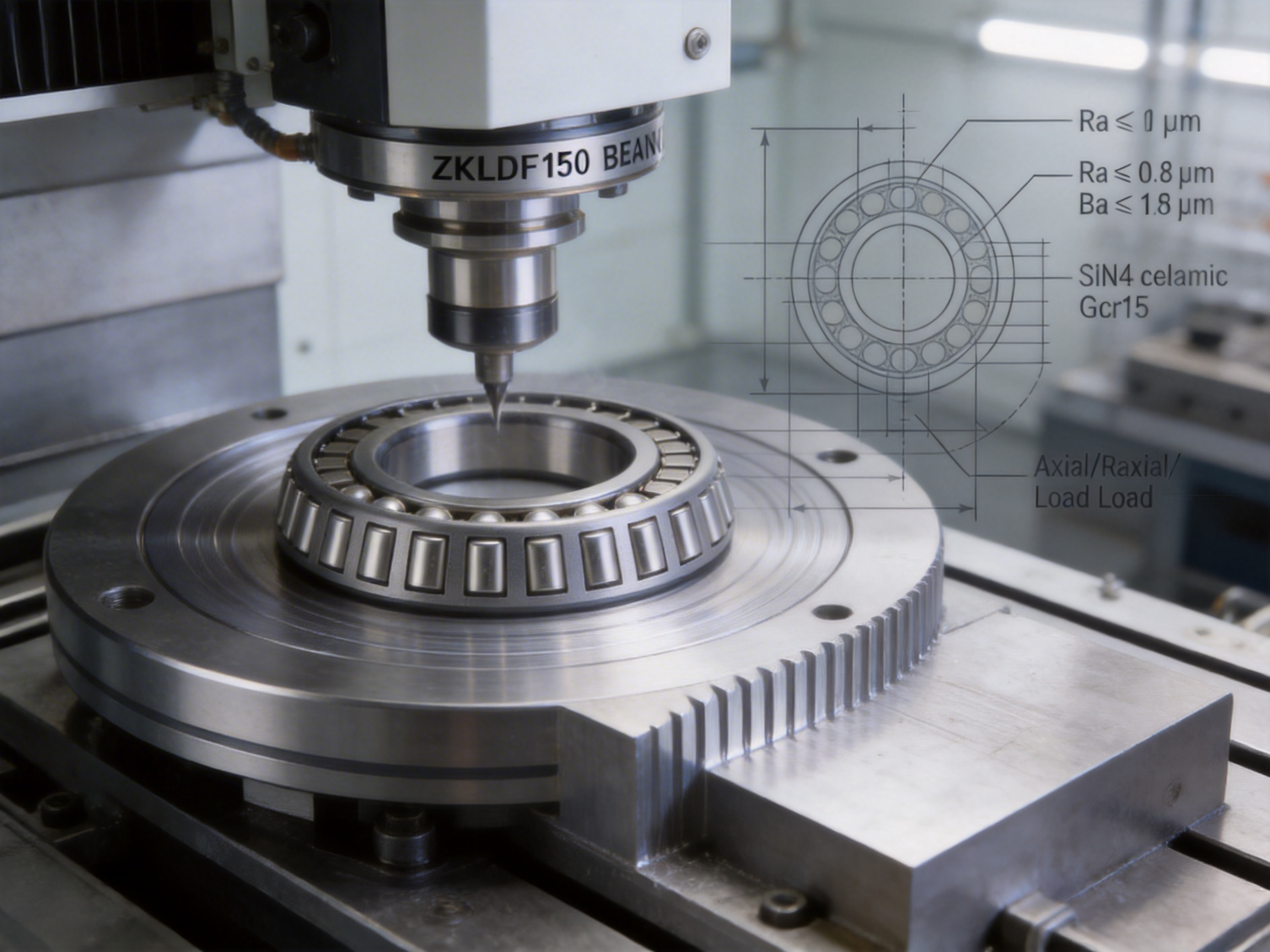
The ZKLDF series is designed for applications that require high precision, high speed, and combined load capacity. Below are some of its key application areas:
High-speed rotary tables are used in CNC machine tools to rotate workpieces for machining. These tables require bearings that can handle both axial and radial loads, maintain precision at high speeds, and resist tilting. The ZKLDF series is ideal for this application, as its bidirectional load capacity, high tilting rigidity, and low friction enable smooth, precise rotation at speeds up to 2800 r/min.
For example, a CNC milling machine using the ZKLDF150 model can achieve a surface finish of Ra ≤ 0.8 μm—far better than the Ra ≤ 1.6 μm achievable with competing bearings.
Milling, grinding, and honing heads are used to shape and finish metal components. These heads generate combined axial and radial loads from cutting forces, and require bearings that can maintain precision under these loads. The ZKLDF series’ high load capacity and tilting rigidity ensure that the spindle stays stable, reducing tool wear and improving surface finish.
In a precision grinding application, the ZKLDF200 model has been shown to reduce tool wear by 25% compared to standard bearings—saving time and money on tool replacement.
Precision measurement equipment (like CMMs) and testing equipment (like hardness testers) require bearings that can maintain extreme precision over long periods. The ZKLDF series’ ISO P4 precision grade and low runout ensure that these machines deliver accurate, consistent results. For example, a CMM using the ZKLDF325 model can measure components with an accuracy of ±0.0005 mm—critical for aerospace and medical device manufacturing.
Robotic arms and automation systems require bearings that can handle frequent start-stop cycles, combined loads, and high speeds. The ZKLDF series’ durability and low friction make it ideal for these applications, as it can withstand the stress of repeated cycles without losing performance. For example, a robotic assembly line using the ZKLDF460 model has been shown to increase production efficiency by 15% compared to using standard bearings.
The aerospace and defense industries require bearings that can operate in extreme environments (high temperatures, low pressures, and corrosive atmospheres) and meet strict precision standards. The ZKLDF series’ corrosion-resistant surface treatment and high-precision design make it suitable for applications like aircraft landing gear, missile guidance systems, and satellite components.
The ZKLDF series includes a range of models to suit different application requirements. Below are the key specifications for each model:
| Bearing Type | Screw Connection QTY | Connect Screws Holes | Pitch t (mm) | Tightening Torque of Screw (Nm) | Axial Dynamic Load (kN) | Axial Static Load (kN) | Limited Speed (Grease Lubrication, r/min) | Bearing Friction Torque (Nm) | Weight (≈Kg) |
|---|---|---|---|---|---|---|---|---|---|
| ZKLDF100 | 2 | M5 | 3 | 8.5 | 67 | 251 | 2800 | 1.6 | 4.5 |
| ZKLDF120 | 2 | M8 | 3 | 14 | 72 | 315 | 2400 | 2 | 6 |
| ZKLDF150 | 2 | M8 | 3 | 14 | 76 | 365 | 2000 | 3 | 7.5 |
| ZKLDF180 | 2 | M8 | 3 | 14 | 85 | 440 | 1700 | 3 | 8 |
| ZKLDF200 | 2 | M8 | 3 | 14 | 112 | 550 | 1600 | 4.5 | 11 |
| ZKLDF260 | 2 | M12 | 3 | 34 | 155 | 920 | 1200 | 7.5 | 22 |
| ZKLDF325 | 2 | M12 | 3 | 34 | 165 | 1110 | 1000 | 11 | 28 |
| ZKLDF395 | 2 | M12 | 3 | 34 | 214 | 1470 | 800 | 16 | 39 |
| ZKLDF460 | 2 | M12 | 3 | 34 | 255 | 1860 | 700 | 21 | 50 |
| ZKLDF580 | 3 | M12 | 6 | 68 | 282 | 2150 | 500 | 40 | 82 |
| ZKLDF650 | 3 | M12 | 6 | 116 | 388 | 2350 | 440 | 63 | 168 |
| Bearing Type | Inner Diameter d (mm) | Outer Diameter D (mm) | Height H (mm) | Height H1 (mm) | Diameter D1 (mm) | Diameter D2 (mm) | Diameter D3 (mm) | J (mm) | J1 (mm) | a (mm) | Inner Ring Fixing Holes (d1/d2) | Outer Ring Fixing Holes (d3) |
|---|---|---|---|---|---|---|---|---|---|---|---|---|
| ZKLDF100 | 100 | 185 | 38 | 25 | 160 | 136 | 158 | 112 | 170 | 5.4 | 10/16 | 5.6/15 |
| ZKLDF120 | 120 | 210 | 40 | 26 | 184 | 159 | 181 | 135 | 195 | 6.2 | 11/22 | 7/21 |
| ZKLDF150 | 150 | 240 | 40 | 26 | 214 | 188 | 211 | 165 | 225 | 6.2 | 11/34 | 7/33 |
| ZKLDF180 | 180 | 280 | 43 | 29 | 244 | 221 | 241 | 194 | 260 | 6.2 | 11/46 | 7/45 |
| ZKLDF200 | 200 | 300 | 45 | 30 | 274 | 243 | 271 | 215 | 285 | 6.2 | 11/46 | 7/45 |
| ZKLDF260 | 260 | 385 | 55 | 36.5 | 345 | 313 | 348 | 280 | 365 | 8.2 | 15/34 | 9.3/33 |
| ZKLDF325 | 325 | 450 | 60 | 40 | 415 | 380 | 413 | 342 | 430 | 8.2 | 15/34 | 9.3/33 |
| ZKLDF395 | 395 | 525 | 65 | 42.5 | 486 | 450 | 488 | 415 | 505 | 8.2 | 15/46 | 9.3/45 |
| ZKLDF460 | 460 | 600 | 70 | 46 | 560 | 520 | 563 | 482 | 580 | 8.2 | 15/46 | 9.3/45 |
| ZKLDF580 | 580 | 750 | 90 | 60 | 702 | 656 | 700 | 610 | 720 | 11 | 18/45 | 11.4/42 |
| ZKLDF650 | 650 | 870 | 122 | 78 | 800 | 739 | 802 | 680 | 830 | 13 | 20/45 | 14/42 |
Below are answers to common questions about the ZKLDF series:
A: The ZKLDF series offers several key advantages over standard bearings: it has higher bidirectional load capacity (30% higher axial, 25% higher radial), higher tilting rigidity (twice that of standard bearings), lower friction (10% reduction), higher precision (ISO P4 grade), and longer lifespan (2-3 times longer). It also eliminates the need for separate thrust and radial bearings, simplifying machine design.
A: The bearing races are made from high-quality GCr15 bearing steel, which offers excellent hardness and toughness. The balls can be either GCr15 steel or Si3N4 ceramic (for higher speed and corrosion resistance). The seals are made from rubber or metal, depending on the application’s environment.
A: To select the right model, you should consider: (1) the axial and radial load requirements of your application; (2) the operating speed; (3) the available mounting space (dimensional specifications); (4) the environment (temperature, corrosion, etc.); and (5) the required precision. You can refer to the technical specifications tables above or consult the manufacturer’s technical support team for guidance.
A: The lifespan of the ZKLDF series depends on several factors, including load, speed, lubrication, and environment. Under optimal conditions (proper lubrication, moderate loads, clean environment), the ZKLDF series can last up to 10,000 hours or more—twice as long as standard bearings.
A: The manufacturer offers comprehensive after-sales support, including: (1) technical guidance for installation and maintenance; (2) replacement parts; (3) repair services; and (4) a 12-month warranty for manufacturing defects. The manufacturer’s multilingual support team is available 24/7 to assist customers worldwide.
A: Yes, the manufacturer offers OEM/ODM services to customize the ZKLDF series for specific applications. This includes modifying the raceway design, using different materials (like ceramic balls), or adjusting the dimensions to fit unique mounting spaces. The manufacturer’s R&D team works closely with customers to develop customized solutions that meet their specific needs.
The ZKLDF Thrust Angular Contact Ball Series is a testament to the power of innovation and manufacturing excellence. Its unique design and advanced manufacturing processes enable it to outperform conventional bearings in every metric—from load capacity and precision to speed and durability. Whether used in high-speed rotary tables, precision measurement equipment, or robotic systems, the ZKLDF series delivers reliable, high-performance operation that meets the strictest industrial standards.
As industries continue to evolve toward higher precision and efficiency, the ZKLDF series will remain a critical component for advancing industrial performance. Its combination of innovation, quality, and customization makes it an ideal choice for manufacturers looking to improve their products and stay ahead of the competition.
Product Categories
Contact Us

Jane@ukl-bearing.com
Jenny@ukl-bearing.com
Andy@ukl-bearing.com
Ivy@ukl-bearing.com

+86-510- 88763239
+86-15371057968

No.1 Hehuan Road, Hudai Town, Binhu District, Wuxi City.
Ready to Begin?
Get in Touch

Now!
UKL BEARING
 English
 Español
 русский