Content
Modern robots require more than a motor and a gearbox. Every articulated joint depends on a bearing system capable of supporting radial loads, axial forces, overturning moments, repeated acceleration, and precise positioning at the same time. In harmonic drive applications, the bearing is especially important because the reducer must remain compact while delivering high torque, low backlash, smooth rotation, and dependable accuracy over a long operating life.
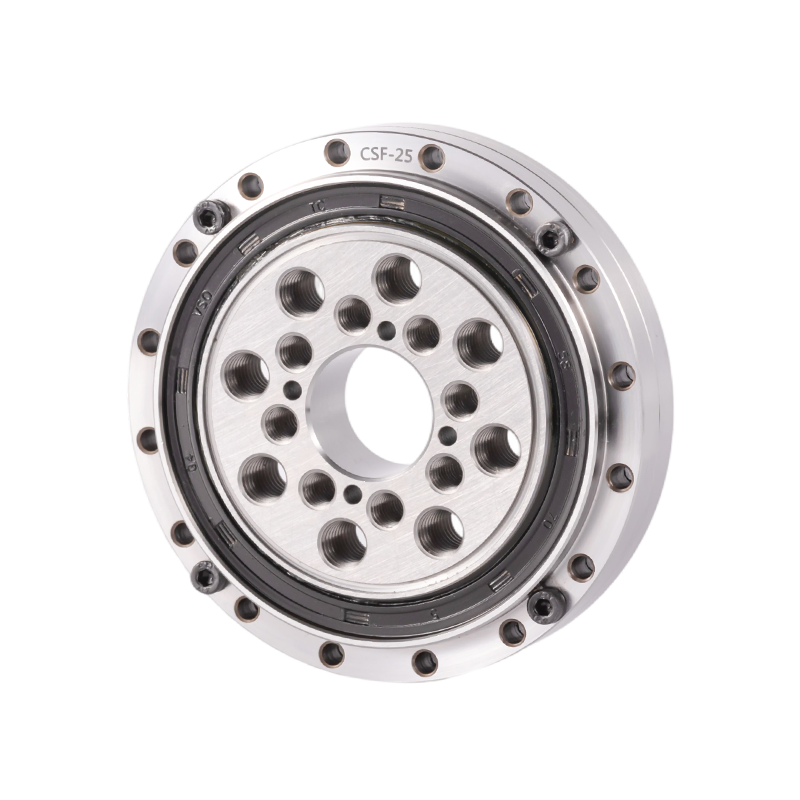
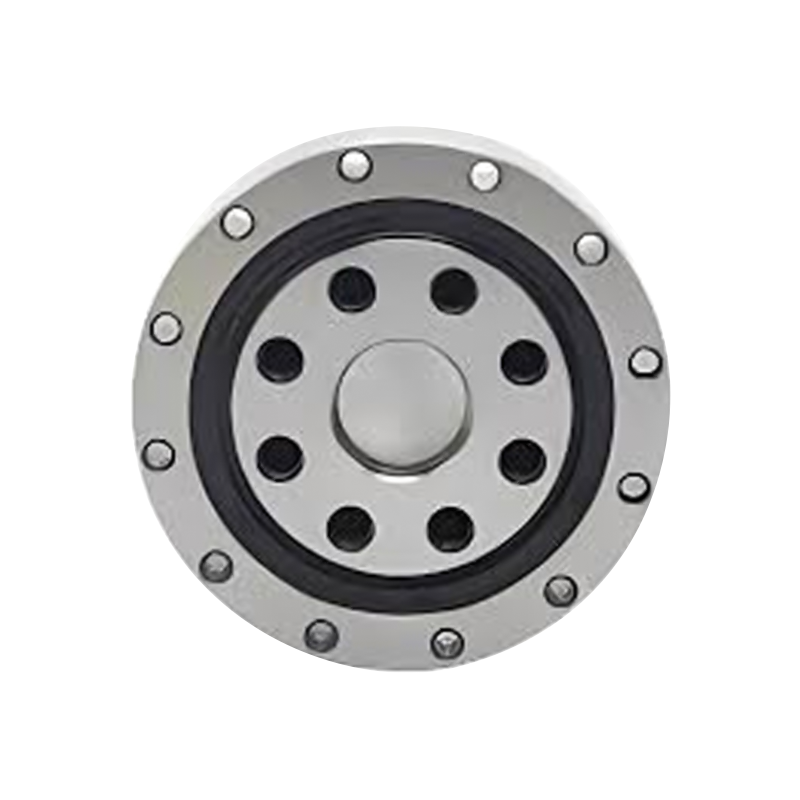
The CSD harmonic reducer bearing is developed for this demanding environment. It uses an integrated one-piece outer ring and inner ring structure, allowing the bearing to provide a rigid and compact support arrangement for the output section of CSD-series harmonic reducers. Its outer diameter is equivalent to the corresponding CSG type, while its structural strength is higher than that of the CSG type. This combination gives designers an efficient way to improve load capacity and rigidity without increasing the external envelope of the reducer.
Manufactured by UKL Bearing Manufacturing Co., Ltd., the CSD bearing range is intended for robotics, automation, aerospace equipment, medical systems, CNC machinery, and other high-precision motion-control applications. Available models include CSD-14, CSD-17, CSD-20, CSD-25, CSD-32, CSD-40, and CSD-50. These models cover a broad range of compact reducer sizes and provide different bore dimensions, mounting patterns, load ratings, and weights.
This article explains the construction, operating benefits, manufacturing strengths, selection considerations, installation requirements, and typical applications of CSD harmonic reducer bearings. It also compares the practical advantages of the integrated design with more conventional bearing arrangements and provides a reference selection table for engineers, purchasing teams, and equipment manufacturers.
CSD Robot Harmonic Reducers Bearing
A harmonic reducer converts high-speed motor rotation into lower-speed, higher-torque output motion. The mechanism typically includes a wave generator, a flexible spline, and a circular spline. These elements work together through controlled elastic deformation and tooth engagement. The design can achieve a high reduction ratio in a relatively small package, making it suitable for robot joints and precision automation axes.
Although the gear elements receive most of the attention, the bearing supporting the reducer output is equally important. The bearing must maintain the concentric relationship between the reducer components while allowing the output section to rotate smoothly. It also needs to resist forces generated by the robot arm, payload, acceleration, deceleration, and external contact.
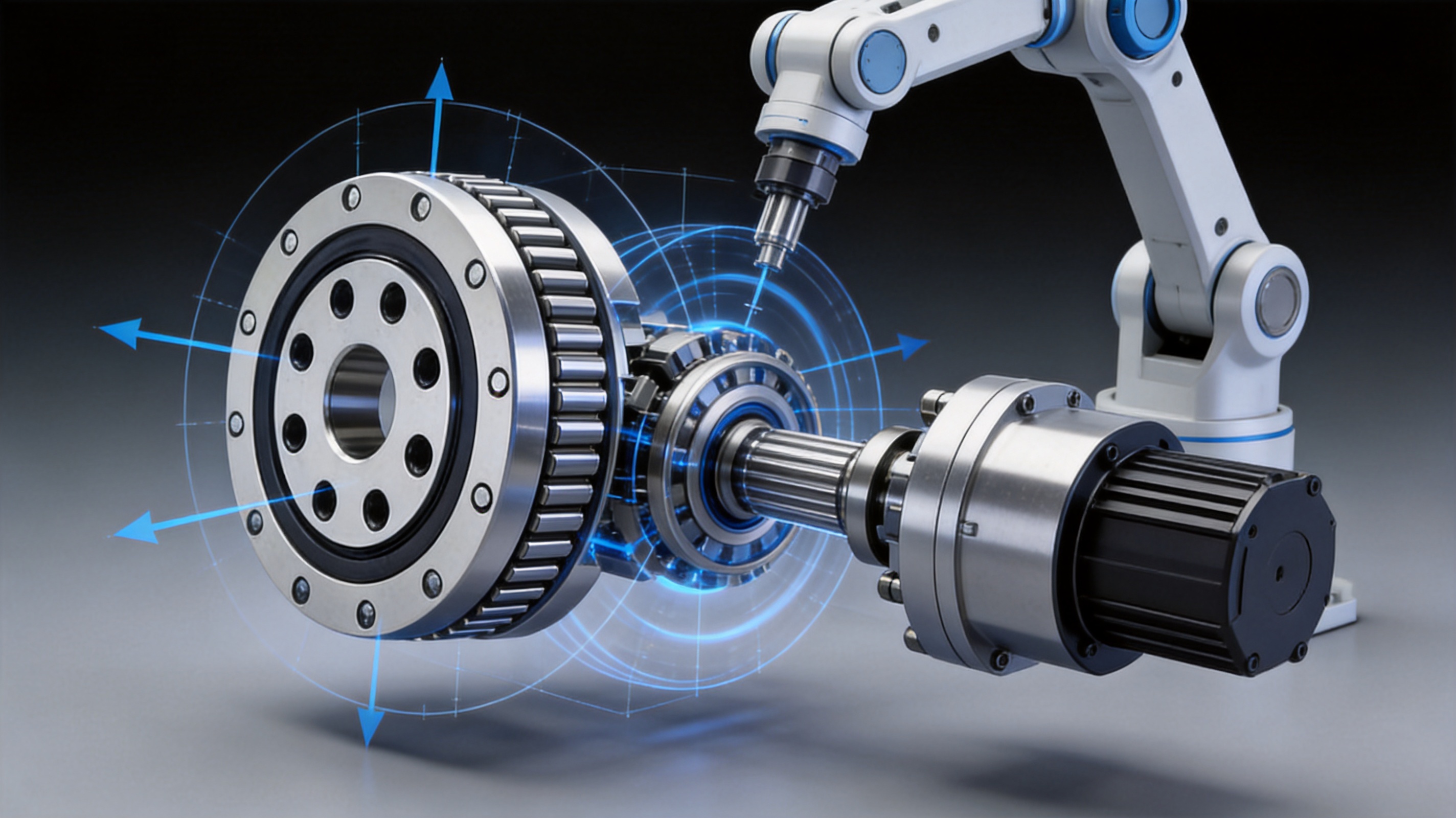
In a robotic joint, the output bearing may be exposed to combined loading rather than a single simple radial load. For example, a vertical robot arm can generate radial loading from its payload, axial loading from the joint arrangement, and moment loading because the payload is positioned away from the bearing centerline. A bearing that is adequate for pure rotation may not be adequate for this combined load environment.
Accuracy is another central requirement. Any clearance, deformation, misalignment, or uneven preload in the bearing can influence the final position of the robot end effector. When several joints are combined, small angular errors may accumulate. A bearing intended for harmonic reducer output support must therefore contribute to rigidity, smoothness, repeatability, and resistance to unwanted displacement.
The CSD type is designed around these operating conditions. Its integrated ring construction reduces the number of separate structural components and creates a direct support interface between the bearing and the reducer housing or output assembly. The result is a bearing arrangement that is compact, rigid, and convenient for equipment designers who need to optimize the complete joint rather than select an isolated rolling element.
The defining feature of the CSD type is that both its outer ring and inner ring use an integrated one-piece structure. Instead of relying on several separate ring sections joined in a more complex assembly, the CSD bearing presents a unified component design. This arrangement is particularly useful in compact reducers where available installation space is limited and where the output bearing must carry significant moment loads.
A one-piece ring structure can improve the continuity of the load path. When the bearing is mounted, forces are transferred through the ring and into the surrounding reducer components. Fewer structural interfaces can help reduce local movement and simplify the mechanical relationship between the bearing, housing, and output flange.
The integrated design also helps reduce assembly complexity. A conventional arrangement may require multiple bearing components, spacers, retaining elements, or carefully controlled adjustment procedures. Each additional part introduces another tolerance, contact surface, or potential assembly variable. The CSD type consolidates the principal bearing structure, allowing the reducer manufacturer to design a more direct mounting arrangement.
Another important benefit is improved use of space. In robot joints, every millimeter can affect the overall arm size, cable routing, motor selection, and payload capacity. The CSD type maintains the same outer diameter as the CSG type while offering greater structural strength than CSG type components. This means that the designer can pursue a stronger output-support solution without automatically increasing the external diameter of the reducer.
The one-piece structure should not be viewed only as a dimensional advantage. It also supports system-level rigidity. A compact bearing with a stable ring structure helps control deflection under moment loads. Reduced deflection can contribute to more consistent positioning, particularly when the robot repeatedly changes direction or handles a load at a long reach.
For reducer designers, the integrated rings provide a simpler foundation for the output section. The bearing can be incorporated into the reducer architecture with dedicated mounting holes on both the outer and inner rings. The resulting design supports direct fastening and can reduce the need for additional support hardware.
The CSD range also allows the same general design concept to be applied across several reducer sizes. This helps simplify product development, assembly procedures, spare-parts planning, and maintenance documentation. Engineers can select a model based on the required dimensions and load ratings while keeping a familiar mounting principle across the product family.
Equipment manufacturers benefit from a component that can be integrated into a finished joint with fewer separate parts. A simpler bearing arrangement may reduce assembly time and lower the risk of incorrect component orientation. It can also make inspection easier because the mounting interfaces and fastener patterns are clearly defined.
For robot manufacturers, a compact output bearing can help reduce joint diameter and total joint mass. Lower joint mass may reduce the torque required from the motor and may improve acceleration response. In a multi-axis robot, reducing mass at one joint can influence the load requirements of the upstream axes as well.
Compactness is one of the principal advantages of harmonic drive technology. The reducer, motor, encoder, brake, cables, seals, and bearing must all fit within a tightly controlled joint envelope. A bearing that occupies excessive radial or axial space can force a larger housing, reduce available room for other components, or limit the final payload-to-weight ratio of the robot.
The CSD bearing is developed specifically for this type of constrained installation. Its design combines the bearing raceway structure and mounting interfaces in a format intended for harmonic reducer output sections. The CSD-14, for example, has an outer diameter of 55 mm, while the largest listed CSD-50 model has an outer diameter of 157 mm. This range allows the same product family to serve small, medium, and larger precision joints.
Compact design does not mean simply reducing the amount of material. A bearing must retain sufficient cross-sectional strength to carry operating loads without excessive deformation. The CSD construction aims to balance envelope size, ring strength, load capacity, and mounting stability. This balance is valuable for robot joints because a smaller bearing is not useful if it causes unacceptable flexure or premature wear.
Compared with a less integrated competitor arrangement, the CSD type may reduce the need for separate support rings, intermediate flanges, or additional structural parts. The actual space savings will depend on the reducer design and the chosen mounting method, but the integrated format gives engineers more freedom to optimize the complete assembly.
Space efficiency is also important in medical and laboratory automation. Devices used near patients or within clean work areas often require smooth, enclosed, and compact motion modules. A smaller bearing-support arrangement can help equipment manufacturers create lighter covers, more accessible service panels, and cleaner cable routes.
The CSD type is described as having a higher strength than CSG type components while maintaining the same outer diameter. This is a significant design advantage when the reducer must resist external moment loads. A robot joint may experience a high overturning moment even when its rotational speed is relatively low, especially when the payload is extended away from the joint axis.
The listed basic dynamic load ratings range from 4.7 kN for the CSD-14 to 34.8 kN for the CSD-50. The listed basic static load ratings range from 6.7 kN to 60.2 kN across the same series. These ratings provide a preliminary basis for model selection, but they should not be treated as a substitute for a complete bearing-life calculation. Actual service performance depends on speed, load direction, moment loading, lubrication, temperature, mounting accuracy, duty cycle, and operating environment.
Greater structural strength can help the bearing maintain its geometry under load. Stable geometry supports consistent raceway contact and helps prevent changes in internal clearance that could affect running accuracy. This is particularly important in harmonic reducers, where the gear mechanism and output support must remain closely aligned.
Rigidity also affects the perceived quality of robot motion. If the output bearing deflects significantly during acceleration, the robot may exhibit settling time, overshoot, or small positional changes after a command is completed. A stronger bearing arrangement can contribute to shorter settling times and improved repeatability, provided that the reducer, motor control system, mounting frame, and payload are also properly designed.
Output bearings in robotic joints are exposed to radial and axial forces. The direction and magnitude of these forces vary according to the robot posture and the payload location. Engineers should calculate the combined load rather than selecting a bearing solely according to radial capacity.
The bearing’s mounting flange and fastener arrangement are also important. Even a strong rolling-element bearing can perform poorly if the surrounding housing is too flexible or if the bolts are incorrectly tightened. The support structure should be sufficiently rigid, and the mounting surfaces should be clean, flat, and accurately machined.
Moment loading is often a defining factor in robot applications. A payload mounted several hundred millimeters from the joint axis can generate a substantial overturning moment. The bearing must distribute this moment through its raceways and mounting interfaces without excessive angular displacement.
The CSD’s relatively broad bearing structure and dedicated ring mounting holes are intended to support this type of output arrangement. For final selection, designers should provide the manufacturer with the radial load, axial load, moment load, speed, duty cycle, and expected service life. This information allows the selected bearing to be evaluated under realistic conditions rather than under a simplified laboratory load.
Harmonic reducers are selected for precision motion because they can provide high reduction ratios and very low transmission backlash. However, the bearing system must support this precision. If the output bearing has excessive clearance, uneven preload, insufficient rigidity, or mounting distortion, the overall reducer may not achieve the positioning performance expected from its gear mechanism.
The CSD bearing is manufactured for high-precision motion-control systems. Its design supports a stable relationship between the inner and outer rings, helping the output section maintain accurate rotation. Precision manufacturing of the raceways and rolling elements is essential because small geometric errors can create vibration, torque variation, or uneven load distribution.
Reduced backlash in the complete reducer is not created by the bearing alone. Backlash is primarily associated with the gear engagement and reducer adjustment. Nevertheless, a rigid, accurately mounted bearing helps prevent additional mechanical play from entering the output assembly. In this way, the bearing contributes to the preservation of the reducer’s intended positioning accuracy.
For high-precision applications, the mounting process should be controlled as carefully as the bearing manufacturing process. The housing and output flange must be concentric, mounting surfaces must be free from burrs, and fasteners should be tightened in a controlled sequence. Incorrect installation can distort the bearing rings and produce running resistance even when the bearing itself has been manufactured correctly.
The CSD design is therefore best understood as part of a precision system. Its advantages are realized when it is combined with an accurately machined reducer, appropriate lubrication, correct preload or clearance, reliable sealing, and a properly tuned servo control system.
The CSD series includes seven listed models. The models differ in bore-related dimensions, overall diameter, height, mounting hole patterns, load ratings, and weight. The following table summarizes the principal data supplied for the product range.
| Model | D1 (mm) | D2 (mm) | D (mm) | H (mm) | C (mm) | B (mm) | H2 (mm) | CR (kN) | COR (kN) | Weight (kg) |
|---|---|---|---|---|---|---|---|---|---|---|
| CSD-14 | 12 | 11 | 55 | 16.6 | 16.1 | 13.9 | 2.7 | 4.7 | 6.7 | 0.24 |
| CSD-17 | 14 | 11 | 62 | 16.6 | 16.1 | 13.9 | 2.7 | 5.3 | 7.5 | 0.30 |
| CSD-20 | 18 | 16 | 70 | 18.3 | 17.8 | 15.6 | 2.7 | 5.8 | 9.0 | 0.42 |
| CSD-25 | 24 | 20 | 85 | 23.4 | 22.9 | 20.0 | 3.4 | 9.6 | 15.1 | 0.80 |
| CSD-32 | 32 | 30 | 112 | 24.5 | 23.5 | 20.9 | 3.6 | 15.0 | 25.0 | 1.40 |
| CSD-40 | 36 | 32 | 126 | 29.1 | 28.1 | 24.6 | 4.5 | 21.3 | 36.5 | 2.10 |
| CSD-50 | 48 | 44 | 157 | 34.0 | 33.0 | 29.4 | 4.6 | 34.8 | 60.2 | 3.80 |
In the table, CR represents the basic dynamic load rating and COR represents the basic static load rating. The dimensional designations should be checked against the latest technical drawing before production release because a catalog may use individual symbols differently depending on the drawing convention. The supplied product information also includes separate dimensions for seal-front and seal-reverse configurations.
The CSD-14 and CSD-17 models are suitable for smaller compact joints where low mass and a reduced outer diameter are priorities. The CSD-20 and CSD-25 models provide an intermediate solution for many compact automation mechanisms. The CSD-32, CSD-40, and CSD-50 models offer higher load ratings and larger mounting interfaces for robot joints, industrial positioning systems, and heavier output assemblies.
Model selection should begin with the required output diameter and available installation envelope. The engineer should then verify the bore, axial height, mounting hole pattern, load ratings, shaft or flange arrangement, and total bearing mass. The final choice should also consider the reducer’s nominal torque, peak torque, rated speed, acceleration profile, and expected operating life.
Each CSD model includes mounting holes on the outer and inner rings. The product data identifies different pitch-circle diameters and threaded-hole quantities for the two ring interfaces. For example, the CSD-14 includes an outer-ring pattern with six holes of 3.5 mm diameter and additional threaded-hole configurations, while the CSD-50 includes a larger pattern with twenty-two holes of 6.6 mm diameter and multiple threaded interfaces.
These mounting patterns allow the bearing to be attached directly to the surrounding structure. Direct fastening can improve assembly repeatability and reduce the number of adapters required. Nevertheless, the mating components must be designed to match the exact pitch-circle diameter, hole count, thread size, thread depth, and sealing arrangement of the selected model.
Designers should avoid treating the mounting holes as a substitute for a correctly fitted locating diameter. Fasteners provide clamping force, but accurate concentricity generally depends on properly designed locating surfaces or pilot diameters. A combination of precision locating features and controlled fastener tightening is recommended for high-accuracy equipment.
Many precision reducers use bearing arrangements made from separate rings, flanges, cross-roller components, or multiple angular-contact bearings. Each solution can be appropriate for a particular application, but the CSD type offers several practical advantages when the reducer is designed around its integrated structure.
The CSD type maintains the outer diameter of the CSG type while providing higher strength than CSG type components. For a robot manufacturer, this can be more valuable than simply increasing the bearing size. A larger outer diameter may require a larger joint housing, a larger cover, additional material, and a higher motor torque requirement. Improving strength without expanding the envelope helps preserve compactness.
An integrated inner ring and outer ring reduce the number of major interfaces in the bearing support. Fewer interfaces can simplify tolerance management and reduce opportunities for assembly error. In comparison, a multi-part arrangement may require careful coordination between separate rings, spacers, retaining plates, and adjustment elements.
The CSD bearing is designed for the output section of CSD-series harmonic reducers rather than being a generic bearing selected without regard to the reducer architecture. Its mounting-hole arrangements and compact geometry support direct integration into the reducer design. This can shorten mechanical design cycles and simplify the creation of standardized joint modules.
The product range includes lightweight models, with the CSD-14 weighing approximately 0.24 kg and the CSD-17 approximately 0.30 kg. Keeping the bearing and support structure compact can help reduce moving mass. Lower mass is valuable in articulated robots because it may improve acceleration, reduce energy consumption, and decrease the load transferred to upstream joints.
The bearing does not independently create a zero-backlash reducer, but its precision and rigidity help the harmonic drive maintain its designed motion characteristics. A stable output support can reduce unwanted movement that would otherwise be added to the gear mechanism’s transmission error.
A product family covering seven sizes gives equipment manufacturers more options than a single standard bearing. The range allows designers to match the bearing to the required output diameter, torque class, payload, and mechanical envelope. It also supports platform standardization across different robot models.
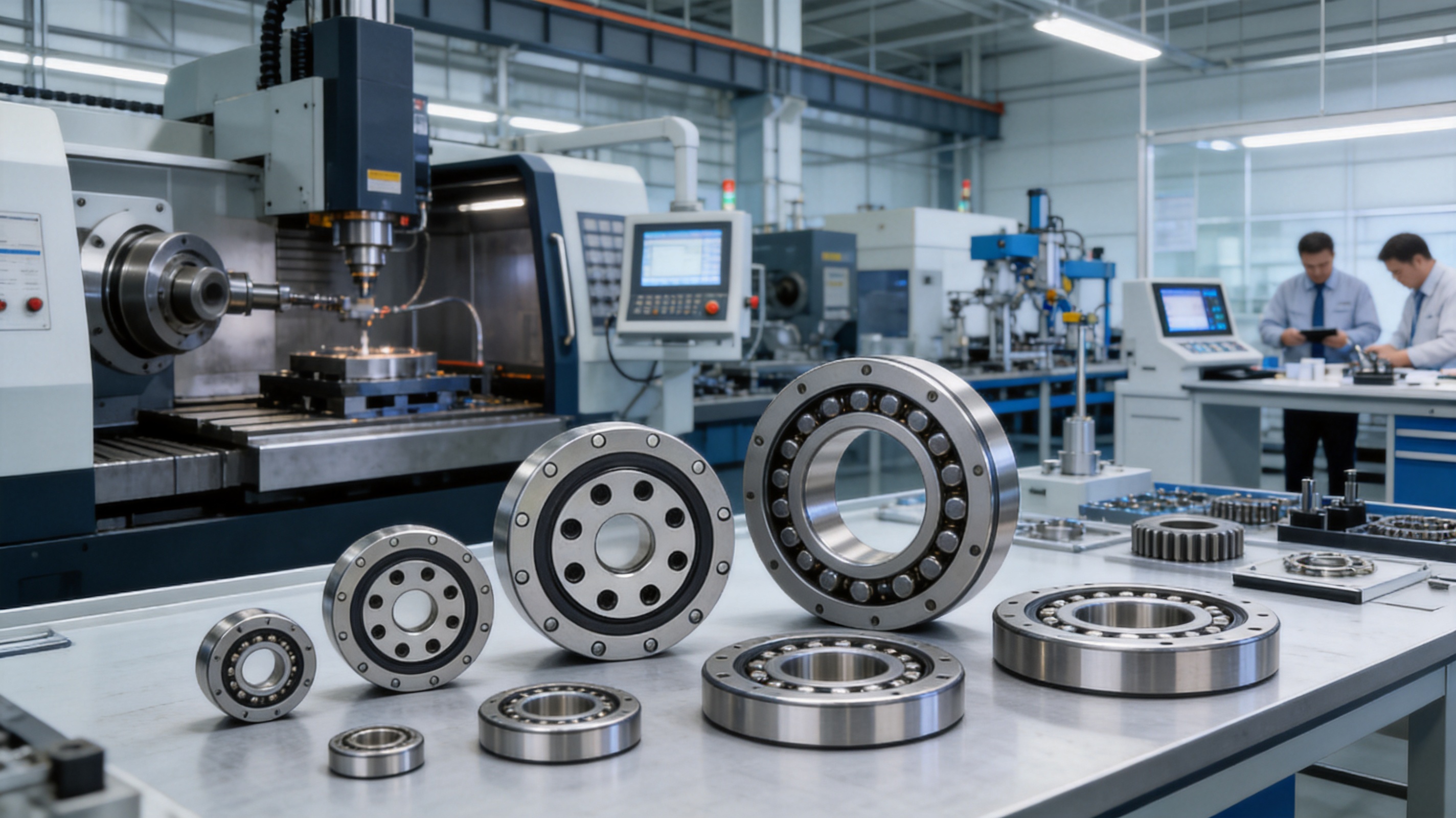
UKL Bearing Manufacturing Co., Ltd. integrates research and development, production, and international distribution. The company operates a modernized factory with production lines covering forging, turning, heat treatment, grinding, assembly, and packaging. This integrated process is important because bearing quality depends on the control of every stage rather than on final inspection alone.
Forging creates the initial ring blank and establishes a favorable material structure for later machining. Proper forging control can improve material consistency and reduce the risk of internal defects. The quality of the blank influences subsequent turning, heat treatment, grinding, and final dimensional stability.
Material preparation should include appropriate process control for composition, cleanliness, grain flow, and dimensional allowance. For precision bearings, the ring blank must provide sufficient and uniform machining stock so that the finished raceway can be produced accurately without excessive local variation.
Turning establishes the main geometry of the inner and outer rings, including diameters, shoulders, mounting surfaces, and other reference features. Consistent turning is essential for efficient downstream grinding and for maintaining a stable relationship between the bearing raceways and mounting interfaces.
For integrated CSD rings, turning accuracy is particularly important because the ring contains both bearing geometry and mounting features. Any error in a locating surface or flange dimension can influence installation concentricity and output rotation. Modern digital production control helps monitor process variation and supports repeatable production across different batches.
Heat treatment gives bearing rings the hardness and structural properties required for rolling contact. The process must balance hardness, toughness, dimensional stability, and resistance to fatigue. Inadequate heat treatment can shorten service life, while excessive distortion can create difficult grinding and assembly problems.
A controlled heat-treatment process generally includes carefully managed heating, soaking, quenching, tempering, and, where necessary, stabilization operations. The exact process depends on the bearing material and product specification. Consistent process records and inspection help ensure that each production batch meets the intended mechanical requirements.
Grinding is one of the most important operations in bearing manufacture. The raceways must achieve accurate geometry, controlled surface finish, and a smooth transition between functional surfaces. Grinding quality influences friction, noise, vibration, load distribution, and service life.
For CSD harmonic reducer bearings, precision grinding supports the accurate rotation required in robotics and automation. The inner and outer rings must be finished so that the rolling elements move smoothly under load. Surface defects, waviness, excessive roughness, or incorrect raceway geometry can cause torque variation and premature fatigue.
Assembly brings together the rings, rolling elements, seals, retainers, and other components. Cleanliness is critical because small particles can create noise, damage raceways, increase friction, or accelerate wear. Controlled assembly procedures help preserve the quality achieved during machining and grinding.
Inspection may include dimensional measurement, rotational testing, noise and vibration checks, runout evaluation, seal inspection, and visual verification of mounting holes. For precision reducer bearings, inspection should also confirm that the product is correctly identified, protected against contamination, and packaged for safe transport.
UKL reports a production capacity of approximately 10,000 to 50,000 units per month and serves customers in multiple international markets, including the United States, Italy, Germany, Poland, South Africa, Egypt, and India. International distribution requires reliable packaging, traceability, documentation, and communication between the factory and the customer.
For OEM projects, production consistency is as important as individual product performance. A stable manufacturing process helps customers plan inventory, standardize replacement parts, and maintain uniform performance across multiple machine builds.
UKL maintains a dedicated research and development team focused on high-precision bearing solutions. Its development activities include cross roller bearings, dual-direction thrust angular contact ball bearings, and other products used in CNC machines, robotics, and intelligent automation systems.
This product knowledge is relevant to the CSD bearing because harmonic reducer applications often require more than a catalog part. The bearing must be evaluated as part of a joint module, with consideration given to mounting structure, reducer geometry, lubrication, sealing, motor inertia, encoder installation, and service conditions.
An experienced engineering team can assist customers with model selection, dimensional confirmation, custom requirements, and application analysis. Such support is especially useful for OEM customers developing a new robot platform or replacing an imported bearing with an equivalent or customized solution.
Customization may involve dimensions, mounting interfaces, sealing arrangements, materials, preload, lubrication, packaging, or production quantities. Any customized specification should be confirmed through a formal drawing and technical approval process before mass production. This protects both the customer and the manufacturer from misunderstandings regarding tolerances and performance requirements.
Industrial robots use harmonic reducers in articulated joints, wrist assemblies, and compact positioning axes. The CSD bearing is suitable for applications where the joint must combine high torque density, low backlash, small dimensions, and strong resistance to moment loads.
Typical examples include six-axis robots, collaborative robots, assembly robots, welding systems, palletizing equipment, and precision handling systems. The bearing can support the output side of the reducer while helping the joint maintain stable and repeatable motion.
Collaborative robots are designed to work near people and often prioritize compact size, low weight, low noise, and controlled force. A compact and lightweight output bearing can contribute to a smaller joint module. Smooth bearing rotation also helps the servo system control motion accurately during low-speed operation.
The final safety performance of a collaborative robot depends on the entire system, including torque sensing, software limits, mechanical brakes, covers, and control algorithms. The bearing is one component in that safety architecture, not an independent safety device.
Aerospace mechanisms require controlled mass, reliable operation, and stable performance under demanding environmental conditions. Compact precision bearings may be used in positioning systems, antenna drives, inspection equipment, robotic manipulators, and test platforms.
Before aerospace use, the bearing must be evaluated against the applicable temperature, vibration, shock, vacuum, lubrication, cleanliness, and documentation requirements. A standard industrial specification may require additional qualification before it is approved for flight or space-related equipment.
Medical and laboratory devices often use compact motion systems for imaging, sample handling, surgical positioning, and automated analysis. These systems may require quiet running, precise repeatability, low maintenance, and controlled contamination.
The appropriate seal, lubricant, material, and cleaning procedure should be confirmed for each medical application. Where the equipment operates in a controlled environment, the bearing’s packaging and cleanliness requirements should be incorporated into the purchasing specification.
CNC equipment and automated production lines require precise positioning under repeated acceleration and deceleration. The CSD bearing can be considered for compact rotary axes, indexing mechanisms, tool-positioning assemblies, and other applications involving harmonic reduction and high positioning accuracy.
In these systems, the bearing should be selected together with the motor, reducer, encoder, and control system. The combined torsional stiffness and bearing rigidity determine how quickly the axis can settle after a movement command.
Correct installation is essential for achieving the benefits of a precision harmonic reducer bearing. The mounting surfaces should be thoroughly cleaned, and all burrs, chips, corrosion, and foreign particles should be removed. The housing and output flange should be checked for flatness, perpendicularity, and concentricity.
The bearing should be handled carefully and should not be dropped, dragged across dirty surfaces, or struck directly with a hammer. Installation forces should be applied only through the ring being fitted. Pressing through the rolling elements can damage the raceways and create indentations that later produce noise and vibration.
Fasteners should match the specified thread size and depth. They should be tightened using a controlled cross-pattern sequence so that the ring is seated evenly. The recommended tightening torque should be based on the fastener grade, lubrication condition, joint material, and bearing manufacturer’s instructions.
The bearing should be protected from excessive external loads during installation. If a reducer is connected to a motor, brake, encoder, or robot arm, these components should be supported independently until the mounting structure is fully secured. Hanging a heavy assembly from the bearing before the mounting bolts are tightened can introduce distortion or damage.
Lubrication must be compatible with the bearing seals, rolling elements, raceway materials, reducer lubricant, operating temperature, and speed. Over-lubrication can increase friction and temperature, while insufficient lubrication can accelerate wear. The lubricant quantity and replenishment interval should be established according to the operating speed, load, temperature, and duty cycle.
After installation, the joint should be rotated slowly by hand or at low motor speed. The technician should check for abnormal resistance, noise, vibration, binding, or temperature rise. A gradual commissioning procedure is recommended before the reducer is operated at full speed, full torque, or maximum acceleration.
Service life depends on more than the basic dynamic load rating. Bearing life is influenced by the magnitude and direction of the load, the number of operating cycles, speed, lubrication, cleanliness, alignment, shock, temperature, and mounting rigidity. Robotic applications may include frequent reversals and short oscillating movements, which should be considered during the calculation.
Periodic inspection should include checking for unusual noise, increased friction, rising operating temperature, vibration, output play, and changes in positioning repeatability. A new sound or increase in servo following error may indicate a problem in the bearing, reducer, coupling, encoder, or control system.
Bearings operating in dusty, humid, corrosive, or contaminated environments may require additional sealing and maintenance protection. The CSD product configuration should be selected according to the actual environment rather than assuming that a standard seal is adequate for every machine.
If the bearing is replaced, the surrounding reducer components should also be inspected. Damage to the mounting flange, locating surface, fastener threads, seals, or lubricant can cause a replacement bearing to fail prematurely. Replacement work should include alignment verification and a controlled running test.
The first selection factor is the available mechanical envelope. Confirm the maximum allowable outer diameter, axial height, bore dimensions, and the space required for seals, cables, encoders, brakes, and reducer components.
The second factor is loading. Calculate radial force, axial force, and overturning moment under normal operation, acceleration, emergency stop, collision, and maximum payload conditions. The highest combined load should be used for verification.
The third factor is motion. Record the operating speed, acceleration, deceleration, oscillation angle, reversal frequency, and expected operating hours. A robot joint that makes short repeated oscillations may experience a different lubrication and fatigue condition from a bearing that rotates continuously in one direction.
The fourth factor is accuracy. Define the required positioning accuracy, repeatability, permissible runout, stiffness, and allowable output deflection. The bearing must be evaluated together with the reducer and mounting structure.
The fifth factor is the environment. Consider temperature, dust, moisture, chemical exposure, vacuum, vibration, shock, cleaning agents, and required maintenance intervals. Seal and lubricant selection should be made at the same time as the bearing model selection.
The final factor is supply and service. For mass-production equipment, confirm monthly demand, lead time, quality documentation, inspection reports, packaging, batch traceability, and technical support. A bearing supplier with integrated manufacturing and international distribution can provide greater continuity than a source that only resells standard products.
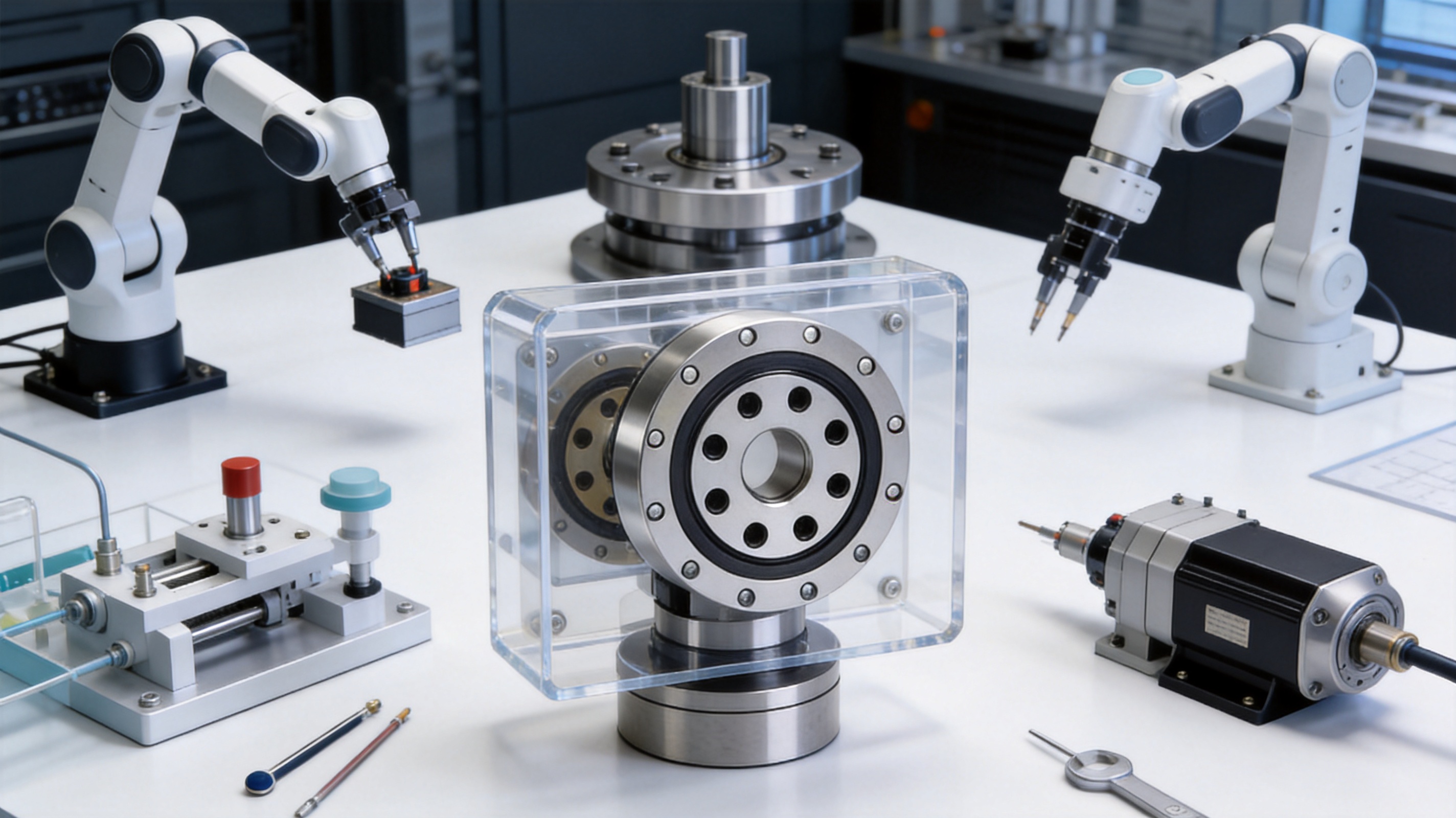
UKL Bearing Manufacturing Co., Ltd. combines manufacturing, engineering, and international sales support. The company reports a workforce of approximately 201 to 500 employees, a monthly production capacity of 10,000 to 50,000 units, and more than 15 years of OEM and ODM export experience.
Its factory covers the main bearing production stages from forging through packaging. This structure can help improve communication between engineering, production, quality control, and customer service. When a customer needs a dimensional modification or a custom bearing solution, direct access to production capabilities can shorten the path from technical discussion to sample development.
UKL also provides multilingual service, installation guidance, technical response, and after-sales maintenance support for customers in different regions. These services are valuable for robot and automation manufacturers that may install the same equipment in multiple countries.
For an OEM project, the supplier should be evaluated not only on price but also on process capability, quality stability, development support, inspection resources, packaging, and long-term availability. A precision bearing is a critical component, and inconsistent supply can affect the performance and delivery schedule of the complete machine.
A CSD harmonic reducer bearing is a precision bearing designed for the output section of CSD-series harmonic reducers. It supports the reducer output while helping manage radial, axial, and moment loads in compact motion-control systems.
Both the outer ring and inner ring use an integrated one-piece structure. The outer diameter is the same as that of the CSG type, while the strength is higher than CSG type components. The design also includes dedicated mounting-hole configurations for reducer integration.
Yes. The product is mainly intended for robotics, automation, and other precision motion-control systems. Its compact design, high load ratings, integrated rings, and low listed mass make it suitable for many robot joint applications, subject to engineering verification.
No bearing can independently eliminate all reducer backlash. The CSD bearing supports low-backlash operation by providing a rigid and accurate output support. Overall backlash depends on the harmonic gear mechanism, assembly, preload, manufacturing accuracy, and control system.
Among the listed models, the CSD-50 has the highest basic dynamic load rating at 34.8 kN and the highest basic static load rating at 60.2 kN. It also has the largest listed outer diameter, 157 mm, and a weight of approximately 3.8 kg.
The CSD-14 is the lightest listed model at approximately 0.24 kg. It has an outer diameter of 55 mm and basic dynamic and static load ratings of 4.7 kN and 6.7 kN, respectively.
Custom requirements may be possible depending on the dimensions, mounting pattern, seals, lubricant, tolerance, quantity, and application. A formal technical review and approved drawing should be completed before customized production begins.
Lubrication should be selected according to speed, load, temperature, seal type, reducer lubricant, and operating environment. The quantity and maintenance interval should follow the manufacturer’s technical recommendation. Both over-lubrication and under-lubrication can reduce performance.
The CSD bearing is listed for aerospace and medical applications, but each project requires separate qualification. Temperature, vibration, cleanliness, vacuum, sterilization, lubricant compatibility, traceability, and regulatory requirements must be reviewed before approval.
Customers should provide the desired model, quantity, operating speed, radial load, axial load, moment load, duty cycle, temperature, environment, lubrication requirements, mounting details, and required documentation. A technical drawing or reducer assembly drawing is also helpful.
The CSD harmonic reducer bearing is a compact, integrated solution for precision output support in harmonic drive systems. Its one-piece inner and outer rings reduce structural complexity, while its design maintains the outer diameter of the CSG type and provides higher strength than CSG type components. This combination is especially valuable in robotic joints where space, stiffness, mass, and accuracy must be optimized together.
The available CSD-14 through CSD-50 models provide a broad selection of dimensions and load ratings. The range supports small lightweight mechanisms as well as larger robot joints and industrial automation systems. Dedicated mounting holes, compact dimensions, and precision manufacturing make the bearing suitable for integration into standardized reducer platforms and customized OEM assemblies.
UKL Bearing Manufacturing Co., Ltd. strengthens the product offering through integrated production capabilities covering forging, turning, heat treatment, grinding, assembly, and packaging. Its R&D resources, export experience, production capacity, and technical service support position the company as a practical partner for manufacturers seeking precision bearing solutions in China.
For the best result, the CSD bearing should be selected as part of a complete mechanical system. Load calculations, mounting accuracy, lubrication, sealing, temperature, duty cycle, and reducer performance must all be considered. When correctly specified and installed, the CSD bearing can help robot and automation manufacturers achieve compact joints, stable output motion, high torque capability, accurate positioning, and dependable long-term operation.
1. UKL Bearing Manufacturing Co., Ltd., CSD Harmonic Reducer Bearing Product Information and Dimensional Data.
2. ISO 281, Rolling Bearings—Dynamic Load Ratings and Rating Life.
3. ISO 76, Rolling Bearings—Static Load Ratings.
4. ISO 15243, Rolling Bearings—Damage and Failures—Terms, Characteristics, and Causes.
5. General engineering principles for harmonic drive reducers, precision motion systems, and robotic joint design.
6. General bearing installation, lubrication, inspection, and maintenance practices for industrial automation equipment.
Product Categories
Contact Us

Jane@ukl-bearing.com
Jenny@ukl-bearing.com
Andy@ukl-bearing.com
Ivy@ukl-bearing.com

+86-510- 88763239
+86-15371057968

No.1 Hehuan Road, Hudai Town, Binhu District, Wuxi City.
Ready to Begin?
Get in Touch

Now!
UKL BEARING
 English
 Español
 русский