Content
Modern rotary motion systems are becoming faster, more compact, more accurate, and more demanding. Machine tool builders, robot manufacturers, automation integrators, and precision equipment designers all require bearing solutions that can carry combined loads while maintaining micron-level positioning accuracy. The YRTS high-speed precision bearing series is designed for exactly these conditions: applications where axial load, radial load, tilting moment, rotational accuracy, rigidity, and speed must be achieved in one compact bearing unit.
The YRTS high-speed series is a precision rotary table bearing solution developed for high-speed operation, especially in direct-drive motor applications. It maintains the same external dimensions as the standard YRT rotary table bearing series, making replacement and design integration easier, but it uses a different internal structure to achieve higher speed capability and low, uniform friction torque across the operating speed range. This combination makes it highly suitable for CNC rotary tables, vertical grinders, indexing heads, gear hobbing machines, gear milling machine workpiece shafts, and other precision devices requiring stable rotation and reliable positioning.
YRTS High Speed Precision Bearing 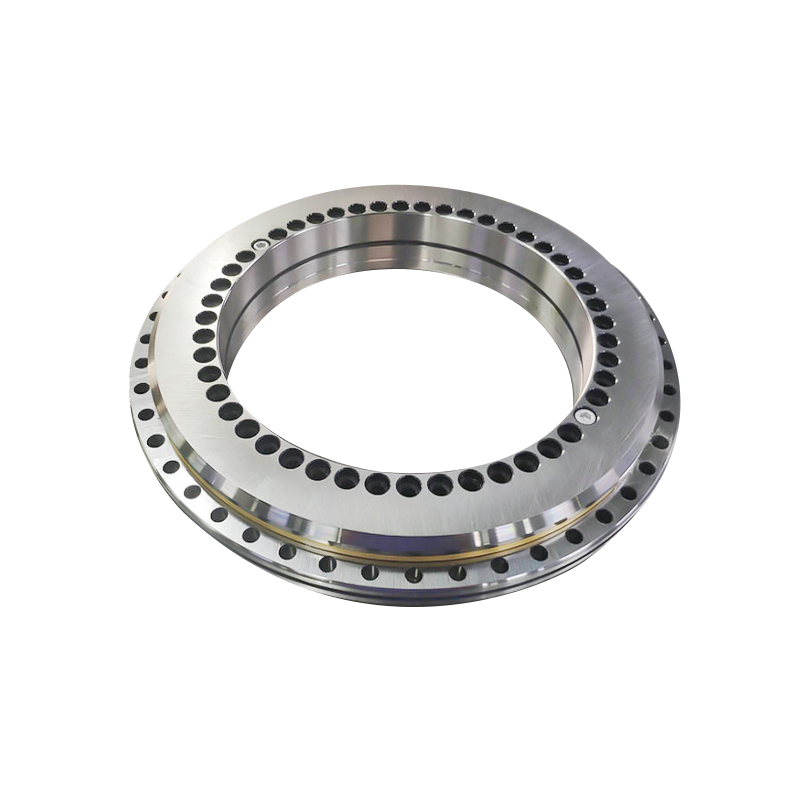
As a product in the field of high-precision cross roller and rotary table bearing technology, the YRTS bearing stands out because it addresses several common engineering challenges at once. Designers often need a bearing that saves space, simplifies assembly, improves rigidity, supports direct-drive motors, reduces frictional heat, and maintains accuracy under complex loading. Compared with conventional bearing arrangements assembled from multiple separate bearings, a YRTS high-speed precision bearing provides an integrated structure that is easier to mount, easier to preload, and more consistent in performance.
Ukl Bearing Manufacturing Co.,Ltd focuses on precision bearing manufacturing and engineering service, with capabilities covering R&D, production, international distribution, OEM and ODM support, and technical consultation. The company operates production lines involving forging, turning, heat treatment, grinding, assembly, inspection, and packaging. These processes are essential for a bearing such as the YRTS series because high-speed precision performance depends not only on design, but also on the stability of material treatment, geometric accuracy, surface finish, cleanliness, and preload control.
The YRTS high-speed precision bearing is designed as a compact rotary table bearing capable of supporting axial loads in both directions, radial loads, and overturning moments. In precision rotary tables and direct-drive systems, a bearing is not simply a support component; it is a key element that determines rotational accuracy, rigidity, vibration behavior, heat generation, and service life. A small improvement in bearing friction, rigidity, or runout can result in a significant improvement in machining quality, indexing accuracy, and servo responsiveness.
The YRTS series is distinguished from the standard YRT series by its internal structure. Although the external dimensions are consistent with the YRT series, the internal design is optimized for higher speeds. This means engineers can often maintain existing dimensional envelopes while upgrading the dynamic capability of the system. Such interchangeability is valuable for machine upgrades, equipment redesigns, and OEM standardization because it reduces redesign costs and shortens development time.
One of the most important features of the YRTS bearing is its low and uniform friction torque across the entire speed range. In a direct-drive rotary table, friction torque affects motor sizing, control precision, heat generation, energy consumption, and dynamic response. If friction is inconsistent, servo tuning becomes more difficult, and positioning accuracy may suffer. A bearing with stable friction behavior allows smoother acceleration, better speed control, and improved repeatability.
The YRTS series can reach high precision grades such as P4 and P2. These grades are important for applications where axial runout, radial runout, and rotational repeatability must remain extremely low. High precision is achieved through accurate raceway grinding, controlled preload, strict inspection, and stable manufacturing processes. In high-end machine tools, robotics, metrology equipment, and automated inspection systems, this level of accuracy helps reduce cumulative mechanical errors and improve finished product quality.
Another key feature is high rigidity. The bearings in this series are preloaded, which helps remove internal clearance and increase stiffness. Preload is particularly important in rotary tables because the bearing must resist tilting moments generated by workpiece weight, cutting forces, indexing loads, and acceleration or deceleration. A high-rigidity bearing reduces deflection, improves dynamic stability, and supports repeatable positioning under changing load conditions.
The first advantage of the YRTS high-speed precision bearing is integration. Traditional rotary table designs may use combinations of angular contact ball bearings, radial bearings, thrust bearings, or tapered roller bearings. While these combinations can be effective, they require careful alignment, preload adjustment, housing precision, spacer control, and assembly expertise. The YRTS bearing offers a more integrated approach by handling axial, radial, and tilting loads in a single bearing unit. This reduces the number of components, simplifies mounting, and improves consistency from one machine to another.
The second advantage is compactness. A machine tool or robot joint often has limited installation space. The bearing must provide high load capacity and rigidity without increasing the axial height or radial envelope excessively. Because the YRTS series is designed specifically for rotary table applications, it can deliver strong combined-load capability in a compact geometry. This helps equipment manufacturers build smaller, more efficient, and more powerful systems.
The third advantage is high-speed suitability. Many rotary table bearings are designed primarily for rigidity and load capacity, but high-speed direct-drive systems require additional optimization. A bearing that performs well at low speed may generate too much heat or torque fluctuation at higher rotational speeds. The YRTS series is intended to operate at higher speeds than the standard YRT series, making it suitable for applications where productivity, fast indexing, and dynamic response are important.
The fourth advantage is uniform friction torque. In precision motion control, predictable friction is often as important as low friction. If friction changes greatly with speed, temperature, or load, control systems must compensate more aggressively. Stable friction behavior supports smoother rotation, lower vibration, better servo performance, and improved accuracy. This makes the YRTS bearing especially attractive for direct-drive motors, where the motor is connected directly to the rotating table without belts, gears, or reduction mechanisms that could mask bearing behavior.
The fifth advantage is high precision. P4 and P2 accuracy grades make the YRTS bearing suitable for demanding equipment where ordinary industrial bearings may not provide sufficient runout control. Competitor products that focus mainly on load capacity but lack precision finishing may be less suitable for high-end machine tools or automated inspection equipment. The YRTS series is positioned for customers who require both strength and accuracy.
The sixth advantage is installation reliability. Because the bearing is preloaded and designed as a precision assembly, the risk of incorrect preload adjustment is reduced compared with multi-bearing arrangements. This does not eliminate the need for careful installation, but it helps reduce variability. Proper mounting tools, clean assembly conditions, correct tightening torque, and suitable housing accuracy remain essential, yet the integrated design supports a more controlled installation process.
The YRTS high-speed precision bearing is widely used in rotary tables for precision machine tools. In vertical grinders, the rotary table must support the workpiece while maintaining excellent axial and radial accuracy. Any bearing deflection or runout can affect grinding quality, surface finish, and dimensional consistency. The high rigidity and precision of the YRTS series help maintain stable workpiece positioning during grinding operations.
In indexing heads, accurate positioning and repeatability are fundamental. An indexing head may rotate to specific angular positions repeatedly during machining, inspection, or assembly. If the bearing has uneven friction torque or insufficient rigidity, angular accuracy can suffer. The YRTS high-speed series supports smooth indexing, stable clamping behavior, and reliable repeatability.
Gear hobbing machines and gear milling machines require workpiece shafts that can withstand cutting forces while maintaining accurate rotation. Gear tooth geometry depends on stable synchronization between tool and workpiece movement. A bearing with strong axial and radial capacity, high stiffness, and precision runout control contributes to improved gear quality, reduced vibration, and longer tool life.
Direct-drive rotary tables are among the most important applications for the YRTS series. Direct-drive technology eliminates mechanical transmission elements such as worm gears or belts, improving responsiveness and reducing backlash. However, because the motor acts directly on the rotating axis, bearing friction, heat, stiffness, and accuracy become even more visible. A high-speed precision bearing with uniform torque behavior is therefore critical for achieving the full benefits of direct-drive motion.
Robotics and intelligent automation systems can also benefit from this bearing concept. Although robot joints vary greatly in design, many advanced robots require compact bearings that support combined loads and allow accurate motion. In high-precision robotic positioning, inspection robots, automated assembly platforms, and semiconductor-related handling systems, bearing accuracy and rigidity directly influence end-effector precision.
Other possible applications include measuring instruments, precision turntables, radar platforms, optical equipment, medical device positioning systems, and automated test equipment. In each of these fields, the bearing serves as a core mechanical reference. When the bearing is more accurate, more rigid, and more predictable, the whole machine becomes easier to control and more reliable.
The YRTS high-speed precision bearing has four main technical features: high precision, high rigidity, high load capacity, and high speed. Each feature contributes to a specific engineering benefit, and together they create a bearing solution optimized for high-value equipment.
High precision means the bearing is manufactured and inspected to strict dimensional and geometric tolerances. Precision grades such as P4 and P2 require advanced grinding, measurement, and assembly control. In use, high precision helps reduce radial runout, axial runout, and angular error. This is essential for machine tools, where even small bearing errors can appear as machining defects.
High rigidity is achieved through preload and internal structural design. Preload improves contact stability between rolling elements and raceways, reduces internal clearance, and helps the bearing resist deformation under load. For rotary tables, rigidity affects not only static accuracy but also dynamic performance. A rigid bearing system is less likely to vibrate, chatter, or drift under changing forces.
High load capacity allows the bearing to withstand axial, radial, and overturning loads. Rotary table bearings rarely experience only one type of load. A workpiece may create axial weight, cutting forces may generate radial loads, and offset loading may create a tilting moment. The YRTS bearing is designed to manage these combined loads while preserving accuracy.
High speed capability is particularly important for the YRTS series. In modern production, fast rotation and rapid indexing can reduce cycle time and increase throughput. However, speed must not come at the expense of heat generation or accuracy loss. The optimized internal structure of the YRTS high-speed series supports higher rotational speeds than the standard YRT series while maintaining low and uniform friction torque.
Low friction torque also contributes to energy efficiency. When a bearing requires less torque to rotate, the drive motor consumes less energy and generates less heat. Lower heat generation helps maintain dimensional stability in precision machines. In high-accuracy systems, thermal expansion can be a major source of error, so reduced friction heat is a meaningful benefit.
Uniform torque behavior improves controllability. A servo motor can compensate for predictable load conditions more easily than for random torque fluctuations. This is why high-end direct-drive equipment depends heavily on bearing quality. The YRTS series supports smoother motion profiles, improved acceleration control, and more stable low-speed rotation.
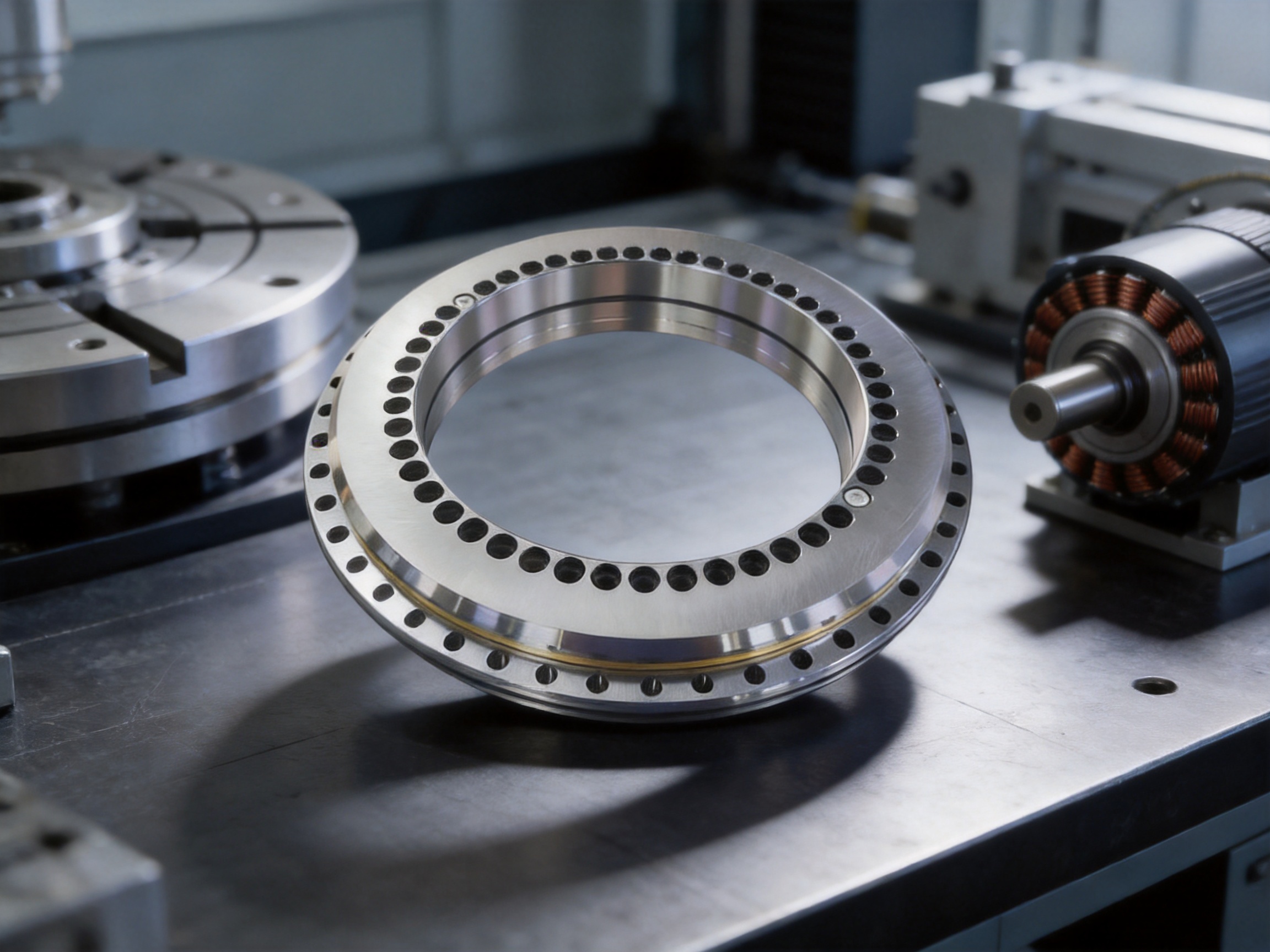
The following table summarizes representative YRTS high-speed precision bearing models and selected technical parameters. The data includes basic dimensions, fixing hole information, load ratings, limiting speed under grease lubrication, and approximate weight. Engineers should always verify final selection based on operating load, speed, lubrication method, installation accuracy, duty cycle, temperature conditions, and required life.
| Bearing Type | Inner Diameter d (mm) | Outer Diameter D (mm) | Height H (mm) | Axial Dynamic Load Ca (kN) | Axial Static Load Coa (kN) | Radial Dynamic Load Cr (kN) | Radial Static Load Cor (kN) | Grease Limiting Speed (/min) | Approx. Weight (kg) |
|---|---|---|---|---|---|---|---|---|---|
| YRTS200 | 200 | 300 | 45 | 105 | 635 | 78 | 202 | 950 | 9.7 |
| YRTS260 | 260 | 385 | 55 | 131 | 840 | 85 | 275 | 800 | 18.3 |
| YRTS325 | 325 | 450 | 60 | 191 | 1260 | 109 | 300 | 680 | 25 |
| YRTS395 | 395 | 525 | 65 | 214 | 1540 | 121 | 390 | 600 | 33 |
| YRTS460 | 460 | 600 | 70 | 221 | 1690 | 168 | 570 | 500 | 45 |
The model range shown above covers bore diameters from 200 mm to 460 mm. This size range is suitable for medium to large rotary tables, precision workholding systems, and direct-drive assemblies. As the bearing size increases, load ratings generally increase, while limiting speed decreases due to larger diameter, higher rolling velocity, and greater rotating mass. This is typical for precision rotary bearings and should be considered during selection.
For example, the YRTS200 offers a grease limiting speed of approximately 950 revolutions per minute and an approximate weight of 9.7 kg, making it suitable for relatively compact high-speed systems. The YRTS460, with a 460 mm bore and 600 mm outside diameter, provides much higher static load capacity and radial capacity, but its grease limiting speed is approximately 500 revolutions per minute. Engineers must balance speed, load, stiffness, and system size when selecting the correct model.
The screw connection and fixing hole design are also important. Proper connection between the shaft, bearing, and housing determines whether the bearing can achieve its rated accuracy and rigidity in the final machine. The product data notes that connecting screw holes and threaded removal holes are circumferentially distributed. Torque values are provided for 12.9-grade bolts, and equal spacing of fixing holes should be observed. This highlights the importance of installation discipline in precision bearing applications.
A high-speed precision rotary table bearing cannot be produced reliably through ordinary machining alone. Its performance depends on multiple controlled processes, from material preparation to final inspection. Ukl Bearing Manufacturing Co.,Ltd operates as an integrated manufacturer and trader with production capabilities covering forging, turning, heat treatment, grinding, assembly, and packaging. For the YRTS series, each of these stages plays a direct role in achieving speed, stiffness, durability, and accuracy.
Forging is the foundation of bearing quality. Proper forging improves material density, grain flow, and mechanical strength. A bearing ring used in a high-load rotary table must resist fatigue, deformation, and crack initiation. If the raw material structure is inconsistent, no amount of final grinding can fully compensate. Controlled forging provides a stable blank for later precision processing.
Turning transforms the forged blank into a near-net ring geometry. Precision turning controls wall thickness, ring symmetry, and machining allowance for grinding. In high-precision bearings, even early-stage machining must be carefully controlled because excessive stress, uneven material removal, or poor roundness can affect later heat treatment and final accuracy.
Heat treatment gives the bearing raceways the required hardness, wear resistance, and fatigue strength. For rotary table bearings operating under combined loads, heat treatment must be uniform. Uneven hardness or distortion can lead to premature wear, reduced precision, or unstable preload. Advanced heat treatment control helps ensure that the rings retain dimensional stability and surface durability.
Grinding is one of the most critical processes for the YRTS high-speed series. Raceways, mounting faces, and reference surfaces must be ground to tight tolerances with high surface quality. Accurate grinding reduces runout, improves contact uniformity, and supports stable preload. Surface finish also affects friction and heat generation, especially at higher speeds. A smoother, more accurate raceway helps rolling elements move consistently with reduced vibration.
Assembly requires clean conditions, experienced technicians, accurate measuring instruments, and strict process control. Rolling elements must be matched, preload must be controlled, and internal geometry must be verified. Since all bearings in the YRTS series are preloaded, assembly quality directly determines the final torque, rigidity, and rotational accuracy. Too little preload can reduce stiffness; too much preload can increase heat and shorten life. Controlled assembly is therefore essential.
Inspection and testing verify that the bearing meets performance requirements before shipment. For a precision bearing, inspection may include dimensional measurement, rotational accuracy checks, torque evaluation, noise assessment, appearance inspection, and packaging verification. Consistent inspection reduces the risk of field problems and provides confidence for OEM customers who depend on repeatable quality.
Packaging is also important for precision bearings. Clean, corrosion-protected packaging prevents contamination and damage during storage and transportation. A bearing with micron-level accuracy can be compromised by impact, dust, moisture, or improper handling. Proper packaging preserves the value created by the manufacturing process.
Ukl Bearing Manufacturing Co.,Ltd has built its business around precision, durability, and engineering service. Since its establishment in 2020, the company has focused on bearing technology and global industrial applications. With 201–500 employees and more than 15 years of OEM and ODM export experience in its team background and operating capability, the company supports customers in Europe, Asia, Africa, Russia, and other regions.
The company integrates research and development, production, and international distribution. This integration is valuable for customers because it creates a direct connection between design feedback, manufacturing capability, and application support. When a customer requires a custom bearing, modified mounting arrangement, special accuracy requirement, or application-specific recommendation, integrated engineering and production resources make communication more efficient.
Monthly production capacity of 10,000–50,000 units supports both small-batch precision orders and larger industrial supply programs. For OEMs, supply stability is a major concern. A bearing supplier must not only produce a correct sample; it must also maintain consistent quality over repeated production batches. Production capacity, quality control, and process discipline help ensure stable delivery.
The company’s product portfolio includes cross roller bearings, robot bearings, angular contact ball bearings, rod end bearings, spherical roller bearings, cylindrical roller bearings, tapered roller bearings, Nilos rings, and mounted bearings. This broad product range gives the engineering team a wide understanding of bearing types and application conditions. Such knowledge is useful when helping customers select the correct bearing structure for a specific mechanical system.
For the YRTS series, R&D capability is especially important. Precision rotary table bearings must be adapted to modern trends such as direct-drive technology, compact automation, intelligent manufacturing, and high-speed machining. A company that invests in R&D can improve internal geometry, friction behavior, load distribution, and manufacturing methods over time.
The company also emphasizes sustainability by adopting environmentally responsible processes, promoting material recycling, and optimizing energy usage. While bearing performance remains the primary concern for machine designers, sustainability is increasingly important in global supply chains. Efficient manufacturing, responsible material use, and long-term product durability all contribute to lower environmental impact.
International service capability further strengthens the product offering. Customers in different regions may need installation guidance, technical response, after-sales maintenance, and communication in multiple languages. A high-precision bearing is not a commodity component; it is part of a system. Technical support helps users avoid installation errors, select suitable lubrication, and troubleshoot operating issues.
Direct-drive rotary systems are changing the requirements for rotary table bearings. In older mechanical drive systems, gears, belts, or worm mechanisms influenced the motion behavior. In direct-drive systems, the motor directly rotates the table, which reduces backlash and improves dynamic response. However, this also means that bearing performance becomes more critical because the bearing is one of the main mechanical elements influencing torque ripple, smoothness, stiffness, and thermal stability.
The YRTS high-speed series is especially suitable for direct-drive motor applications because it combines high speed capability with low, uniform friction torque. When the bearing rotates smoothly, the direct-drive motor can achieve better low-speed control and more stable high-speed performance. This is beneficial in precision machining, laser processing, inspection tables, and automated assembly systems.
In direct-drive systems, thermal behavior must be controlled carefully. Excessive bearing friction can heat the rotary table, causing expansion and reducing accuracy. Heat can also affect lubricant viscosity, preload, and motor performance. By reducing friction torque and improving uniformity, the YRTS series helps maintain more stable operating temperatures.
Rigidity is equally important. Direct-drive motors can generate rapid acceleration and deceleration, creating dynamic loads on the bearing. A low-rigidity bearing may allow micro-deflection, resulting in positioning errors or vibration. The preloaded YRTS design helps resist these effects and supports more accurate servo control.
Compared with some conventional bearing combinations, the integrated YRTS design can reduce assembly stack errors. In multi-bearing systems, each bearing, spacer, housing shoulder, and locknut can introduce small deviations. These deviations accumulate and may affect final runout or preload. A precision rotary table bearing with a controlled internal structure helps reduce this complexity.
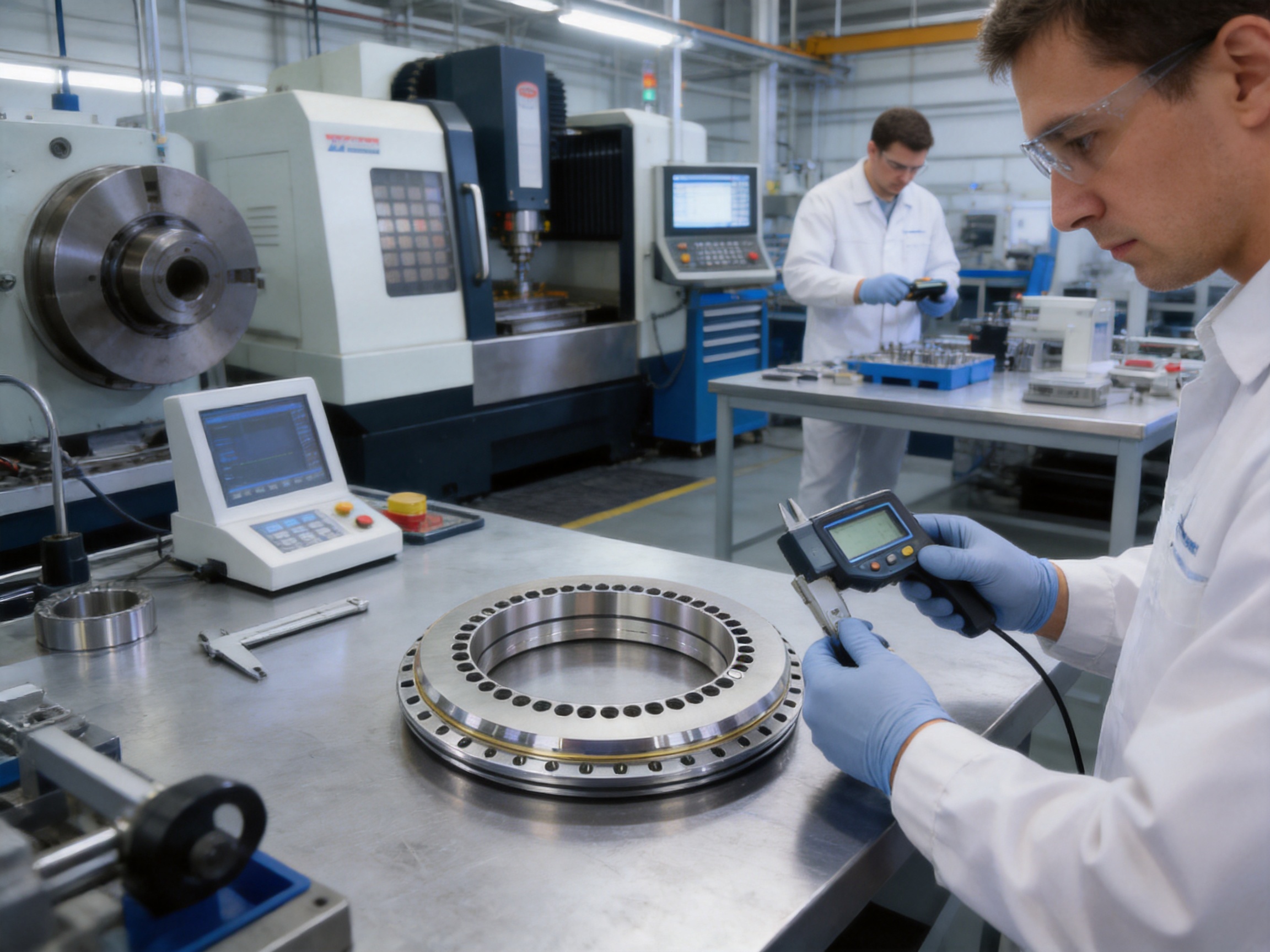
Even a high-quality precision bearing can lose accuracy if it is improperly used, installed, lubricated, or maintained. The YRTS high-speed precision bearing is engineered for demanding applications, but users must follow correct operating practices to preserve performance. The most common causes of decreased precision include wear, insufficient lubrication, improper installation, and environmental contamination.
Mechanical wear occurs when rolling elements and raceways experience repeated contact during operation. Over time, surface wear can gradually reduce bearing precision. In high-load or high-speed applications, wear may accelerate if lubrication is inadequate or contamination is present. Symptoms may include increased runout, abnormal noise, vibration, torque variation, or reduced positioning accuracy.
To prevent wear-related precision loss, users should establish a regular inspection program. Inspection may include checking vibration, noise, temperature, rotational torque, lubrication condition, and machining accuracy. If severe wear is detected, worn components or the entire bearing should be replaced promptly. Continuing to operate a worn precision bearing can damage related components and reduce machine quality.
Lubrication reduces friction, dissipates heat, protects surfaces, and prevents wear. If lubricant quantity is insufficient or the lubricant type is unsuitable, friction increases and bearing accuracy may decline. Incorrect lubrication can also cause excessive heat, lubricant breakdown, or rolling surface damage. For high-speed applications, lubricant selection is especially important because viscosity, base oil type, thickener, and operating temperature all influence performance.
Users should select lubricant according to bearing operating speed, load, temperature, duty cycle, and environmental conditions. Regular lubrication intervals should be established based on actual working conditions. Over-lubrication should also be avoided because excess grease can increase torque and heat, especially at higher speeds. The goal is effective lubrication, not simply maximum lubricant quantity.
Improper installation is one of the most frequent causes of reduced precision in rotary table bearings. If the bearing is mounted with uneven tightening, contaminated surfaces, incorrect alignment, or unsuitable tools, internal stress can become uneven. This may cause runout error, torque fluctuation, deformation, and early failure. Because the YRTS series is a high-precision preloaded bearing, installation accuracy is extremely important.
Installers should strictly follow the manufacturer’s installation instructions. Mounting surfaces should be clean, flat, and free of burrs. Bolts should be tightened in a controlled sequence using the specified torque values. Proper installation tools should be used to avoid impact damage or misalignment. Shaft and housing accuracy should match the bearing’s precision level; otherwise, the bearing cannot deliver its rated performance.
Dust, chips, coolant, chemicals, and other contaminants can adhere to bearing surfaces or enter the internal bearing area. Contamination may damage raceways, degrade lubricant, and increase friction. In machine tools, cutting fluid and metal particles are common risks. In automation systems, dust or chemical vapor may be present. Environmental protection is therefore essential.
Users should maintain a clean working environment around the bearing and use protective devices such as sealing covers when necessary. During installation, the bearing should remain protected from dust and moisture. Maintenance operations should also be performed carefully to prevent contamination. Cleanliness is one of the simplest and most effective ways to preserve precision bearing life.
Precision bearings require precision handling. Before installation, the bearing should be stored in a clean, dry environment and kept in its protective packaging until needed. The installation area should be prepared in advance, and all tools, bolts, measuring instruments, and lubricants should be clean and ready. Handling should avoid shock, dropping, or direct impact on the bearing rings.
The shaft and housing should be inspected before mounting. Important factors include dimensional accuracy, roundness, flatness, perpendicularity, and surface roughness. Even the best bearing cannot compensate for poor mounting geometry. If the housing or shaft is inaccurate, the bearing may deform after installation, causing runout and torque problems.
Mounting surfaces should be cleaned thoroughly. Burrs, chips, paint residue, rust, or dents can create uneven support and reduce accuracy. Bolts should be tightened gradually and evenly in a cross pattern or recommended sequence. The product note emphasizes that fixing holes should be equally spaced and that specified tightening torque values are based on 12.9-grade bolts. Using unsuitable bolts or incorrect torque may reduce connection rigidity.
After installation, rotational torque should be checked to confirm that the bearing turns smoothly. Any sudden tight spots, abnormal noise, or excessive torque should be investigated before operation. It is better to correct installation problems immediately than to allow damage during running.
Run-in operation may be necessary, especially for grease-lubricated high-speed bearings. During run-in, speed is increased gradually while monitoring temperature and noise. This helps distribute grease and stabilize operating conditions. Directly running a newly installed precision bearing at maximum speed may increase heat generation and reduce grease life.
Lubrication strategy has a major influence on YRTS bearing performance. Grease lubrication is common because it is convenient, provides sealing support, and reduces maintenance complexity. The specification table lists grease lubrication limiting speeds for representative models. However, the correct grease type and quantity must be selected according to the actual application.
For high-speed operation, grease should offer suitable viscosity and mechanical stability. If the grease is too thick, it may increase torque and heat. If it is too thin, it may not provide sufficient film strength under load. Temperature range, compatibility with sealing materials, resistance to oxidation, and service life should also be considered.
Lubrication intervals depend on operating speed, load, temperature, contamination level, and duty cycle. A rotary table operating intermittently in a clean environment may require different maintenance from a continuously running high-speed system exposed to coolant or dust. Monitoring temperature and torque trends can help determine whether lubrication remains effective.
In some specialized applications, oil lubrication or oil-air lubrication may be considered, but such decisions require engineering evaluation. The bearing design, sealing arrangement, speed target, and machine architecture must all be compatible. For most users, following the recommended grease lubrication method and maintenance schedule is the most practical approach.
High-speed operation magnifies small imperfections. Minor raceway waviness, surface defects, preload inconsistency, or rolling element variation may produce heat, vibration, or noise when speed increases. For this reason, a high-speed precision bearing requires more than basic dimensional conformity. It requires stable material, refined raceway surfaces, accurate geometry, clean assembly, and consistent inspection.
In low-speed applications, some defects may remain hidden for a long time. In high-speed direct-drive systems, the same defects can quickly become visible through torque fluctuation, temperature rise, servo instability, or vibration. The YRTS high-speed series is designed to reduce these risks through optimized internal structure and precision manufacturing.
Competitors that rely on general-purpose production methods may struggle to achieve the same consistency in high-speed precision applications. The difference is not only in the nominal bearing type, but also in how the bearing is manufactured and controlled. Precision grinding, preload matching, torque testing, and cleanliness management all contribute to real-world performance.
For OEM customers, consistency is often as important as peak performance. A prototype bearing may perform well, but production machines require repeatable results over many units. Ukl Bearing Manufacturing Co.,Ltd’s integrated production processes and inspection systems support this requirement by controlling quality from raw material processing to final packaging.
Selecting the correct YRTS bearing model requires a complete understanding of the application. Engineers should consider maximum axial load, radial load, tilting moment, speed, duty cycle, accuracy requirement, lubrication method, temperature, installation space, and expected service life. Because the bearing supports combined loads, calculations should consider simultaneous loading rather than isolated load values only.
Speed selection should account for the listed grease limiting speed and the actual thermal environment. A bearing operating near its limiting speed may require careful lubrication, run-in, and temperature monitoring. If the application demands continuous high-speed operation, additional engineering review is recommended.
Rigidity requirements should be based on machining forces, workpiece weight, table diameter, and required positioning accuracy. Larger rotary tables may generate high overturning moments even when the axial load seems moderate. Bearing selection should therefore include moment load analysis.
Accuracy grade should match machine requirements. P4 or P2 precision may be necessary for high-end grinding, inspection, or ultra-precision positioning. For less demanding applications, a lower precision solution might be acceptable, but for direct-drive precision equipment, higher accuracy often provides measurable performance advantages.
Installation space should be reviewed using overall dimensions such as d, D, H, H1, H2, fixing hole positions, and screw connection details. Since the YRTS series shares external dimensions with the YRT standard series, it may simplify upgrades, but internal performance differences should still be evaluated.
Finally, engineers should consider total cost of ownership rather than only purchase price. A high-quality precision bearing can reduce assembly time, improve machine accuracy, lower maintenance frequency, increase productivity, and reduce downtime. In advanced equipment, these benefits often outweigh the initial price difference compared with lower-grade alternatives.
Many customers require more than a standard catalog bearing. They may need special accuracy verification, modified lubrication, customized packaging, private labeling, technical drawings, or application-specific recommendations. OEM and ODM experience is therefore an important supplier strength. Ukl Bearing Manufacturing Co.,Ltd supports customers with engineering communication and international distribution, helping them integrate precision bearings into different machine platforms.
Customization may involve dimensional adjustments, clearance or preload discussion, material and heat treatment considerations, mounting interface review, or special inspection documentation. For rotary table and robot bearing applications, close communication between the customer and bearing manufacturer can prevent design problems before production begins.
Export experience also matters because international customers need reliable documentation, packaging, logistics coordination, and after-sales response. Bearings are precision components, and long-distance shipping requires proper anti-corrosion protection and impact prevention. A supplier familiar with export requirements can reduce risk and improve delivery reliability.
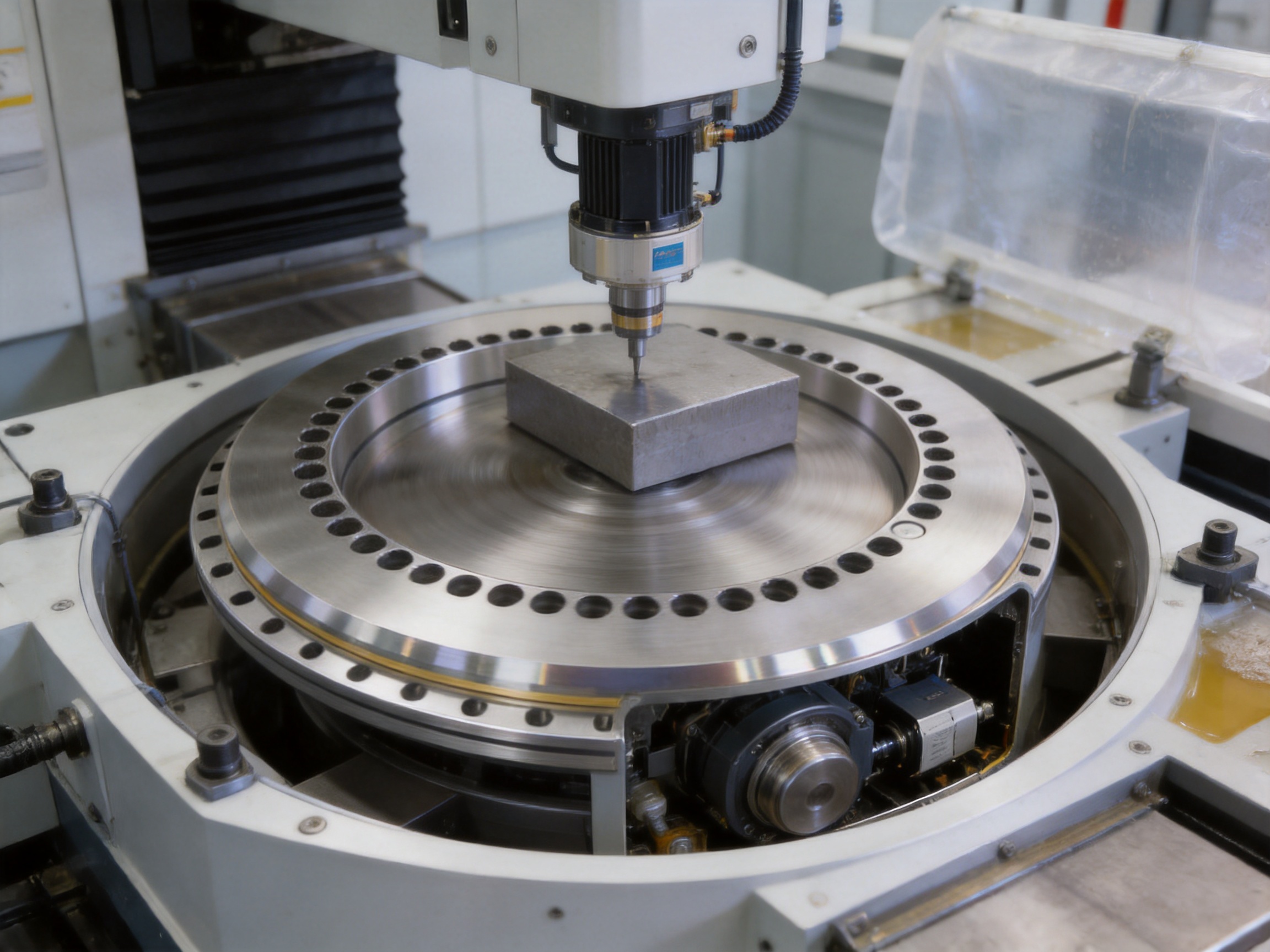
Quality control for the YRTS high-speed precision bearing begins before production. Design review ensures that the bearing structure meets the target load, speed, rigidity, and accuracy requirements. Material selection and process planning then establish the foundation for stable manufacturing. During production, each stage must be controlled to prevent errors from accumulating.
Dimensional inspection verifies ring geometry and key mounting dimensions. Surface inspection checks raceway finish and detects defects that could affect fatigue life. Hardness testing confirms heat treatment results. Rotational accuracy testing helps ensure that the final bearing can meet precision requirements. Torque evaluation confirms smooth movement and preload consistency.
Cleanliness control is especially important during assembly. Small particles can damage raceways or create torque fluctuations. Clean assembly practices, proper handling, and protective packaging help preserve performance. For high-speed bearings, cleanliness also supports longer lubricant life and reduced wear.
Final inspection and packaging complete the process. A precision bearing should leave the factory protected, identified, and ready for controlled installation. Documentation may include model data, inspection results, and handling recommendations according to customer needs. This systematic approach supports the company’s goal of delivering reliable products to global industries.
A YRTS high-speed precision bearing is designed for rotary tables and precision rotating systems that need to support axial loads, radial loads, and overturning moments while maintaining high accuracy, high rigidity, and higher speed capability. It is especially suitable for direct-drive motor applications.
The YRTS series has the same external dimensions as the standard YRT series, but its internal structure is different. The YRTS design is optimized for higher speeds and low, uniform friction torque across the speed range, making it better suited for high-speed direct-drive rotary systems.
The YRTS high-speed precision bearing can reach high precision grades such as P4 and P2. These grades are used in demanding applications where runout control, rotational accuracy, and repeatability are critical.
Preload removes internal clearance and increases rigidity. In rotary table applications, preload helps resist axial, radial, and tilting loads while improving positioning accuracy. Correct preload also supports stable motion and reduced vibration.
Typical applications include precision rotary tables, vertical grinders, indexing heads, gear hobbing machines, gear milling machine workpiece shafts, direct-drive motor tables, robotics, automated inspection equipment, and other precision devices.
Common causes include mechanical wear, insufficient lubrication, improper installation, and contamination from dust, impurities, coolant, or chemicals. Regular inspection, correct lubrication, careful installation, and environmental protection help prevent accuracy loss.
Yes. The product data provides grease lubrication limiting speeds for each model. For example, YRTS200 has a listed grease limiting speed of approximately 950 revolutions per minute, while larger models have lower limiting speeds. Actual operating conditions must be evaluated before final selection.
Direct-drive motors require bearings with smooth rotation, low friction torque, high rigidity, and stable accuracy. The YRTS series provides low and uniform friction torque, helping improve servo control, reduce heat generation, and support precise positioning.
Mounting surfaces must be clean, accurate, and free of burrs. Bolts should be tightened evenly using specified torque values and proper tools. The shaft and housing should meet the required geometric accuracy. Improper installation can reduce precision and shorten bearing life.
High-speed precision rotary table bearings require advanced manufacturing processes, accurate grinding, controlled heat treatment, clean assembly, preload expertise, and strict inspection. A specialized manufacturer with R&D, production, and technical support capability can provide more reliable performance than a general bearing supplier.
The YRTS high-speed precision bearing is a high-performance solution for modern rotary motion systems that demand speed, accuracy, rigidity, and compactness. Its optimized internal structure allows higher speed operation than the standard YRT series while maintaining the same external dimensions. This makes it attractive for new machine designs as well as upgrades where installation space is already defined.
The bearing’s main advantages include high precision up to P4 and P2 grades, preloaded high rigidity, combined axial-radial-moment load capacity, high-speed capability, and low uniform friction torque. These features make it especially valuable in direct-drive rotary tables, precision grinders, indexing heads, gear machining equipment, robotics, and automated systems.
Behind the product is a manufacturing system involving forging, turning, heat treatment, grinding, assembly, inspection, and packaging. Ukl Bearing Manufacturing Co.,Ltd combines production capacity, R&D capability, OEM and ODM experience, international distribution, and technical service to support customers worldwide. In demanding applications where bearing performance directly affects machine accuracy and productivity, these manufacturing and engineering strengths provide a meaningful competitive advantage.
For engineers seeking a compact, high-speed, high-rigidity rotary table bearing, the YRTS series offers a balanced and practical solution. When properly selected, installed, lubricated, and maintained, it can help precision equipment achieve smoother motion, better accuracy, improved productivity, and longer reliable service.
1. Harris, T. A., and Kotzalas, M. N. Rolling Bearing Analysis: Essential Concepts of Bearing Technology. CRC Press.
2. Eschmann, P., Hasbargen, L., and Weigand, K. Ball and Roller Bearings: Theory, Design and Application. Wiley.
3. ISO 492. Rolling Bearings: Radial Bearings, Geometrical Product Specifications and Tolerance Values.
4. ISO 76. Rolling Bearings: Static Load Ratings.
5. ISO 281. Rolling Bearings: Dynamic Load Ratings and Rating Life.
6. Brändlein, J., Eschmann, P., Hasbargen, L., and Weigand, K. Ball and Roller Bearings: Theory, Design and Application.
7. Machine Tool Design Handbook. Central Machine Tool Institute.
8. Precision Machine Design. Society of Manufacturing Engineers.
Product Categories
Contact Us

Jane@ukl-bearing.com
Jenny@ukl-bearing.com
Andy@ukl-bearing.com
Ivy@ukl-bearing.com

+86-510- 88763239
+86-15371057968

No.1 Hehuan Road, Hudai Town, Binhu District, Wuxi City.
Ready to Begin?
Get in Touch

Now!
UKL BEARING
 English
 Español
 русский