Content
Cylindrical roller and needle thrust bearings are specialized rolling elements designed for machine structures that must carry heavy axial force within limited axial space. In industrial equipment, robotics, transmission systems, lifting mechanisms, machine tools, and automated production lines, axial load control directly affects reliability, motion accuracy, operating life, and safety. A thrust bearing is not simply a supporting component; it is a precision-engineered interface that manages force, reduces friction, stabilizes rotating motion, and protects surrounding machine parts from premature wear.
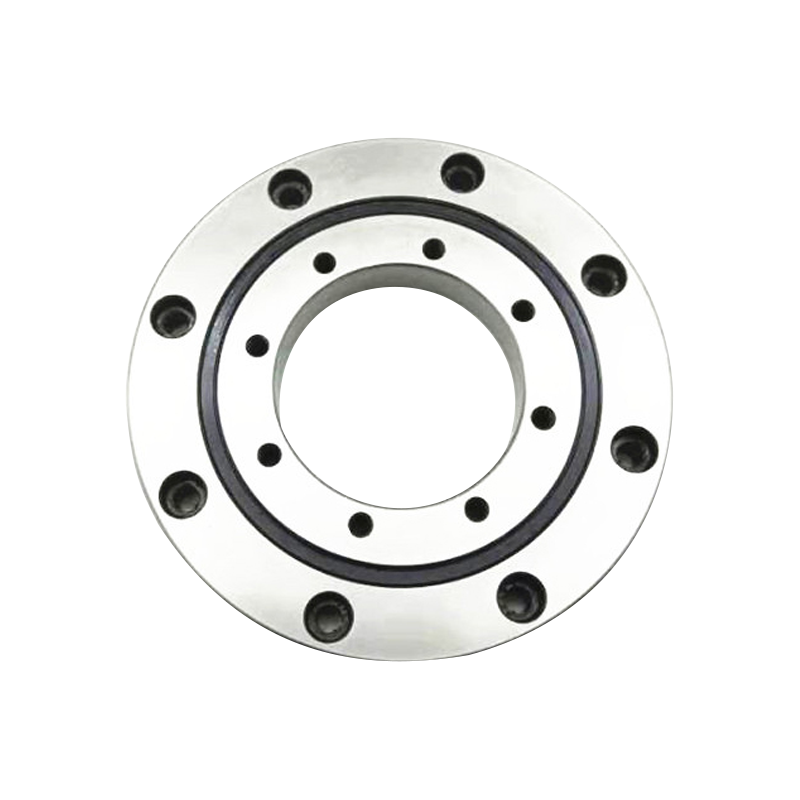
The product discussed in this article belongs to the cylindrical roller bearing family and is designed specifically for axial load applications. Unlike radial cylindrical roller bearings, cylindrical roller thrust bearings are intended to support forces acting along the shaft axis. Their structure makes them suitable for heavy axial loads and impact loads, while requiring very little axial space. They are not designed to bear radial loads, and this distinction is essential for correct selection, installation, and long-term performance.
In demanding industrial environments, bearing buyers often compare products based on load capacity, dimensional accuracy, material stability, heat treatment quality, lubrication performance, consistency, delivery capability, and after-sales technical support. A high-quality cylindrical roller or needle thrust bearing must perform well in all these areas. Ukl Bearing Manufacturing Co.,Ltd focuses on precision bearing manufacturing and engineering services, providing products that support industrial customers requiring stable axial load capacity, reliable operation, and flexible OEM or ODM customization.
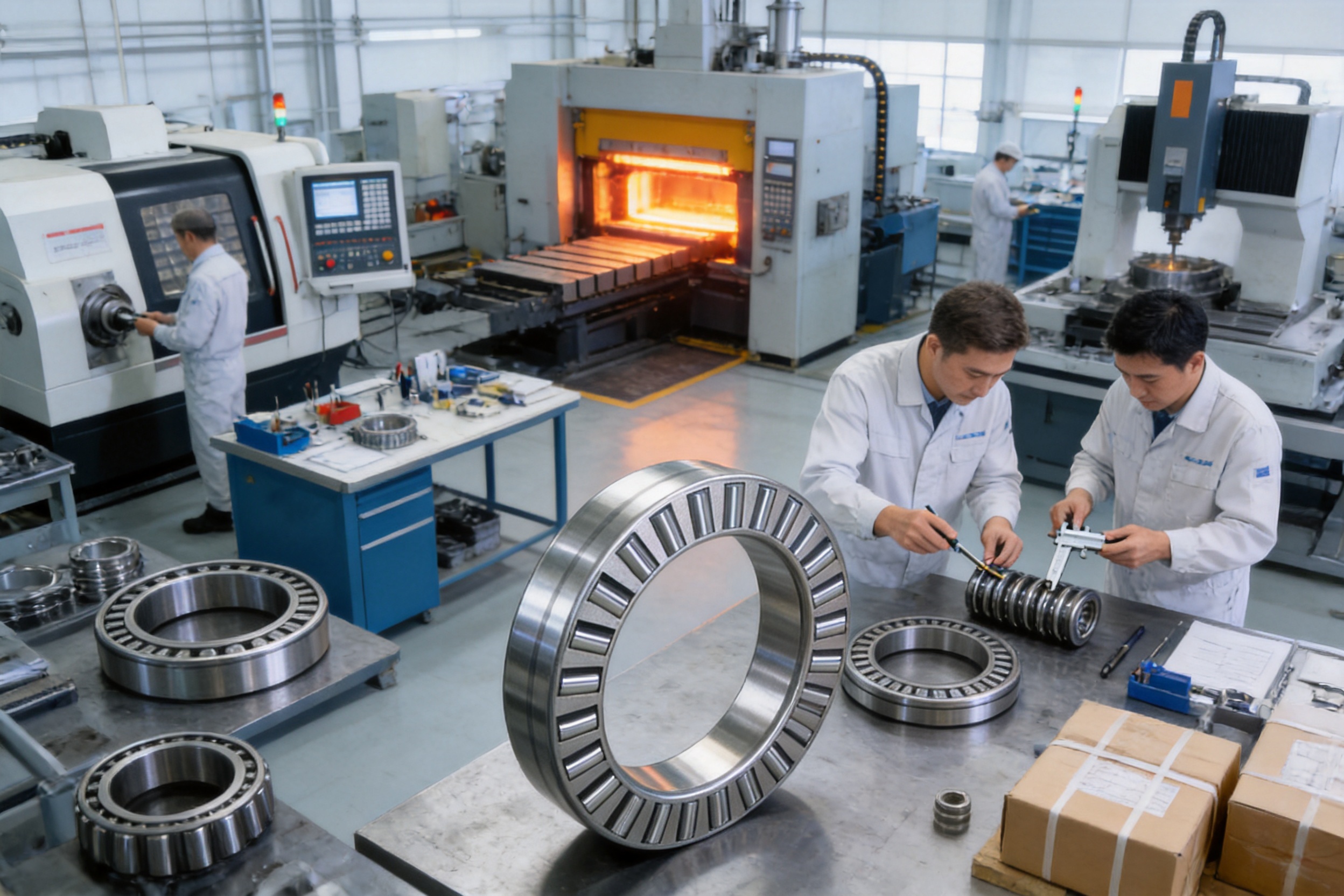
With manufacturing processes covering forging, turning, heat treatment, grinding, assembly, and packaging, the company builds bearings through a controlled production system rather than simple component supply. This integrated approach is especially important for thrust bearings because each process influences the final contact geometry, hardness, surface finish, dimensional accuracy, and fatigue life of the finished bearing. When axial loads are heavy and operating space is limited, small differences in manufacturing quality can lead to significant differences in service life.
Cylindrical Roller/Needle Thrust Bearings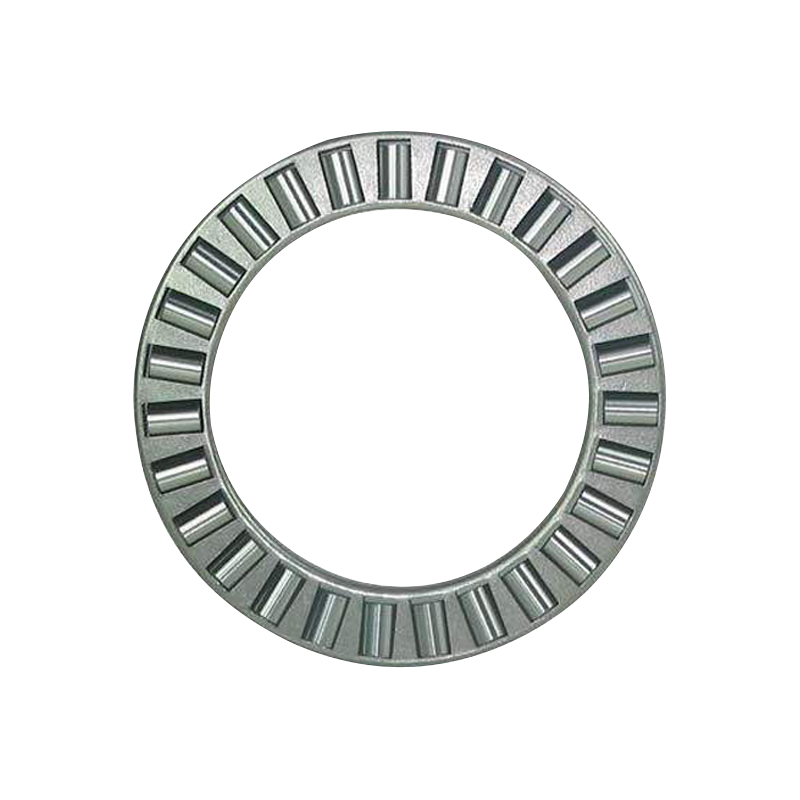
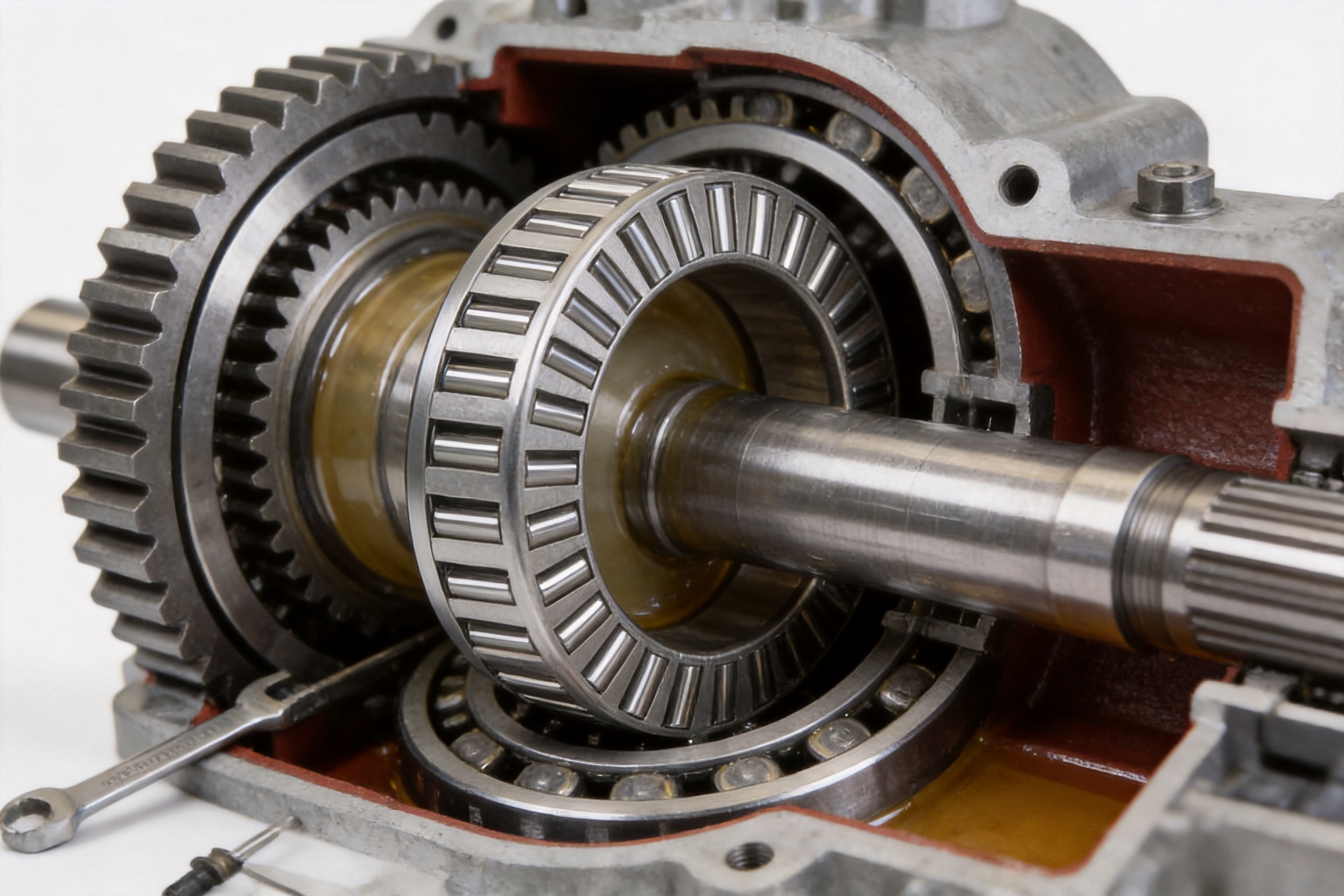
A cylindrical roller thrust bearing is composed of rolling elements arranged to carry axial load between bearing washers or raceways. The rollers are usually guided by a cage, helping maintain proper spacing and reducing friction between adjacent rollers. The design creates line contact between the rollers and raceways, allowing the bearing to carry greater axial load than many ball-type thrust bearing arrangements of similar size.
Needle roller thrust bearings operate on a similar principle but use long, thin rolling elements with smaller diameters. Needle designs are especially valuable where axial space is extremely limited and the bearing must remain compact. Cylindrical roller thrust bearings, by comparison, are often selected when higher load capacity, stronger rigidity, and resistance to impact loads are required.
The basic purpose of both types is to transmit axial force efficiently while minimizing friction and wear. In rotating machinery, axial loads may be produced by gears, screws, clutches, pumps, vertical shafts, actuators, rotary tables, or pressing mechanisms. If these forces are not properly supported, the shaft can shift, gears can misalign, seals can fail, and machine accuracy can deteriorate.
Cylindrical roller thrust bearings are frequently preferred in heavy-duty applications because their roller geometry distributes load over a larger contact area than point-contact rolling elements. This enables improved axial rigidity and greater resistance to shock or sudden loading. In applications where machine downtime is expensive, this structural advantage becomes a major purchasing consideration.
However, proper use is essential. These bearings do not carry radial load. If radial force exists in the application, it must be supported by a separate radial bearing or a bearing arrangement designed for combined loads. Correct bearing arrangement is one of the key reasons why technical support from an experienced manufacturer can improve equipment reliability.
The main advantages of cylindrical roller and needle thrust bearings include high axial load capacity, compact design, strong rigidity, reliable shock-load resistance, and efficient operation under properly lubricated conditions. These characteristics make them suitable for machinery where axial force is significant but available mounting space is limited.
High axial load capacity is achieved through roller-to-raceway contact geometry. Because rollers create line contact, the load is distributed over a larger contact zone. This helps reduce localized stress and allows the bearing to operate under heavier axial loading than many compact alternatives.
Compact axial dimension is another major benefit. Machinery designers often face strict space limitations, especially in gearboxes, reducers, robotics joints, automation modules, and machine tools. A thrust bearing that requires very little axial space provides greater flexibility in mechanical design and can help reduce total equipment size.
Impact-load resistance is also important. Industrial equipment may experience sudden load changes during start-stop operation, reversing motion, pressing cycles, material handling, or shock events. Cylindrical roller thrust bearings are well suited to these conditions when correctly specified, manufactured, installed, and lubricated.
Rigidity supports motion accuracy. In machine tools, automation systems, and precision rotary mechanisms, axial displacement can affect machining quality, positioning repeatability, and system stability. A rigid thrust bearing helps maintain alignment and reduce axial movement under load.
Low friction under correct lubrication contributes to energy efficiency and reduced heat generation. While thrust bearings carrying heavy loads naturally produce contact stress, precision surface finishing, accurate roller geometry, and suitable lubrication can reduce operating resistance and improve service life.
When selecting a thrust bearing, engineers may compare cylindrical roller thrust bearings with ball thrust bearings, tapered roller thrust arrangements, spherical roller thrust bearings, or plain thrust washers. Each has its own role, but cylindrical roller and needle thrust bearings offer several advantages in specific operating conditions.
Compared with ball thrust bearings, cylindrical roller thrust bearings generally provide higher axial load capacity because rollers create line contact rather than point contact. Ball thrust bearings may be suitable for lighter axial loads and higher-speed conditions, but when the application requires heavy axial force in a compact space, roller designs often provide stronger performance.
Compared with plain thrust washers, rolling-element thrust bearings greatly reduce friction. Plain thrust washers may be simple and low-cost, but they often require larger lubrication margins and can generate greater wear under continuous load. A precision rolling bearing provides smoother motion, better repeatability, and reduced maintenance risk in suitable applications.
Compared with some tapered roller arrangements, cylindrical roller thrust bearings can offer a simpler axial-load solution when radial load support is handled separately. Tapered roller bearings are excellent for combined loads, but they may require careful preload adjustment and more axial space. For pure axial loading, a cylindrical roller thrust bearing can be more direct and space-efficient.
Compared with spherical roller thrust bearings, cylindrical roller thrust bearings are usually selected where alignment is controlled and compactness is critical. Spherical roller thrust bearings can accommodate misalignment and combined loading better, but they may occupy more space and may not be necessary in machine designs with good alignment control.
The competitive advantage of cylindrical roller and needle thrust bearings therefore lies in focused performance: high axial load capacity, high rigidity, small axial size, and efficient force transmission. For applications with primarily axial load and controlled alignment, this bearing type offers a strong balance of strength, compactness, and operating efficiency.
| Bearing Type | Primary Strength | Typical Limitation | Best Application Condition |
|---|---|---|---|
| Cylindrical Roller Thrust Bearing | High axial load capacity and rigidity | Does not support radial load | Heavy axial loads with limited axial space |
| Needle Roller Thrust Bearing | Very compact axial design | May have lower load capacity than larger cylindrical roller designs | Compact mechanisms with moderate to high axial force |
| Ball Thrust Bearing | Smooth operation under lighter axial load | Lower heavy-load capacity | Light to medium axial loads and moderate speed |
| Plain Thrust Washer | Simple structure and low initial cost | Higher friction and wear risk | Low-speed or cost-sensitive applications |
| Spherical Roller Thrust Bearing | Misalignment accommodation and high load capacity | Larger design envelope | Heavy axial load with possible shaft deflection |
Heavy axial load is one of the most demanding conditions for bearing systems. Under high axial force, rolling elements and raceways experience substantial contact stress. If the bearing material, hardness, geometry, or lubrication is not properly controlled, the result can be pitting, spalling, excessive heat, or early fatigue failure.
Cylindrical roller thrust bearings address this challenge through their roller geometry. The rollers distribute load along their length, creating a larger contact area than balls. This improves load-sharing capability and allows the bearing to resist deformation under axial pressure. For equipment manufacturers, this means improved reliability and fewer failures caused by overload or impact.
Another advantage is axial stiffness. Under load, all bearings experience some elastic deformation. A bearing with high stiffness limits axial displacement, which is essential in machine tools, lifting equipment, and positioning mechanisms. Cylindrical roller thrust bearings provide strong resistance to axial movement, helping maintain the correct relationship between rotating and stationary components.
Shock resistance is also valuable. Many machines do not operate under perfectly stable loads. Pressing machines, gear systems, construction machinery, industrial drives, and automated equipment may encounter sudden load peaks. A well-designed cylindrical roller thrust bearing can absorb these axial impacts more effectively than lighter-duty alternatives.
Because these bearings require little axial space, designers can use them in compact equipment without sacrificing axial load performance. This is especially useful as modern machinery becomes smaller, faster, and more integrated. Compactness can reduce equipment weight, simplify assembly, and improve overall system layout.
The performance of a cylindrical roller or needle thrust bearing depends not only on its design but also on manufacturing precision. Even a strong theoretical design can fail if roller diameter variation is too large, raceway flatness is poor, heat treatment is inconsistent, or surface finish is inadequate.
Ukl Bearing Manufacturing Co.,Ltd operates with production processes that cover forging, turning, heat treatment, grinding, assembly, and packaging. This full-process capability helps maintain control from raw material shaping to final product preparation. For global OEM and distributor customers, process control is a major factor in consistent batch quality.
Forging contributes to material strength and internal structure. Proper forging can improve metal grain flow and prepare bearing rings or components for further machining. Turning establishes the basic geometry and dimensions of washers, raceways, and other components. Heat treatment creates the required hardness and wear resistance. Grinding refines dimensions, flatness, raceway quality, and surface finish. Assembly ensures correct matching of rollers, cages, and washers. Packaging protects the bearing during transportation and storage.
Every step matters. In thrust bearings, raceway flatness and parallelism are especially important because load is applied axially. If the raceway is uneven or the rollers are not uniformly sized, load distribution becomes irregular. Some rollers may carry excessive force, creating local stress and reducing service life.
Precision grinding is one of the most critical operations. It controls the final contact surfaces that interact with the rollers. A smooth and accurate raceway reduces friction, improves load distribution, and supports stable rotation. Poor grinding can increase noise, heat, and wear.
Heat treatment must also be carefully managed. Bearing components need sufficient hardness to resist wear and fatigue, but they must also maintain toughness to handle impact loads. Over-hardening, under-hardening, uneven hardness, or excessive distortion can all reduce performance. Controlled heat treatment helps produce a stable and durable bearing structure.
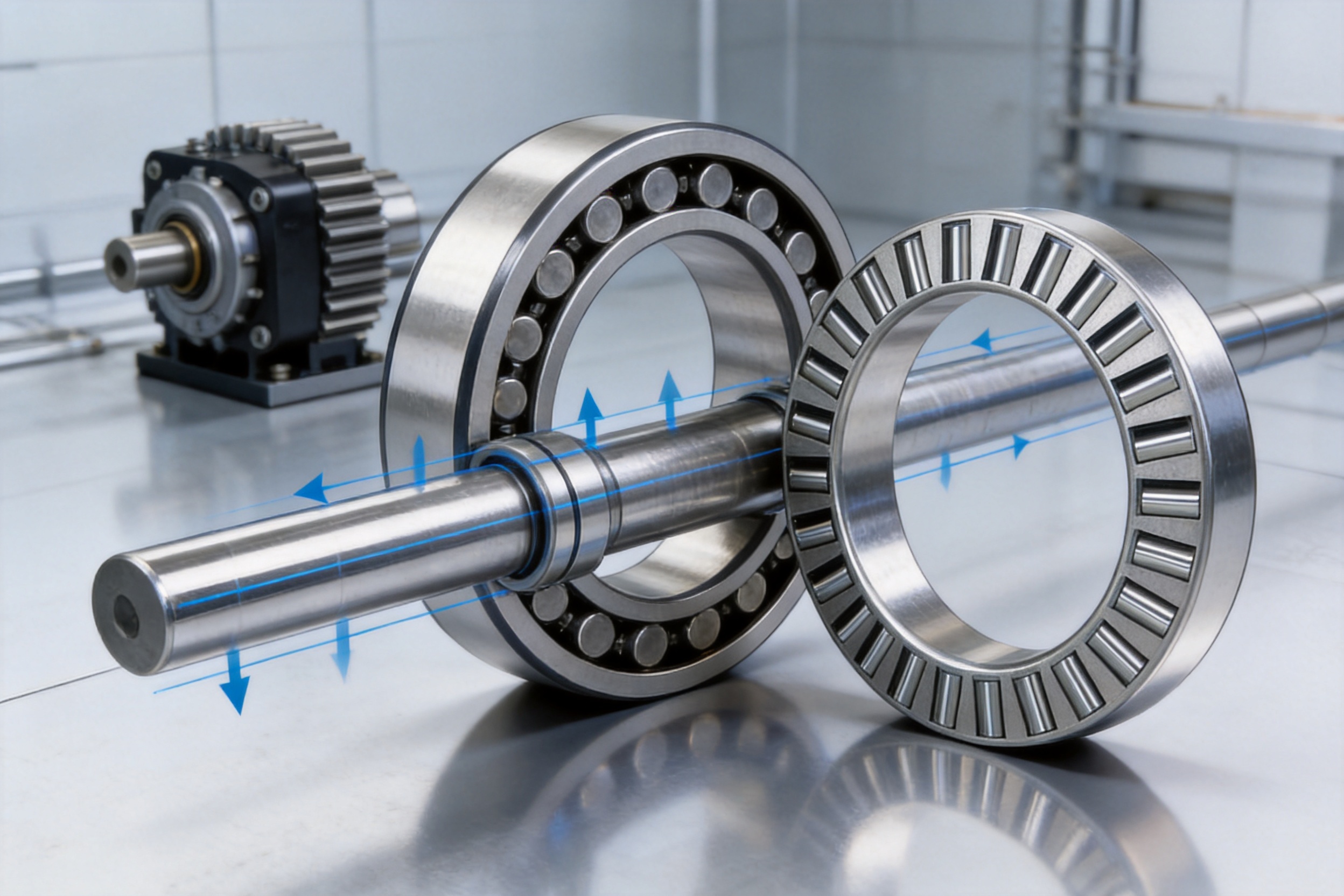
Bearing steel quality is a foundation of product reliability. Rolling bearings operate under repeated stress cycles, and fatigue resistance depends heavily on steel cleanliness, microstructure, hardness, and dimensional stability. Impurities, inclusions, or poor heat treatment can become initiation points for cracks and surface fatigue.
For cylindrical roller thrust bearings, the material must withstand concentrated contact stress between rollers and raceways. The steel should provide wear resistance, compression strength, and fatigue durability. Proper metallurgical control supports long service life under heavy axial load.
Heat treatment transforms the material into a hardened structure suitable for bearing operation. This process must be stable and repeatable. Uniform heating, quenching, tempering, and distortion control are necessary to achieve consistent hardness and geometry. If parts deform too much during heat treatment, later grinding must remove additional material, potentially affecting cost and dimensional consistency.
Advanced manufacturers pay close attention to the relationship between heat treatment and final grinding. A stable heat-treated component is easier to grind accurately and less likely to change shape during operation. For applications requiring high axial accuracy, this stability is particularly important.
In addition, proper heat treatment supports impact-load performance. A bearing that is too brittle may crack under shock loading, while a bearing that is too soft may wear rapidly. The correct balance of hardness and toughness is essential for industrial thrust bearing applications.
The contact between roller and raceway is the heart of bearing performance. Surface finish, roundness, waviness, roller diameter consistency, and raceway flatness all influence friction, vibration, load distribution, and fatigue life.
A high-quality cylindrical roller thrust bearing should have finely finished raceways that allow the rollers to move smoothly under load. Rough surfaces can break down lubricant film, increase heat, and accelerate wear. Excessive waviness can cause vibration or uneven stress. Poor roller matching can lead to load concentration.
Needle thrust bearings require equally careful control because their thin rollers must maintain stable contact under limited space conditions. Small dimensional errors can become significant when bearing height is very low. Precision manufacturing therefore directly affects the compact bearing’s functional reliability.
Contact geometry is also important at roller ends. Edge stress can occur if rollers are not properly shaped or if raceways do not support even load distribution. Advanced grinding and finishing methods help reduce stress concentration and improve fatigue resistance.
In competitive comparisons, these details often separate reliable bearings from low-cost alternatives. Bearings may look similar from the outside, but internal geometry and surface quality determine long-term performance. A product manufactured under strict process control can provide better consistency, lower failure risk, and improved value over its life cycle.
Industrial machinery is becoming more compact, integrated, and performance-driven. Designers need components that deliver high load capacity without increasing equipment size. Cylindrical roller and needle thrust bearings meet this requirement by providing high axial load support in a limited axial envelope.
In robotics and automation, compact bearings allow joint modules and actuators to remain small while maintaining stiffness. In gearboxes and reducers, they help manage axial forces generated by helical gears or screw mechanisms. In machine tools, they support axial positioning accuracy and spindle-related functions. In lifting and pressing equipment, they help withstand vertical loads and operational impacts.
Needle thrust bearings are especially useful where every millimeter matters. Their low sectional height makes them suitable for compact assemblies. Cylindrical roller thrust bearings are preferred when higher load capacity and rigidity are required. Together, these product types give engineers flexible options for solving axial load challenges.
Compact bearing design can also reduce surrounding component costs. If the bearing occupies less axial space, the shaft, housing, and overall machine structure can often be optimized. This may reduce weight, material use, and assembly complexity.
However, compactness must not compromise strength. This is why manufacturing accuracy, material quality, and proper selection are critical. A compact bearing operating under heavy axial load must be carefully engineered to prevent overheating, excessive stress, or lubricant failure.
Cylindrical roller and needle thrust bearings are used across many industries where axial load management is required. Their compact and robust design makes them suitable for both heavy machinery and precision equipment.
Machine tools require rigidity, accuracy, and reliable motion control. Axial displacement can affect machining precision, surface finish, and tool life. Cylindrical roller thrust bearings help maintain stable axial positioning under load. They are suitable for feed mechanisms, rotary components, indexing systems, and other structures requiring axial stiffness.
Robots and automated equipment require compact components with predictable performance. Bearings used in robotic joints, actuators, rotary modules, and precision handling systems must support load while maintaining smooth movement. Needle thrust bearings are useful where compact height is critical, while cylindrical roller thrust bearings can serve heavier axial load requirements.
Gears often produce axial forces, especially helical gears and worm gear systems. Thrust bearings control these forces and prevent shaft displacement. In industrial drives, stable axial support contributes to gear mesh accuracy, reduced vibration, and longer gearbox life.
Pumps and compressors may generate axial thrust due to fluid pressure and rotating components. A suitable thrust bearing helps stabilize the shaft and reduce mechanical wear. Selection must consider load, speed, lubrication, temperature, and operating environment.
Heavy machinery often experiences shock loads and uneven loading. Cylindrical roller thrust bearings can provide strong axial support in lifting, rotating, pressing, and driving mechanisms. Their impact-load resistance is valuable in rugged working environments.
Modern production lines rely on continuous operation. Bearing failure can stop production and create high downtime costs. Reliable thrust bearings help maintain performance in indexing tables, transfer systems, press stations, and automated assembly equipment.
Some buyers may initially compare bearings based mainly on purchase price. However, thrust bearings used under heavy axial load should be evaluated by total operating value rather than initial cost alone. A low-cost bearing with poor material, inconsistent hardness, inaccurate grinding, or weak packaging may create expensive machine failures.
High-quality cylindrical roller and needle thrust bearings offer advantages that can reduce total ownership cost. These include longer service life, fewer unplanned replacements, improved equipment reliability, lower maintenance frequency, better running stability, and reduced risk of damage to shafts or housings.
Commodity alternatives may have inconsistent roller dimensions or raceway finishing. In a thrust bearing, such inconsistency can cause uneven load sharing. The overloaded rollers fatigue sooner, leading to spalling and bearing failure. Once the bearing fails, adjacent machine components may also be damaged.
Another common issue in lower-grade bearings is insufficient hardness control. If the bearing is too soft, wear accelerates. If it is too brittle, impact loads can cause cracking. Stable heat treatment and inspection are therefore important competitive advantages.
Packaging quality also matters. Bearings are precision components that must be protected from moisture, dust, shock, and corrosion before installation. A reliable manufacturer treats packaging as part of the quality system, not as an afterthought.
Technical support is another differentiator. Correct bearing selection, installation guidance, lubrication advice, and troubleshooting support can extend bearing life. Ukl Bearing Manufacturing Co.,Ltd provides international service support and technical response for customers working across different regions and industries.
Ukl Bearing Manufacturing Co.,Ltd is located at No.1 Hehuan Road, Hudai Town, Binhu District, Wuxi City. Since its establishment in 2020, the company has developed as an integrated manufacturer and trader with a focus on precision bearing technology and engineering service. With 201–500 employees and more than 15 years of OEM and ODM export experience, the company serves customers in Europe, Asia, Africa, Russia, and other international markets.
The company’s production capacity of 10,000–50,000 units per month supports both standard supply and customized project requirements. This production scale is important for OEM customers who need stable delivery schedules and consistent quality from batch to batch.
The manufacturing system includes multiple production lines covering forging, turning, heat treatment, grinding, assembly, and packaging. This integrated structure gives the company better control over product quality and delivery coordination. Instead of relying entirely on fragmented external processing, the company can manage key quality factors throughout the production chain.
The R&D team develops products for CNC machines, robotics, intelligent automation systems, and other precision applications. This technical foundation supports the improvement of high-precision cross roller bearings, dual-direction thrust angular contact ball bearings, cylindrical roller bearings, and related bearing products. For thrust bearings, engineering knowledge from these precision product categories helps strengthen design and process control.
International distribution experience is another strength. The company exports to the United States, Italy, Germany, Poland, South Africa, Egypt, India, and other regions. Different markets have different expectations regarding standards, documentation, packaging, communication, and after-sales service. Long-term export experience helps the company understand these requirements and respond effectively.
The multilingual service team provides rapid technical response, installation guidance, and after-sales maintenance support. This is valuable for customers who need more than a product shipment; they need a reliable manufacturing partner capable of supporting machine performance over time.
OEM and ODM bearing projects require more than standard catalog supply. Customers may need special dimensions, specific materials, modified cages, special lubrication, unique packaging, private labeling, performance documentation, or application-specific engineering recommendations. Ukl Bearing Manufacturing Co.,Ltd has more than 15 years of OEM and ODM export experience, allowing it to support customized bearing programs for global customers.
For cylindrical roller and needle thrust bearings, customization may involve bearing washer dimensions, roller arrangement, cage material, surface treatment, tolerance level, clearance considerations, lubrication method, or packaging requirements. The goal is to match bearing design to the actual operating environment.
OEM customers often require stable quality across repeated batches. Consistency matters because the bearing must fit the same assembly process and meet the same performance expectations each time. Integrated production and quality control help reduce variation and support repeatability.
ODM projects may require deeper engineering cooperation. The customer may present a functional requirement, available installation space, load condition, operating speed, and target life. The manufacturer then helps develop a bearing solution. This cooperation can improve equipment design and reduce trial-and-error costs.
In global supply chains, customization must also be supported by reliable communication. Clear technical drawings, material requirements, inspection standards, and packaging specifications help avoid misunderstandings. A professional export-oriented manufacturer understands the importance of documentation and communication discipline.
Quality control for thrust bearings begins before production starts. Raw materials must be selected and verified according to the required bearing performance. Material quality affects fatigue life, hardness stability, and wear resistance. After material preparation, each manufacturing stage must be monitored to control dimensions, surface finish, and mechanical properties.
During forging and turning, dimensional allowances must be controlled to prepare components for heat treatment and grinding. During heat treatment, hardness and structural stability must be verified. During grinding, final dimensions and surface quality must meet technical requirements. During assembly, rollers, cages, and washers must be correctly matched. During packaging, bearings must be protected from corrosion and contamination.
Inspection may include dimensional measurement, hardness testing, visual checking, surface quality inspection, rotational smoothness evaluation, and packaging verification. For customized projects, additional inspection items may be agreed upon according to customer requirements.
A major quality objective is consistency. One good bearing is not enough; industrial customers need every bearing in a batch to perform within expected limits. Consistency reduces assembly problems and supports predictable equipment performance.
Traceability is also important. If a customer later has a technical question, production records and inspection information can help identify the relevant batch and process conditions. This supports faster troubleshooting and continuous improvement.
Even the best bearing can fail early if installed incorrectly. Cylindrical roller and needle thrust bearings must be mounted in a way that supports axial load properly while avoiding radial loading, misalignment, contamination, and improper lubrication.
The mounting surfaces should be clean, flat, and properly finished. Since thrust bearings carry axial force through their washers and raceways, uneven support surfaces can create stress concentration. The shaft and housing must be designed to keep the bearing aligned and properly seated.
Because these bearings do not carry radial load, radial forces must be supported separately. A common bearing arrangement uses radial bearings to control shaft position and thrust bearings to support axial load. Engineers should confirm load direction and ensure the bearing is not exposed to unintended side forces.
Lubrication must be selected according to speed, load, temperature, and environment. Grease may be suitable for many applications, while oil lubrication may be preferred in higher-speed or higher-temperature systems. Insufficient lubrication can cause heat, wear, and early failure. Excessive or unsuitable lubrication can also create problems, such as churning heat or contamination retention.
Cleanliness is essential. Dust, metal chips, moisture, and other contaminants can damage raceways and rollers. Bearings should remain packaged until installation and should be handled with clean tools and hands. In precision machinery, even small particles can reduce bearing life.
Lubrication creates a protective film between rolling elements and raceways. In thrust bearings operating under heavy axial load, lubricant quality and supply are vital. The lubricant reduces friction, carries away heat, protects against corrosion, and helps prevent surface fatigue.
The correct lubricant depends on application conditions. High load may require lubricant with strong film strength. High temperature may require better thermal stability. Low-speed heavy-load applications may need additives that protect against boundary lubrication conditions. Clean environments and sealed systems may allow long service intervals, while dusty or wet environments require more frequent inspection.
Maintenance practices should include monitoring for abnormal noise, vibration, temperature rise, lubricant leakage, contamination, and axial play. Early detection of problems can prevent severe damage. If a bearing begins to show signs of distress, engineers should investigate load conditions, alignment, lubrication, mounting accuracy, and contamination control.
Replacement intervals should be based on operating conditions rather than a fixed universal rule. A bearing in a clean, well-lubricated, properly aligned machine may last much longer than one exposed to shock, contamination, or inadequate lubrication.
For OEM users and maintenance teams, working with the bearing manufacturer can help determine suitable lubrication and maintenance practices. Technical support can reduce uncertainty and improve equipment uptime.
Impact loads are especially challenging because they create sudden stress peaks. A bearing may be rated for a certain static or dynamic load, but repeated shock events can accelerate fatigue or cause indentation if the bearing is not properly selected.
Cylindrical roller thrust bearings are designed to adapt to heavy axial load and impact load. Their line-contact roller structure helps distribute force, while proper material and heat treatment improve resistance to surface damage. However, application design still matters. If impact loads are extreme, engineers may need to consider safety factors, bearing size, lubrication, shaft support, and housing rigidity.
Impact resistance also depends on the quality of the cage and roller guidance. Under sudden loading, rollers must remain properly positioned. A stable cage helps prevent roller skewing and uneven contact. Manufacturing precision supports smooth load transition during shock events.
In applications such as pressing equipment, lifting machinery, indexing systems, and heavy drives, shock loading may be unavoidable. Choosing a high-quality thrust bearing can reduce failure risk and improve machine stability.
Modern industrial customers increasingly consider sustainability when selecting suppliers. Responsible manufacturing includes efficient material use, energy optimization, recycling awareness, process control, and long-term product reliability. A durable bearing supports sustainability because it reduces replacement frequency, lowers waste, and helps machinery operate efficiently.
Ukl Bearing Manufacturing Co.,Ltd treats sustainability as a long-term commitment. The company adopts environmentally responsible processes, promotes material recycling, and optimizes energy usage to reduce its environmental footprint. These efforts align with the broader direction of intelligent manufacturing and global industrial responsibility.
Precision manufacturing also supports sustainability indirectly. A bearing that runs smoothly reduces frictional losses. A bearing that lasts longer reduces material consumption and maintenance-related waste. A consistent product reduces rejected parts and production inefficiency.
The company also supports educational and technical training initiatives to foster future engineering talent. This commitment helps strengthen the industrial knowledge base and supports the development of skilled professionals for manufacturing and engineering fields.
International customers need reliable products, but they also need responsive communication and technical understanding. Bearings are often part of complex machinery, and application questions can arise before purchase, during installation, or after operation begins.
Ukl Bearing Manufacturing Co.,Ltd has built long-term partnerships with distributors and OEM clients across multiple continents. Its export markets include the United States, Italy, Germany, Poland, South Africa, Egypt, India, and other regions. This global experience helps the company understand different customer expectations, industrial standards, and logistics requirements.
The company’s multilingual service team provides rapid technical response, installation guidance, and after-sales maintenance worldwide. This is particularly valuable for OEMs that need consistent communication across design, purchasing, production, and service departments.
Global reach with local understanding means more than shipping products internationally. It means recognizing that each customer may operate under different regulations, climates, maintenance practices, and production schedules. A responsive supplier helps reduce risk and improve cooperation efficiency.
Correct bearing selection begins with understanding the application. The first question is whether the load is axial, radial, or combined. Cylindrical roller and needle thrust bearings are intended for axial load, not radial load. If radial load exists, the bearing arrangement must include appropriate radial support.
The second factor is load magnitude. Heavy axial loads may require cylindrical roller thrust bearings because of their higher load capacity and rigidity. More compact applications may use needle roller thrust bearings if the load and speed conditions are suitable.
The third factor is available space. If axial space is extremely limited, a low-height needle thrust bearing may be preferred. If more load capacity is required and slightly more space is available, a cylindrical roller thrust bearing may be more suitable.
The fourth factor is speed. Thrust bearings under high axial load can generate heat, especially at higher speeds. Lubrication, cage design, surface finish, and bearing size must be considered. Engineers should avoid choosing only by load rating without considering speed and thermal behavior.
The fifth factor is alignment and housing accuracy. Cylindrical roller thrust bearings require good alignment. If the shaft or housing may deflect significantly, another bearing arrangement may be required, or the machine structure must be improved.
The sixth factor is operating environment. Temperature, contamination, moisture, vibration, and shock all influence bearing life. Sealing, lubrication, material choice, and maintenance practices should match the environment.
Finally, engineers should consider supplier capability. A bearing manufacturer with strong production control, OEM experience, technical service, and export reliability can provide more than a single component. It can provide application support and long-term supply stability.
The external appearance of thrust bearings may be similar, but their internal quality can differ greatly. Process control creates the difference between a bearing that merely fits and a bearing that performs reliably under heavy axial load.
Forging quality influences the internal strength of bearing components. Turning accuracy affects machining allowance and later process stability. Heat treatment determines hardness, fatigue resistance, and toughness. Grinding defines final raceway accuracy and surface finish. Assembly determines matching quality and cleanliness. Packaging protects the finished precision component until installation.
When these processes are controlled within one integrated manufacturing system, the supplier can respond more effectively to quality issues, customization requirements, and delivery schedules. If a customer needs a modified thrust bearing, the manufacturer can coordinate process changes across production stages rather than relying on disconnected suppliers.
For competitors that depend heavily on outsourced or inconsistent processing, maintaining batch-to-batch quality can be more difficult. In high-load applications, inconsistent quality may not be visible during initial inspection but can appear as premature failure during operation. Therefore, buyers should evaluate process capability as part of supplier selection.
Ukl Bearing Manufacturing Co.,Ltd’s modernized factory and multiple production lines support stable manufacturing capacity and quality management. Its focus on R&D, precision design, and digital production control helps ensure that products meet international expectations for accuracy and performance.
Distributors need products that are reliable, marketable, and supported by consistent supply. Cylindrical roller and needle thrust bearings are important items for industrial customers who require axial load solutions. A distributor working with a capable manufacturer can serve customers in machine tools, automation, drives, heavy equipment, and maintenance markets.
OEM customers need bearings that integrate smoothly into their equipment. Dimensional consistency, predictable service life, technical documentation, and responsive communication are essential. A bearing failure in an OEM product can affect the reputation of the entire machine, not just the bearing supplier.
For both distributors and OEMs, the value of a supplier includes product quality, customization flexibility, delivery capability, technical support, and long-term cooperation. Ukl Bearing Manufacturing Co.,Ltd positions itself as a partner for global industrial customers through manufacturing strength, export experience, and engineering service.
The company’s production capacity allows it to support regular demand, while its OEM and ODM experience allows it to handle specialized requirements. This combination is useful for customers who need both catalog supply and project-based development.
Understanding failure causes helps users improve bearing life. Common causes include overload, incorrect bearing selection, radial loading, poor lubrication, contamination, misalignment, improper installation, and inadequate support surfaces.
Overload can cause plastic deformation, fatigue, or surface damage. Users should confirm that the bearing load rating and safety factor are appropriate for both normal and peak loads. Impact loads should be considered, not ignored.
Incorrect bearing selection is common when radial forces are present. Since cylindrical roller and needle thrust bearings do not support radial load, they must not be used as a complete support solution for combined loading unless paired with radial bearings.
Poor lubrication leads to heat, wear, and surface fatigue. The lubricant must be appropriate for load, speed, and temperature. Maintenance teams should also ensure lubricant cleanliness and correct replenishment intervals.
Contamination causes abrasive wear and surface indentation. Bearings should be stored properly, installed cleanly, and protected by suitable seals or machine design features.
Misalignment and uneven support surfaces produce local stress. Bearing seats should be accurately machined, and assembly should ensure proper contact. If the surrounding structure is weak, even a high-quality bearing may experience uneven loading.
Improper installation can damage raceways or rollers before the machine even begins operating. Bearing components should not be struck directly with hard tools. Correct mounting tools and procedures should be used.
A cylindrical roller thrust bearing is used to support heavy axial loads acting along the shaft axis. It is commonly used in gearboxes, machine tools, automation equipment, lifting systems, pressing mechanisms, and other machinery where strong axial support is required.
No. Cylindrical roller and needle thrust bearings are designed for axial load and should not be used to carry radial load. If radial load exists, a separate radial bearing or a suitable combined bearing arrangement is required.
A cylindrical roller thrust bearing generally provides higher axial load capacity and greater rigidity because its rollers create line contact with the raceway. Ball thrust bearings may be suitable for lighter loads, but cylindrical roller designs are preferred for heavier axial force and impact-load conditions.
A needle roller thrust bearing offers a very compact axial design. It is useful when installation space is extremely limited and the application still requires efficient axial load support.
Heat treatment gives bearing components the hardness, wear resistance, and fatigue strength required for heavy-load operation. Stable heat treatment also helps maintain dimensional accuracy and impact-load resistance.
Precision grinding creates accurate dimensions, flat raceways, and smooth contact surfaces. This improves load distribution, reduces friction, lowers heat generation, and supports longer bearing life.
Installation should ensure clean handling, accurate seating surfaces, correct alignment, proper lubrication, and suitable radial support from other bearings if radial forces are present. The bearing should not be exposed to contamination or improper impact during mounting.
Supplier capability affects product consistency, customization options, delivery stability, technical support, and long-term reliability. A manufacturer with integrated processes and strong quality control can better support demanding industrial applications.
Industries such as machine tools, robotics, automation, gearboxes, industrial drives, pumps, compressors, construction machinery, and material handling equipment can benefit from cylindrical roller and needle thrust bearings.
Bearing life can be extended by selecting the correct bearing type, avoiding radial loading, using proper lubrication, maintaining cleanliness, ensuring accurate alignment, preventing overload, and following correct installation and maintenance procedures.
Cylindrical roller and needle thrust bearings are essential components for machines that must carry axial load reliably within limited space. Their key strengths include high axial load capacity, compact design, strong rigidity, and impact-load resistance. When used correctly, they provide a highly effective solution for gearboxes, machine tools, robotics, automation systems, heavy equipment, and many other industrial applications.
Their advantages over competing bearing solutions are clearest in applications involving heavy axial force and limited axial space. Compared with ball thrust bearings, they offer stronger load capacity. Compared with plain thrust washers, they reduce friction and improve reliability. Compared with larger or more complex bearing arrangements, they provide a focused and efficient axial-load solution.
Product performance depends heavily on manufacturing quality. Material selection, forging, turning, heat treatment, grinding, assembly, inspection, and packaging all influence final bearing reliability. Ukl Bearing Manufacturing Co.,Ltd strengthens its competitive position through integrated production lines, R&D capability, OEM and ODM export experience, international service support, and a commitment to precision engineering.
For buyers, the best bearing choice is not always the lowest initial price. A high-quality thrust bearing can reduce downtime, protect equipment, improve accuracy, and lower total maintenance cost. By selecting a capable manufacturer and applying proper installation and maintenance practices, industrial users can achieve stable, long-term axial load performance.
Harris, T. A., and Kotzalas, M. N. Rolling Bearing Analysis: Essential Concepts of Bearing Technology. CRC Press.
Brändlein, J., Eschmann, P., Hasbargen, L., and Weigand, K. Ball and Roller Bearings: Theory, Design and Application. Wiley.
Palmgren, A. Ball and Roller Bearing Engineering. SKF Industries.
ISO 281. Rolling Bearings: Dynamic Load Ratings and Rating Life. International Organization for Standardization.
ISO 76. Rolling Bearings: Static Load Ratings. International Organization for Standardization.
Neale, M. J. The Tribology Handbook. Butterworth-Heinemann.
Shigley, J. E., Mischke, C. R., and Budynas, R. G. Mechanical Engineering Design. McGraw-Hill.
Product Categories
Contact Us

Jane@ukl-bearing.com
Jenny@ukl-bearing.com
Andy@ukl-bearing.com
Ivy@ukl-bearing.com

+86-510- 88763239
+86-15371057968

No.1 Hehuan Road, Hudai Town, Binhu District, Wuxi City.
Ready to Begin?
Get in Touch

Now!
UKL BEARING
 English
 Español
 русский