Content
In modern machinery, bearing performance depends not only on the precision of the bearing itself but also on the quality of its protection system. Dust, moisture, metal particles, lubricant loss, and external contamination can dramatically shorten bearing life, even when the bearing is manufactured to a high accuracy grade. Nilos sealing rings, also known as Nilos rings or metal bearing seals, provide a compact and effective solution for protecting rolling bearings in demanding environments. They are especially valuable where space is limited, sealing stability is required, and long-term operational reliability is expected.
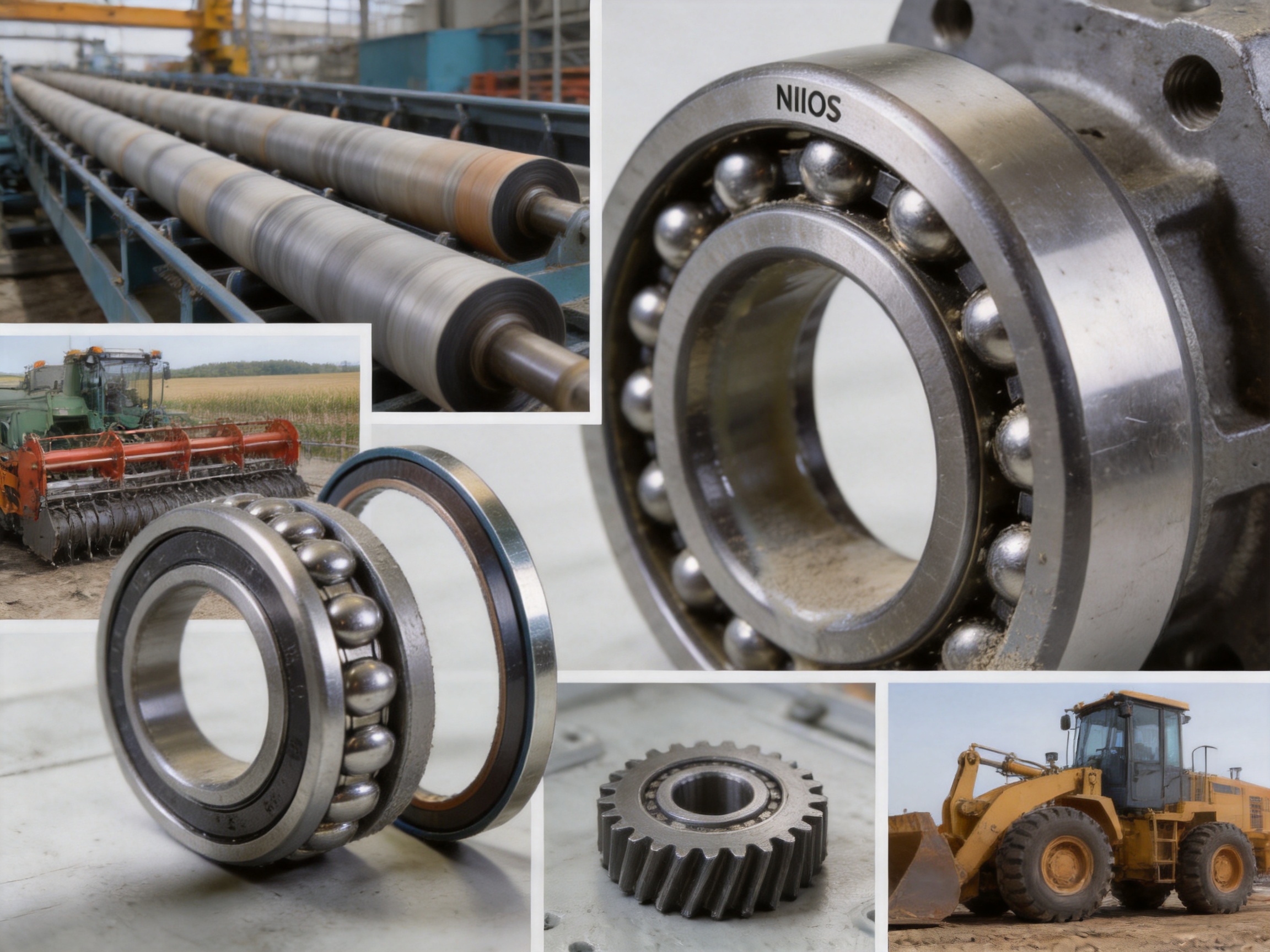
Nilos rings are thin metal sealing components designed to sit beside a bearing and form a close-fitting sealing barrier against the bearing ring. Unlike many rubber or polymer seals, a Nilos ring is made of metal and can withstand more challenging conditions involving mechanical contact, grease retention, dirt exclusion, and high structural stability. This makes it a preferred choice for applications in conveyors, gearboxes, agricultural machinery, construction equipment, industrial motors, mounted bearing units, and other rotating systems where bearings must remain clean and lubricated.
As a specialized bearing manufacturing company in China, UKL Bearing Manufacturing Co., Ltd. supplies Nilos ring seals and other bearing-related products to global OEM and aftermarket customers. With integrated manufacturing, engineering support, OEM/ODM service capabilities, and a broad bearing product portfolio, the company is positioned to support customers who need both standard and customized sealing solutions. Its experience in cross roller bearings, robot bearings, angular contact ball bearings, rod end bearings, spherical roller bearings, cylindrical roller bearings, tapered roller bearings, mounted bearings, and metal seals allows it to understand sealing requirements across many bearing types and industrial conditions.
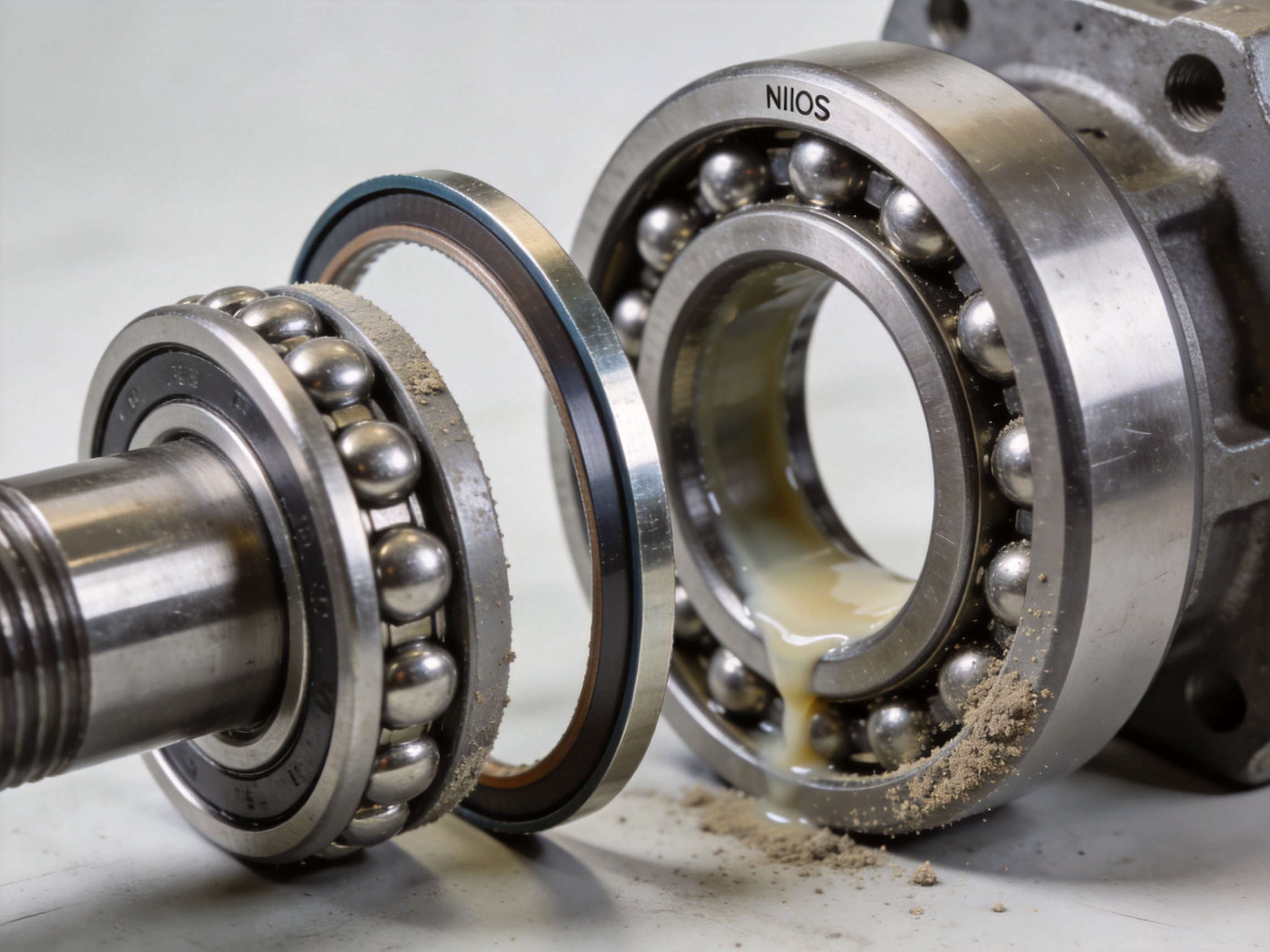
A Nilos ring is a precision-formed metal seal used to protect the inner space of a bearing from contamination and lubricant leakage. It is typically mounted on one side of a rolling bearing, with its sealing lip positioned against the inner or outer bearing ring. During operation, the sealing edge creates a controlled contact or near-contact sealing effect. This helps maintain grease inside the bearing while preventing dust, dirt, water spray, and foreign particles from entering the rolling element area.
The design principle is simple but highly effective. Instead of relying on bulky external housings or flexible elastomeric lips, the Nilos ring uses a thin metal profile that conforms to the bearing geometry. This provides a space-saving sealing method that is especially useful when the bearing arrangement does not allow room for complex sealing assemblies. The ring can be selected according to bearing series, shaft diameter, housing design, and the side of the bearing that requires protection.
In many installations, bearing failure is not caused by overload alone. A significant percentage of premature bearing damage is related to contamination, insufficient lubrication, or grease leakage. Abrasive particles can scratch raceways and rolling elements, while moisture may cause corrosion and lubricant degradation. A Nilos ring reduces these risks by acting as a durable protective barrier. When correctly selected and installed, it improves bearing service life, reduces maintenance frequency, and lowers total operating cost.
Nilos rings are often used with deep groove ball bearings, angular contact ball bearings, tapered roller bearings, cylindrical roller bearings, spherical roller bearings, and various mounted bearing arrangements. Their compact structure makes them compatible with industrial equipment where axial space is limited. For customers seeking dependable bearing protection without changing the entire bearing arrangement, metal Nilos seals offer a practical and cost-efficient solution.
Sealing is one of the most important factors in bearing reliability. Even a high-quality bearing can fail early if exposed to abrasive dust, dirty grease, aggressive moisture, or repeated lubricant loss. A bearing operates through precise rolling contact, and the contact surfaces depend on a thin lubricant film. When contamination enters the rolling path, this film can break down, causing wear, noise, temperature rise, vibration, and eventual failure.
Metal sealing provides advantages that are different from rubber, felt, or plastic seals. A metal Nilos ring offers dimensional stability, resistance to deformation, and compatibility with mechanical environments where soft sealing materials may wear quickly. In applications with exposure to dry dust, metallic particles, or moderate heat, metal sealing can deliver stable protection while maintaining a compact installation profile.
Another benefit of a Nilos ring is its ability to retain grease near the bearing. Grease leakage not only increases maintenance requirements but also exposes the bearing to dry running conditions. When grease escapes, operators may need frequent relubrication, which increases labor cost and downtime. In difficult-to-access equipment, repeated lubrication can be inconvenient or unsafe. By helping to retain grease, a properly fitted metal seal supports a more predictable maintenance schedule.
Nilos rings also contribute to equipment cleanliness. In food machinery, packaging systems, conveyors, automated production lines, and material handling equipment, excess grease leakage can contaminate products or surrounding components. Although material selection and application conditions must always be evaluated carefully, metal sealing can help reduce uncontrolled lubricant loss and improve the cleanliness of the operating environment.
The competitive value of Nilos rings comes from their combination of compact size, simple installation, durable metal construction, and effective bearing protection. Compared with many conventional sealing methods, they can provide strong performance without requiring major redesign of the bearing housing or shaft arrangement.
One of the main advantages is space efficiency. Many machines are designed with limited axial space around the bearing. A large seal housing or external sealing unit may not fit without changing the machine structure. A Nilos ring uses a thin metal form that can be mounted directly adjacent to the bearing, making it suitable for compact mechanical assemblies. This is especially helpful for gearboxes, electric motors, reducers, agricultural machinery, and conveyor rollers where every millimeter of space matters.
Another advantage is durability. Because the ring is made from metal, it resists tearing, swelling, and aging problems that may affect some non-metallic seals. Rubber seals can be affected by certain lubricants, temperatures, ozone, or long-term aging. A metal Nilos ring, when used under suitable operating conditions, maintains its shape and sealing function for extended periods. This supports reliable performance in applications where stable mechanical contact and contamination resistance are required.
Nilos rings are also cost-effective. They are relatively simple components, but their impact on bearing life can be significant. By reducing contamination-related failures and grease loss, they help minimize unplanned downtime, replacement costs, and maintenance labor. For OEM manufacturers, using a Nilos ring can improve the reliability of the final equipment without greatly increasing assembly complexity. For maintenance teams, replacing or adding a metal seal can be a practical way to improve bearing protection in existing systems.
The product is adaptable. Different designs are available depending on whether sealing is required against the inner ring or outer ring of the bearing. Nilos rings can be matched with bearing dimensions and mounting conditions. For customers with special operating environments, customized dimensions, material considerations, and packaging requirements can be discussed through OEM/ODM cooperation.
Different sealing technologies serve different purposes. Rubber seals, labyrinth seals, shield plates, felt seals, and metal sealing rings each have their own strengths. The advantage of a Nilos ring lies in its ability to provide compact metallic protection with direct compatibility for many rolling bearing arrangements.
| Sealing Solution | Main Strength | Possible Limitation | Nilos Ring Advantage |
|---|---|---|---|
| Rubber contact seal | Good flexible sealing and common availability | May age, swell, harden, or wear under certain conditions | Metal structure offers high dimensional stability and aging resistance |
| Metal shield | Low friction and simple protection | Often less effective against fine contamination and grease leakage | Designed to create a closer sealing effect beside the bearing |
| Labyrinth seal | Non-contact operation and good for high-speed systems | Requires more installation space and precise housing design | Compact profile fits where axial space is limited |
| Felt seal | Traditional and economical | May absorb moisture and degrade with contamination | Metal seal provides stronger structural resistance |
| Customized housing seal | Can be designed for specific machines | Higher tooling cost and more complex assembly | Standardized Nilos ring options reduce design and installation complexity |
Compared with rubber seals, Nilos rings are not subject to the same aging mechanisms. They are not easily softened by oil or hardened by air exposure. This is valuable for equipment expected to remain in service for long periods. In storage, transportation, or intermittent operation, metal seals can maintain their shape and function more predictably than some elastomeric components.
Compared with shielded bearings, a Nilos ring can provide additional external protection. Bearing shields are usually integrated into the bearing and may not fully prevent fine contamination in harsh environments. A Nilos ring mounted outside or adjacent to the bearing can add another protective layer. This is useful in dusty workshops, outdoor machinery, construction equipment, and agricultural systems where contaminants are present around the bearing housing.
Compared with labyrinth seals, Nilos rings are more compact and easier to integrate into many bearing arrangements. Labyrinth seals can be highly effective, especially for high-speed and non-contact sealing, but they often require complex machining and more space. A Nilos ring provides an efficient alternative when machine design is already fixed or when customers need a straightforward sealing upgrade.
Compared with felt seals, metal Nilos rings offer better structural reliability in many mechanical environments. Felt can work in traditional machinery, but it may retain moisture, collect abrasive dust, or degrade under certain operating conditions. A metal ring offers a more robust barrier and is easier to specify based on bearing dimensions.
Nilos rings are used in a wide range of machines because nearly every industry depends on bearings. Wherever bearings rotate under load, protection from contamination and lubricant loss is essential. The practical value of a Nilos ring becomes especially clear in environments where bearing replacement is expensive, downtime is costly, and equipment reliability directly affects production output.
In conveyor systems, bearings are often exposed to dust, material particles, vibration, and continuous operation. Mining conveyors, packaging conveyors, logistics sorting lines, and food handling systems all rely on bearing units that must run smoothly for long periods. Nilos rings help protect bearing interiors from fine dust and reduce grease escape, contributing to longer service intervals.
In agricultural machinery, bearings operate in some of the most challenging environments. Soil, crop residue, fertilizers, moisture, and seasonal storage can all affect bearing reliability. Metal sealing rings can help defend against abrasive contamination while supporting grease retention. Equipment such as seeders, harvesters, tillers, balers, and agricultural trailers may benefit from improved bearing protection.
In gearboxes and reducers, lubricant management and contamination control are critical. Bearings inside gearboxes may be exposed to oil mist, metallic particles, and temperature changes. While gearbox sealing systems are usually more complex, Nilos rings can be applied in bearing positions where additional localized protection is needed. They support stable operation and reduce risks associated with contamination migration.
In electric motors and industrial fans, bearing cleanliness affects vibration, noise, and service life. Fine particles or grease loss can increase bearing temperature and produce abnormal sound. Nilos rings provide an additional sealing measure in compact spaces, helping motor and fan manufacturers improve reliability without greatly increasing component size.
In construction and material handling equipment, bearings often experience shock loads, dirt, rain, mud, and irregular maintenance. Although no seal can eliminate all harsh-environment risks, metal Nilos rings can improve resistance to external particles and support more durable operation. They are well suited for pulleys, rollers, wheel systems, and rotating joints where compact protection is needed.
In automated machinery and robotics-related systems, precision and cleanliness are essential. UKL Bearing Manufacturing Co., Ltd. has experience in robot bearings, cross roller bearings, and angular contact ball bearings, giving it a strong understanding of precision motion systems. While Nilos rings are often associated with general industrial sealing, the same principle of protecting bearing performance is valuable in precision equipment where contamination can lead to positioning errors, vibration, or loss of smooth rotation.
The quality of a Nilos ring depends on more than its visible shape. It depends on material selection, forming accuracy, edge consistency, dimensional control, surface finish, packaging protection, and inspection discipline. Because the ring interacts closely with bearing surfaces, small deviations can influence sealing performance, assembly fit, and service life. A reliable supplier must therefore combine manufacturing experience with strict quality control.
UKL Bearing Manufacturing Co., Ltd. operates as an integrated manufacturer and trader with capabilities covering research and development, production, and international distribution. The company’s production system includes multiple process stages such as forging, turning, heat treatment, grinding, assembly, and packaging for its bearing products. This broad manufacturing background is important because metal seals must match the precision expectations of the bearings they protect.
For Nilos rings, forming accuracy is essential. The ring must be shaped to the correct profile so that it can be mounted properly and produce the intended sealing effect. If the ring is too loose, sealing may be weak. If it is too tight or incorrectly shaped, installation may be difficult or friction may increase. Consistent tooling, controlled forming pressure, and regular dimensional checks help ensure that each batch meets customer requirements.
Surface quality is also important. Burrs, scratches, or uneven edges may interfere with installation or damage neighboring components. Careful finishing and inspection help reduce these risks. For export customers, packaging quality matters as well. Thin metal components must be protected against deformation, corrosion, and transport damage. Proper stacking, anti-rust measures, labeling, and carton design help ensure that customers receive products ready for assembly.
The company’s experience in high-precision bearings also supports the development of reliable metal seals. Cross roller bearings, dual-direction thrust angular contact ball bearings, and robot bearings require advanced dimensional control and an understanding of motion accuracy. This precision culture can be extended to sealing rings, ensuring that customers receive components manufactured with attention to detail rather than treated as simple stamped parts.
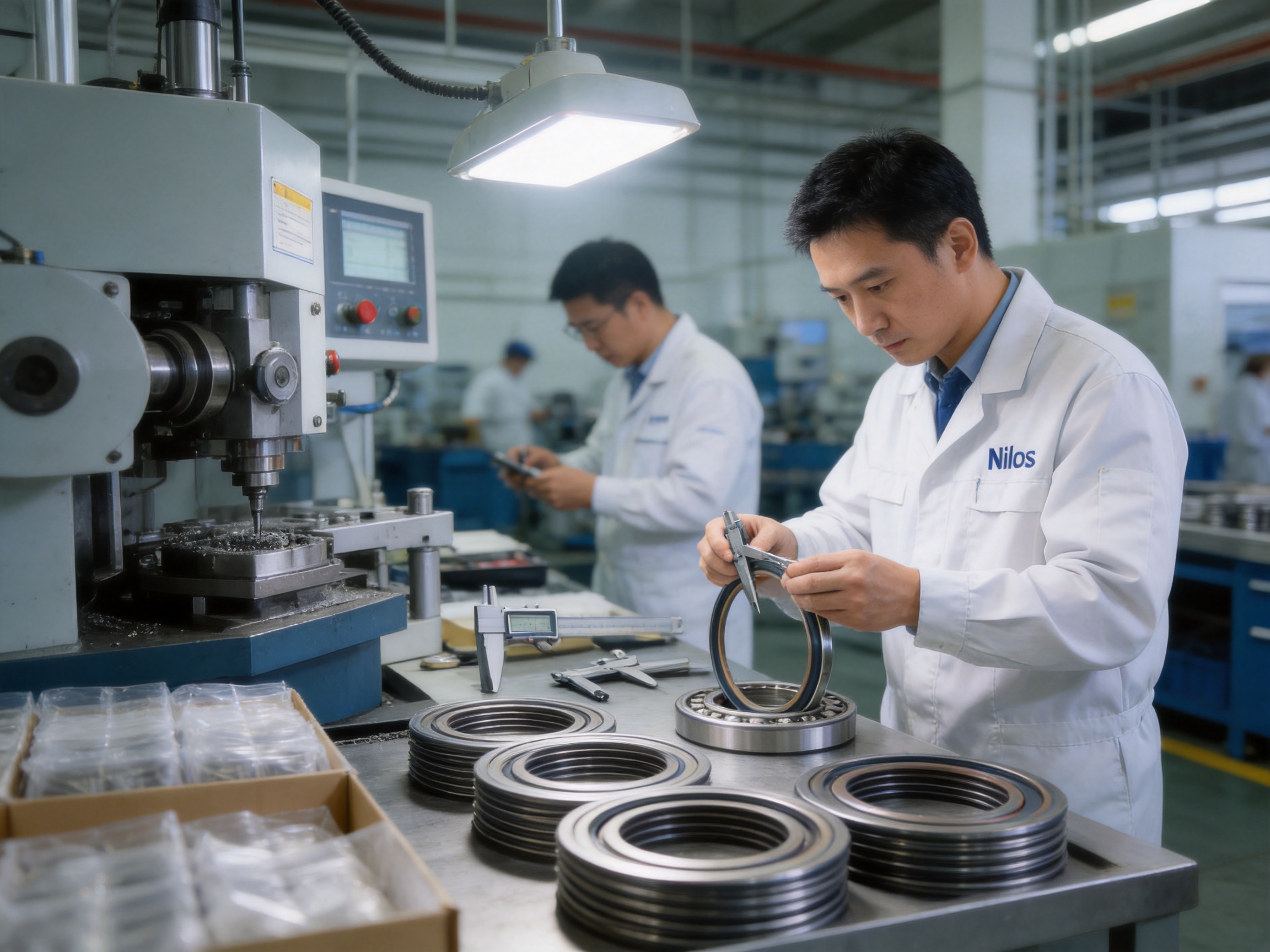
Quality control for Nilos rings begins with material verification. The selected metal must provide the required strength, elasticity, forming behavior, and corrosion resistance for the intended application. While specific material grades may vary according to customer requirements, the supplier must ensure that the material meets agreed specifications and remains consistent across production batches.
During production, dimensional inspection is performed to confirm inner diameter, outer diameter, profile height, lip geometry, and flatness. These dimensions are critical because the seal must fit the bearing and surrounding machine components. Precision measuring tools and standardized inspection procedures help prevent variation that could affect assembly performance.
Process control is another key factor. Metal forming operations must be repeatable. Tool wear, machine setting changes, and material thickness variation can all influence the final ring geometry. A disciplined manufacturer monitors these factors and adjusts production parameters when necessary. This reduces the chance of nonconforming parts reaching the customer.
Surface inspection helps confirm that the ring is free from visible defects. The sealing edge must be clean and consistent. Sharp burrs or deformed edges can reduce performance and may create handling risks. Proper deburring, cleaning, and final inspection help ensure product safety and function.
Packaging inspection is often overlooked, but it is critical for thin metal seals. A Nilos ring can be precise at the factory but damaged during transportation if packaging is inadequate. Export packaging should protect against compression, moisture, vibration, and mixing of different models. Clear labeling helps customers identify parts quickly and avoid assembly errors.
UKL’s export experience supports this requirement. With customers across regions such as the United States, Italy, Germany, Poland, South Africa, Egypt, India, and other markets, the company understands that overseas shipments must arrive in stable condition. Reliable packaging and documentation are part of a professional supply chain.
Many customers require more than standard parts. OEM manufacturers may need a Nilos ring that matches a particular bearing type, housing structure, shaft arrangement, or maintenance requirement. ODM customers may require design support for a new machinery platform. In both cases, engineering communication and customization capability are important.
UKL Bearing Manufacturing Co., Ltd. has more than 15 years of OEM/ODM export experience through its team and operational background. This experience allows the company to support customers with drawing review, sample evaluation, model selection, production planning, packaging customization, and shipment coordination. For Nilos rings, customization may include dimensional adjustments, material selection, surface treatment, labeling, bulk packing, or kit packaging with bearing products.
OEM support is especially valuable when customers need consistent supply. A sealing ring used in mass-produced equipment must meet the same dimensional and functional expectations batch after batch. A reliable manufacturing partner can maintain stable quality while supporting production schedules. With a monthly production capacity of 10,000 to 50,000 units across its product operations, the company is able to serve customers who need regular supply and scalable cooperation.
For distributors and wholesalers, product range and availability are key. Nilos rings are often sold alongside bearings and related accessories. A supplier with a broad bearing portfolio can help distributors consolidate purchasing and reduce supplier management costs. UKL’s product categories include cross roller bearings, robot bearings, angular contact ball bearings, rod end bearings, spherical roller bearings, cylindrical roller bearings, tapered roller bearings, mounted bearings, and Nilos rings. This range enables customers to source complementary products from one manufacturing partner.
ODM collaboration can also support new product development. When a customer designs equipment for a specific industry, bearing protection must be considered early. By discussing operating speed, contamination level, lubrication method, mounting space, temperature, and maintenance expectations, engineers can identify whether a Nilos ring is suitable and what design details require attention.
Selecting the correct Nilos ring requires attention to bearing type, dimensions, mounting position, operating speed, load condition, lubrication method, and environmental exposure. Although the product appears simple, incorrect selection can reduce sealing effectiveness or create unwanted friction. Proper engineering review helps ensure that the ring performs as intended.
The first consideration is bearing compatibility. Nilos rings are commonly specified according to bearing series and size. The ring geometry must match the bearing ring that it seals against. Customers should confirm bearing designation, inner diameter, outer diameter, width, and mounting arrangement before ordering. If a bearing is non-standard or customized, drawings may be required.
The second consideration is sealing direction. Some Nilos rings are designed to seal against the inner ring, while others are designed to seal against the outer ring. The choice depends on the bearing arrangement and which side requires protection. Incorrect selection may result in poor sealing contact or assembly interference.
The third consideration is operating environment. Dusty, humid, outdoor, or abrasive environments may require more robust sealing arrangements. A Nilos ring can be part of a broader protection strategy, possibly combined with shields, housings, grease selection, or maintenance schedules. In extremely aggressive environments, engineers should evaluate whether additional sealing is necessary.
The fourth consideration is speed and friction. Because some Nilos ring designs create contact or near-contact with the bearing ring, operating speed and heat generation must be considered. For high-speed applications, the seal type, lubrication, and contact condition should be reviewed carefully. Proper installation and alignment are essential to prevent excessive wear.
The fifth consideration is lubrication. Nilos rings help retain grease, but the selected grease must match operating temperature, load, speed, and environmental conditions. A good seal cannot compensate for unsuitable lubrication. Customers should consider grease compatibility and relubrication intervals as part of the complete bearing system.
Correct installation is critical for Nilos ring performance. Even a well-manufactured ring can fail to seal effectively if it is damaged, misaligned, or installed on the wrong side of the bearing. Operators should handle the rings carefully and avoid bending or deforming them before assembly.
Before installation, the bearing, shaft, housing, and seal area should be clean. Dirt or metal chips trapped during assembly can damage the bearing or interfere with the sealing lip. Components should be inspected for burrs, corrosion, and dimensional irregularities. The ring should match the bearing designation and the planned sealing direction.
During installation, force should be applied evenly. Uneven pressure can deform the thin metal profile. Suitable mounting tools may be used to support the ring and prevent localized bending. The ring should sit flat and concentric with the bearing. If resistance is abnormal, the assembly should be stopped and checked rather than forced.
After installation, the bearing should rotate smoothly. Any unusual friction, scraping sound, or irregular movement may indicate misalignment, incorrect ring selection, or deformation. Early detection prevents damage during operation. For critical machinery, a test run can confirm temperature stability, noise level, and sealing performance.
Maintenance teams should also monitor bearing condition during service. A Nilos ring reduces contamination risk, but it does not eliminate the need for proper lubrication, alignment, load control, and inspection. Bearing temperature, vibration, noise, and grease condition remain important indicators of system health.
For wholesalers, a dependable Nilos ring supplier must offer consistent product quality, competitive pricing, stable delivery, and responsive service. Metal seals are often purchased in quantity and used for many bearing sizes. Distributors need accurate model identification, clear packaging, and reliable batch consistency. A supplier with bearing expertise can reduce the risk of mismatched products and customer complaints.
UKL’s position as a China metal seal supplier and OEM/ODM Nilos ring company supports wholesale cooperation. The company can supply various Nilos rings for industrial customers and distributors, while also offering related bearing products. This combination is useful for buyers who want to streamline sourcing and work with a manufacturer that understands both seals and bearings.
Industrial buyers benefit from technical communication. Instead of purchasing seals only by price, they can discuss application conditions and receive support in selecting suitable products. This is especially valuable for OEM manufacturers, repair companies, and maintenance departments dealing with repeated bearing failures. A low-cost seal that does not fit correctly can cause more expense than it saves. A properly selected Nilos ring can improve machinery reliability and reduce long-term cost.
Another advantage is export service experience. International buyers need suppliers who can handle documentation, packaging, shipping coordination, and communication across time zones. UKL’s multilingual service team and global customer base help support efficient cooperation. The company provides technical response, installation guidance, and after-sales support for customers in different regions.
Sustainability in industry is not only about energy consumption; it is also about extending equipment life, reducing waste, and lowering unnecessary replacement. Bearings that fail prematurely generate scrap, downtime, emergency logistics, and additional maintenance activity. By protecting bearings from contamination and lubricant loss, Nilos rings contribute to more sustainable machinery operation.
Longer bearing life means fewer replacement parts and less material waste. When bearings run reliably, machines require fewer emergency repairs and consume fewer spare parts. This supports both economic and environmental goals. For factories operating many machines, even small improvements in bearing life can create significant reductions in maintenance cost and waste generation.
Grease retention also supports cleaner operation. Excessive lubricant leakage can contaminate machine surfaces and surrounding areas, requiring cleaning materials and labor. By helping keep grease inside the bearing area, a Nilos ring can contribute to a more controlled lubrication system. This is particularly useful in production environments where cleanliness is important.
UKL Bearing Manufacturing Co., Ltd. states a long-term commitment to environmentally responsible processes, material recycling, and energy optimization. This manufacturing philosophy aligns with the role of Nilos rings in improving bearing system efficiency and durability. The product may be small, but its contribution to reliable operation and reduced waste can be meaningful.
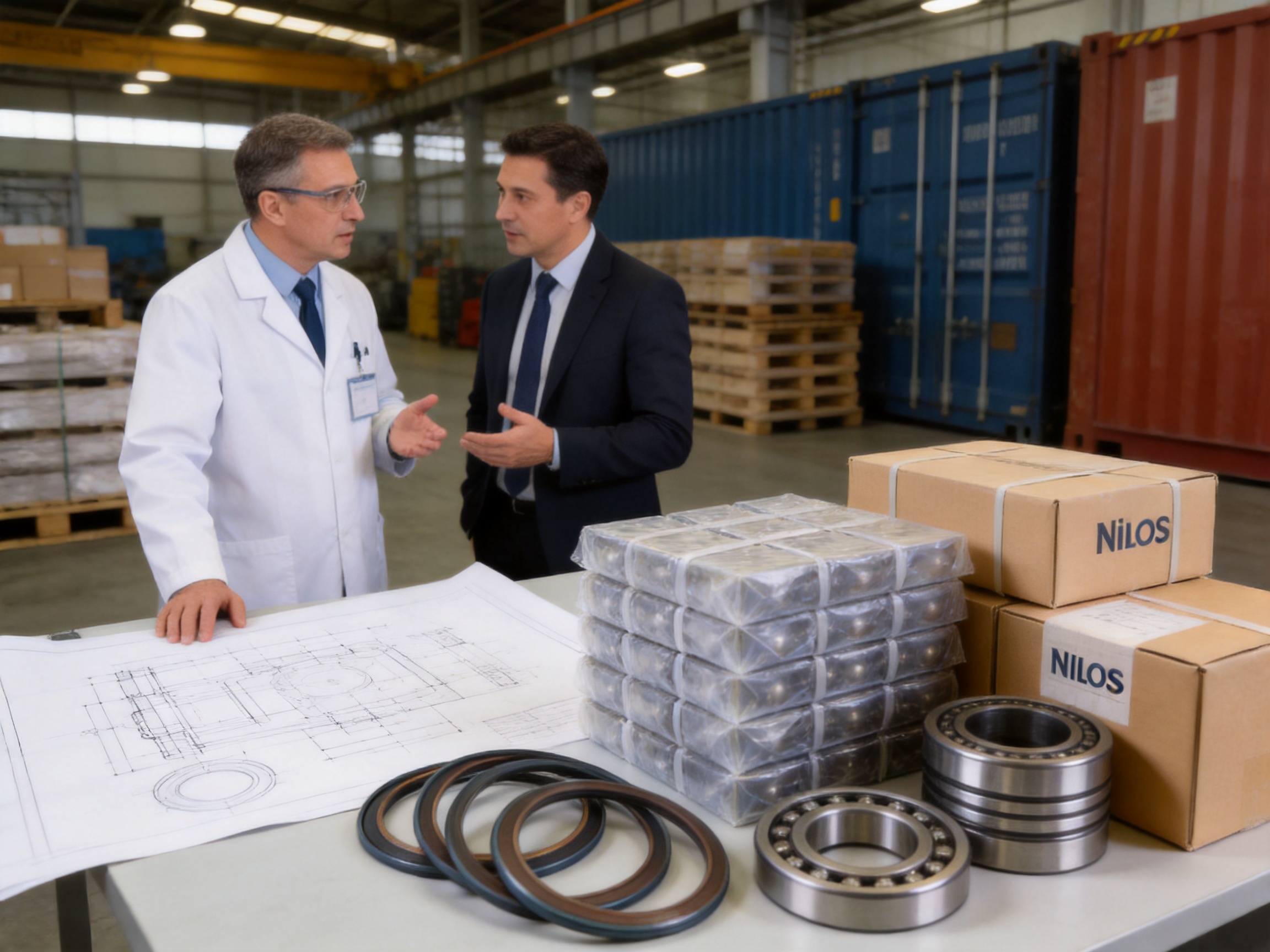
UKL Bearing Manufacturing Co., Ltd. was established in 2020 and has developed as an integrated manufacturer and trader serving international industrial customers. The company is located in Wuxi City, China, and operates with a team of 201 to 500 employees. Its operational strength combines manufacturing capacity, engineering knowledge, export experience, and customer service.
The company’s factory is equipped with multiple production lines covering key manufacturing processes, including forging, turning, heat treatment, grinding, assembly, and packaging. These processes are essential for producing reliable bearing products and related components. A manufacturer that controls and understands these stages can better manage dimensional accuracy, material performance, surface finish, and final product consistency.
Research and development is a major part of the company’s competitiveness. Its R&D team works on high-precision cross roller bearings, dual-direction thrust angular contact ball bearings, and other products used in CNC machines, robotics, and intelligent automation systems. This technical foundation supports a deeper understanding of bearing applications, which is useful when designing or supplying protective sealing components such as Nilos rings.
Digital production control and precision design are emphasized to ensure that products meet international expectations for accuracy and performance. For global buyers, this means the supplier is not only producing standard parts but also investing in process improvement and technical capability. In competitive markets, manufacturing discipline is a key differentiator.
The company exports products to countries and regions including the United States, Italy, Germany, Poland, South Africa, Egypt, India, and others. International market experience requires the ability to meet diverse technical expectations, documentation requirements, and delivery standards. This global reach demonstrates the company’s ability to serve both distributors and OEM customers.
Customer service is another strength. The company’s multilingual service team provides technical response, installation guidance, and after-sales maintenance support. In bearing and seal applications, clear communication can prevent selection mistakes and improve customer satisfaction. Buyers often need more than a catalog number; they need practical guidance based on real operating conditions.
Choosing a specialized supplier is important because Nilos rings must interact correctly with bearings. A general metal stamping supplier may produce a ring shape, but a bearing-focused manufacturer understands how that ring functions inside a rotating system. This difference matters when customers need dependable sealing performance rather than merely a low-cost component.
A bearing-focused supplier can help customers identify the correct ring based on bearing series and operating conditions. It can also advise when a Nilos ring is suitable and when additional sealing measures may be needed. This reduces the risk of incorrect application and improves long-term reliability.
Another reason to choose a specialized supplier is consistency. Bearings and seals often operate in large fleets of equipment. If one batch differs from another, assembly problems or performance variation may occur. A supplier with quality systems and manufacturing control can maintain better consistency across repeated orders.
Specialized suppliers also understand packaging and handling requirements. Thin metal rings can deform if carelessly packed. A professional supplier protects the product from transport damage and ensures that models remain clearly identified. This reduces receiving inspection time and assembly errors for customers.
Finally, a specialized supplier with OEM/ODM capability can support future product development. As machinery becomes more compact, automated, and efficient, sealing solutions must also evolve. Working with a manufacturer that understands precision bearings, industrial applications, and global supply requirements gives customers a stronger long-term partner.
One common mistake is selecting a ring only by approximate size. Even small dimensional differences can affect sealing performance. Customers should match the ring to the correct bearing designation and confirm whether the sealing arrangement is for the inner or outer ring.
Another mistake is ignoring operating speed. If the seal creates contact and the speed is too high for the arrangement, excessive friction or heat may occur. Speed, lubrication, and installation accuracy should be reviewed before use.
A third mistake is rough handling. Nilos rings are thin metal components and can be bent if mishandled. Deformed rings may not seal correctly. Workers should keep rings in protective packaging until installation and use proper tools during assembly.
A fourth mistake is assuming the seal replaces all maintenance. A Nilos ring improves bearing protection, but machinery still requires correct lubrication, alignment, load management, and periodic inspection. Sealing is one part of a complete reliability strategy.
A fifth mistake is using the same sealing solution for every environment. Some applications may require additional protection against water pressure, chemicals, high temperature, or severe abrasive contamination. Engineering review helps determine the best sealing combination.
A Nilos ring is a thin metal sealing ring used beside a rolling bearing to help prevent contamination from entering the bearing and to reduce lubricant leakage. It creates a compact sealing barrier and is commonly used in industrial machinery, gearboxes, conveyors, agricultural equipment, and mounted bearing arrangements.
It improves bearing life by helping keep grease inside the bearing area and blocking dust, dirt, moisture, and abrasive particles from entering. Since contamination and lubricant loss are major causes of premature bearing failure, a properly installed Nilos ring can reduce wear and support longer service intervals.
A metal seal offers strong dimensional stability, resistance to aging, and durability in many mechanical environments. Rubber seals can be effective, but they may age, harden, swell, or wear depending on temperature, lubricant, and exposure conditions. Nilos rings are useful where a compact and stable metal sealing solution is preferred.
Yes. Nilos rings can be used with many rolling bearing types, including deep groove ball bearings, angular contact ball bearings, tapered roller bearings, cylindrical roller bearings, spherical roller bearings, and mounted bearing units. The correct model must be selected according to bearing dimensions and sealing direction.
They can be used in many rotating applications, but speed must be evaluated carefully. Some designs create contact or near-contact with the bearing ring, so friction and heat generation should be considered. For high-speed systems, customers should consult the supplier and confirm suitability based on operating conditions.
Customers should provide the bearing designation, bearing dimensions, sealing side, shaft and housing arrangement, operating speed, lubrication method, and environmental conditions. If the bearing or machine design is non-standard, drawings or samples may be needed.
Yes. Customization may be available for dimensions, materials, surface treatment, packaging, and application-specific requirements. OEM and ODM support is useful for manufacturers designing new equipment or improving existing bearing protection systems.
A bearing manufacturer understands how seals interact with bearing geometry, lubrication, load, speed, and installation conditions. This expertise helps customers select suitable products and avoid problems caused by incorrect sealing arrangements.
Common industries include machinery manufacturing, agriculture, construction equipment, conveyors, logistics systems, gearboxes, electric motors, industrial fans, material handling, mining equipment, and general maintenance repair operations.
They should be installed carefully using clean components, correct alignment, and even mounting pressure. The ring should not be bent or forced into position. After installation, the bearing should rotate smoothly without abnormal scraping, friction, or noise.
Industrial machinery is becoming more compact, automated, and efficiency-driven. As equipment designs become smaller and more integrated, sealing solutions must provide reliable protection without occupying excessive space. Nilos rings are well aligned with this trend because they offer compact metal sealing for many bearing arrangements.
Another trend is predictive maintenance. Sensors increasingly monitor vibration, temperature, and operating condition. However, even advanced monitoring cannot replace the need for physical protection against contamination. Better sealing reduces the frequency of alarm conditions and helps machines operate within stable performance ranges.
Sustainability will also influence sealing choices. Components that extend bearing life and reduce lubricant leakage support cleaner and more resource-efficient operation. As companies seek lower maintenance costs and reduced environmental impact, small components such as Nilos rings will continue to play an important role in reliability engineering.
Customization demand is expected to grow. OEM manufacturers are designing machines for specific operating environments, and standard seals may not always meet special requirements. Suppliers with engineering support, flexible production, and global service capability will be better positioned to serve these needs.
Nilos rings are compact, durable, and practical metal sealing components that help protect bearings from contamination and lubricant loss. Their advantages include space-saving design, stable metal construction, cost-effective bearing protection, and compatibility with many rolling bearing types. Compared with rubber seals, shields, felt seals, and complex housing seals, Nilos rings offer a valuable balance of simplicity, reliability, and mechanical strength.
For industrial users, the main benefit is longer and more predictable bearing performance. By reducing the entry of dust, moisture, and abrasive particles, a Nilos ring helps prevent premature bearing damage. By supporting grease retention, it reduces maintenance demands and improves operational cleanliness. These advantages are important in conveyors, agricultural machinery, gearboxes, motors, construction equipment, mounted bearing units, and many other applications.
The performance of a Nilos ring depends on correct selection, accurate manufacturing, careful installation, and suitable operating conditions. Working with an experienced supplier is therefore essential. UKL Bearing Manufacturing Co., Ltd. combines bearing manufacturing knowledge, OEM/ODM export experience, multiple production processes, R&D capability, and global customer service to support customers seeking reliable metal seals and bearing solutions.
As machinery continues to advance toward higher precision, longer service life, and more sustainable operation, bearing protection will remain a critical engineering priority. Nilos rings provide a proven and efficient way to strengthen bearing reliability, reduce maintenance cost, and support stable industrial performance.
Harris, T. A., and Kotzalas, M. N. Rolling Bearing Analysis: Essential Concepts of Bearing Technology. CRC Press.
Hamrock, B. J., Schmid, S. R., and Jacobson, B. O. Fundamentals of Machine Elements. McGraw-Hill Education.
Neale, M. J. The Tribology Handbook. Butterworth-Heinemann.
Stachowiak, G. W., and Batchelor, A. W. Engineering Tribology. Butterworth-Heinemann.
ISO 281. Rolling Bearings: Dynamic Load Ratings and Rating Life. International Organization for Standardization.
ISO 492. Rolling Bearings: Radial Bearings Geometrical Product Specifications and Tolerance Values. International Organization for Standardization.
Industrial Bearing Maintenance and Lubrication Guidelines. Technical reference materials for bearing reliability engineering.
Product Categories
Contact Us

Jane@ukl-bearing.com
Jenny@ukl-bearing.com
Andy@ukl-bearing.com
Ivy@ukl-bearing.com

+86-510- 88763239
+86-15371057968

No.1 Hehuan Road, Hudai Town, Binhu District, Wuxi City.
Ready to Begin?
Get in Touch

Now!
UKL BEARING
 English
 Español
 русский